Andrey Zvyagintsev’s appeal to Vladimir Putin to stop the war in Ukraine
By Matthew Parish, Associate Editor
Thursday 28 May 2026
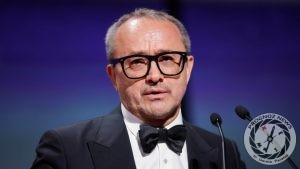
There is something profoundly Russian about a celebrated artist standing before the world, addressing the Kremlin as though the Kremlin were both executioner and father. When the Russian film director Andrey Zvyagintsev accepted the Grand Prix at the Cannes Film Festival for his latest film Minotaur, he used the moment not to celebrate cinema but to implore Vladimir Putin to end the war in Ukraine. “Put an end to this carnage”, he declared, insisting that “the whole world is waiting for this.”
The appeal was moving, dignified and courageous. It was also tragic in a specifically Russian way.
Zvyagintsev belongs to that rare tradition of Russian artists who understand the moral decomposition of the state not as an abstraction but as a condition of daily life. His films — particularly Leviathan and Loveless — dissect the spiritual corrosion of contemporary Russia with an almost surgical precision. Corruption, cruelty, emotional emptiness and institutional violence are not merely political defects in his work; they are atmospheric conditions.
For years, long before the full-scale invasion of Ukraine in 2022, Zvyagintsev portrayed a society consumed by cynicism and governed by arbitrary power. The provincial bureaucrats and businessmen in his films often seemed like miniature reflections of the Kremlin itself. In retrospect, his cinema appears less prophetic than diagnostic. Russia’s descent into aggressive militarism was already visible in the moral architecture of her society.
That is why his appeal matters.
Not because it will influence Putin — it almost certainly will not — but because it reveals the continuing struggle of the Russian intelligentsia to comprehend the nature of the system under which they live. Zvyagintsev’s words assume, however faintly, that persuasion remains possible. They imply that somewhere inside the Russian presidency there exists a listener capable of shame, reflection or exhaustion.
Yet the modern Russian state has demonstrated repeatedly that it does not operate upon those premises.
The Kremlin’s response was revealing. Dmitry Peskov, Putin’s spokesman, dismissed the director’s comments and asserted that Zvyagintsev had “no right” to speak because he had not condemned alleged Ukrainian actions in Donbas. This was not merely bureaucratic defensiveness. It reflected the ideological grammar of contemporary Russian power, in which moral legitimacy derives not from truth but from obedience. The regime no longer argues substantively against dissent; it simply denies dissenters the authority to speak.
This is one of the defining characteristics of authoritarian systems in their mature phase. They cease even pretending to seek consensus. They demand ritual affirmation instead.
The Soviet Union at least maintained an elaborate ideological framework through which intellectual disagreement could occasionally be negotiated or concealed. Contemporary Putinism is simultaneously more cynical and more emotional. It relies upon grievance, historical mythology and permanent mobilisation. The war in Ukraine has accelerated this transformation. The Russian state increasingly presents itself not as a government accountable to citizens but as a civilisation besieged by enemies. In such an environment, appeals to compassion become almost unintelligible to the governing elite.
And yet artists continue making them.
This has happened repeatedly throughout Russian history. Writers, musicians and directors have often attempted to humanise power through direct moral address. One thinks of Solzhenitsyn writing to Soviet leaders, or earlier still of Tolstoy imploring the Tsarist state to renounce violence and repression. Russian intellectual culture has long oscillated between rebellion and supplication — between condemning authority and pleading with it to rediscover its conscience.
There is a paradox here. Russian artists frequently understand the brutality of the system more clearly than ordinary citizens do, yet they also retain a persistent belief that the ruler can somehow still be morally awakened. This may arise partly from the extraordinary centralisation of Russian political culture across centuries. The state has so dominated public life that even opposition often becomes personalised around the figure of the ruler himself.
Ukraine’s experience since 2022 has demonstrated a radically different political trajectory. Ukrainian society, despite wartime pressures, has become more decentralised, more civic-minded and more participatory. Political legitimacy increasingly flows upwards from society rather than downwards from imperial authority. This is one reason why many Ukrainians react sceptically to Russian liberal appeals directed personally at Putin. Such appeals can appear to preserve the assumption that history remains dependent upon the conscience of a single man.
For Ukrainians living under bombardment, the issue is no longer whether Putin understands the suffering his war has caused. Few doubt that he does. The issue is that the Russian political system has structurally organised itself around violence as an instrument of historical destiny.
Nevertheless Zvyagintsev’s intervention retains importance.
First, because public dissent inside Russian cultural life has become extraordinarily dangerous. Since the invasion, anti-war voices have faced censorship, exile, prosecution or professional destruction. Thousands of Russian intellectuals, artists and scientists signed anti-war appeals in the early stages of the invasion, while protests were met with mass arrests and repression. Many of Russia’s most talented creative figures have since emigrated, creating a growing cultural diaspora scattered across Europe and the Caucasus.
Second, because art possesses a peculiar ability to preserve moral memory during periods of political madness. States wage wars with statistics, maps and slogans. Artists restore the human face beneath abstraction. Zvyagintsev’s latest film Minotaur reportedly explores the pressures of mobilisation and moral collapse within wartime Russia itself. In doing so, it challenges one of the Kremlin’s central narratives: that Russian society is unified behind the war.
Authoritarian systems fear this sort of cultural testimony because it exposes internal fracture. A regime can imprison dissidents more easily than it can extinguish ambiguity, irony or grief.
The deeper significance of Zvyagintsev’s appeal may therefore lie not in the words themselves but in the fact that they were spoken publicly, internationally and unapologetically by one of Russia’s most acclaimed living directors. He spoke not as a politician, nor as an exile seeking relevance, but as an artist whose work has spent decades documenting the spiritual consequences of Russian authoritarianism.
In this sense his appeal was not really addressed to Putin at all.
It was addressed to history.
For some day the war will end. The Russian state that prosecuted it may endure, or it may mutate into another form, as Russian states have done so many times before. When that day comes, Russia will confront the same terrible question faced by all societies emerging from catastrophe: who spoke, who remained silent and who attempted to resist.
Zvyagintsev has chosen his place in that future memory.
138 Views


Most Readings



Crimea Under Pressure: Ukraine’s Long Campaign Against Russia’s Southern Bastion
96 Views