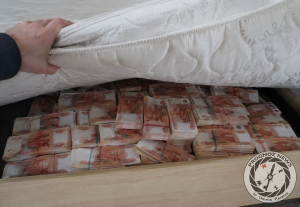
Russian Cash Under the Mattress: Why Russians Are Pulling Their Money from the Banks
By Matthew Parish, Associate Editor
Tuesday 9 January 2026
For most of the post-Soviet period, one of the Kremlin’s most important economic achievements was persuading Russians to trust banks. The memory of the Soviet Union’s collapse, the inflationary chaos of the 1990s and repeated banking crises had left a deep cultural suspicion of financial institutions. Yet over the last two decades Russians gradually deposited increasing amounts of money into banks, attracted by rising incomes, modern electronic payment systems and a perception that the state would ultimately guarantee financial stability.
That confidence is now showing signs of strain.
During the first months of 2026, Russian citizens withdrew extraordinarily large amounts of cash from the banking system. According to reports citing Russian Central Bank data, January alone witnessed net cash outflows equivalent to approximately US$14 billion, one of the largest withdrawals since the full-scale invasion of Ukraine in 2022. The trend continued through the spring, with record increases in cash circulating outside the banking system during March, April and May. Some analysts have described May 2026 as the largest month of cash withdrawals for that period of the year since Russian records began in 1995.
The question is why.
The most obvious explanation is uncertainty.
Economists have long observed that when citizens become uncertain about the future, they prefer liquidity. Cash in one’s hand is psychologically reassuring. It cannot be frozen by a bank, interrupted by a technical failure or delayed by administrative procedures. Throughout history, sudden increases in cash withdrawals have often reflected public anxiety before they appear in any other economic indicator.
Russia in 2026 presents numerous sources of uncertainty. The war in Ukraine continues to consume vast resources. Economic growth has slowed dramatically. Senior Russian banking executives have begun publicly discussing the possibility of economic stagnation. Investment has declined, borrowing costs remain elevated and inflationary pressures persist despite the Central Bank’s efforts to control them.
Ordinary Russians may not follow macroeconomic statistics closely, but they experience their consequences directly. Prices continue to rise. Future employment prospects appear less certain. The possibility of additional taxes or administrative controls remains ever present. Under such conditions, holding cash becomes attractive even if it earns no interest.
A second factor appears to be the growing disruption of Russia’s digital infrastructure.
One of the more unexpected consequences of the war has been the increasing frequency of mobile internet shutdowns inside Russia. Originally designed to complicate Ukrainian drone operations and strengthen internal security, these interruptions have had significant economic side effects. Electronic payment systems become unreliable, banking applications cease functioning and card transactions may fail. Russian citizens have consequently begun maintaining larger cash reserves to ensure that they can continue purchasing necessities during outages. Even the Bank of Russia has acknowledged that internet disruptions have contributed to increased demand for physical currency.
There is also a fiscal dimension to the phenomenon.
The Russian government has become increasingly aggressive in its efforts to raise revenue for wartime expenditure. New tax measures, enhanced monitoring of financial transactions and greater scrutiny of bank accounts have encouraged some individuals and businesses to conduct a larger share of their economic activities in cash. Analysts have suggested that some of the growth in cash circulation reflects a gradual migration of economic activity into the informal or “shadow” economy, where transactions are more difficult for tax authorities to monitor.
Another explanation lies in changing interest rates.
For much of 2024 and 2025, exceptionally high Russian interest rates encouraged households to keep money in banks. Depositors could earn substantial returns simply by holding fixed-term deposits. As inflation moderated and the Central Bank began reducing rates, the attractiveness of deposits diminished. Households started shifting funds into bonds, real estate, consumer purchases and cash holdings. The first significant withdrawal from fixed-term deposits since the mobilisation panic of 2022 occurred in 2026.
Perhaps the most revealing aspect of the trend is not its immediate economic impact but its psychological significance.
Banking systems ultimately rest on confidence. A bank does not physically hold every depositor’s money in a vault. It lends much of that money to businesses, consumers and governments. The system functions because depositors believe they will be able to access their funds whenever needed. When confidence weakens, even a healthy banking system can experience stress.
At present there is little evidence that Russia faces an imminent banking collapse. The Russian banking sector remains heavily supported by the state, and the Central Bank continues to insist that financial institutions possess sufficient capital buffers. Nevertheless the authorities appear concerned. Reports indicate that Russian regulators have recently increased monitoring of large withdrawals and granted banks greater authority to scrutinise what they regard as suspicious cash transactions.
The broader economic consequences could be significant.
Cash withdrawn from banks ceases to support lending activity. Banks have fewer resources available for mortgages, business loans and investment financing. Economic growth consequently slows. Moreover increased reliance on cash can encourage tax evasion, reduce economic transparency and weaken the state’s ability to monitor financial flows. These effects are particularly problematic for a government attempting simultaneously to finance a costly war and maintain economic stability.
There is also a symbolic dimension. Modern economies increasingly operate through electronic payments, digital banking and sophisticated financial networks. A return to cash often signals declining trust in institutions. It reflects a preference for tangible assets over promises. In this sense, the growth of cash circulation in Russia represents not merely an economic statistic but a measure of public sentiment.
The irony is striking. For years the Russian state sought to modernise its financial system, encourage electronic payments and reduce dependence upon cash. Yet the pressures created by war, sanctions, inflation, taxation and security restrictions appear to be reversing that trend. Russians are increasingly choosing the oldest form of financial security available: banknotes kept close at hand.
Whether this becomes a temporary wartime phenomenon or the beginning of a deeper crisis of confidence will depend largely upon Russia’s economic trajectory over the next several years. If growth remains weak, inflation persists and uncertainty continues to dominate public expectations, the cash now flowing out of the banking system may prove to be an early warning signal of more profound economic difficulties ahead. The history of financial crises suggests that when ordinary citizens begin preferring cash to confidence, policymakers would be wise to pay attention.
99 Views



Most Readings