Northern Ireland’s Paramilitary Shadow
By Matthew Parish, Associate Editor
Thursday 11 June 2026
The recent violence in Belfast and elsewhere in Northern Ireland, following the charging of a Sudanese national with attempted murder after a shocking knife attack, has once again exposed a reality that many outside the province prefer to forget. Nearly three decades after the signing of the Good Friday Agreement, Northern Ireland remains a society in which the structures, habits and instincts of paramilitarism have not entirely disappeared. They have changed form, but they have not vanished.
The immediate events are straightforward enough. A Sudanese man was charged with attempted murder after a brutal knife attack that left the victim with catastrophic injuries. Graphic footage circulated rapidly online, provoking widespread outrage. Within hours, protests against immigration escalated into rioting, arson attacks and assaults upon homes believed to be occupied by immigrants or ethnic minorities. Political leaders across the spectrum condemned the violence, while the victim’s family explicitly appealed for calm and rejected efforts to exploit their tragedy for political purposes.
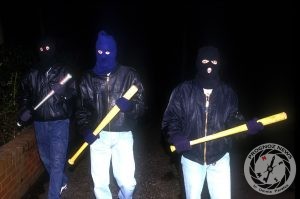
Yet what distinguishes Northern Ireland from many other societies experiencing tensions over immigration is the existence of a deeply embedded paramilitary culture. Throughout the years of the Troubles, both republican and loyalist organisations developed sophisticated local structures. These groups were not merely armed organisations; they often acted as alternative systems of authority within working-class communities. They enforced rules, punished perceived offenders and frequently claimed to provide security where the state was absent or distrusted.
The peace process succeeded in ending the large-scale terrorist campaigns that once claimed thousands of lives. It did not, however, entirely dismantle the social infrastructure that supported them. Independent assessments have repeatedly concluded that many of the principal paramilitary organisations that operated during the Troubles continue to exist in some form, even if their leaderships have formally committed themselves to peaceful political methods.
This creates a peculiar situation. In most parts of Western Europe, political violence emerges from loose networks, extremist groups or spontaneous mob action. In Northern Ireland, there remains the possibility that organised actors with historical legitimacy inside certain communities can influence events behind the scenes. Whether they actively direct unrest is often difficult to prove. What is easier to observe is that traditions of territorial control, community vigilantism and extra-legal enforcement remain stronger than elsewhere in the United Kingdom.
Indeed the continuing phenomenon of so-called “punishment attacks” demonstrates that paramilitary organisations still exercise a degree of informal authority in some neighbourhoods. Thousands of such attacks have been recorded over the decades, long after the formal cessation of the Troubles. The existence of these parallel systems of coercion reveals that the state’s monopoly on force is not yet universally accepted in all communities.
The recent disturbances also reveal a deeper transformation. During the Troubles, violence was primarily sectarian. Communities defined themselves as nationalist or unionist, Catholic or Protestant. The fault lines of conflict were well understood, however tragic their consequences. Contemporary Northern Ireland is increasingly diverse. Immigration from Eastern Europe, Africa and Asia has altered the demographic landscape. The result is that some of the fears, resentments and tribal instincts that once expressed themselves through sectarian conflict are now finding new targets. Reuters reported that community leaders and observers increasingly identify racism, rather than traditional sectarianism, as a growing source of tension.
This development should concern anyone who values the achievements of the peace process. The danger is not necessarily a return to the Troubles as they were historically experienced. Few serious observers believe Northern Ireland is on the verge of renewed republican-insurgent warfare or loyalist terrorist campaigns on the scale witnessed between the late 1960s and the 1990s. The greater risk is the persistence of a culture in which organised violence remains a recognised means of political expression.
Paramilitary organisations flourish where communities feel alienated from institutions. They thrive where policing is mistrusted, where economic opportunity is limited and where identity politics overwhelms civic identity. Northern Ireland has made extraordinary progress since 1998, yet many of the socio-economic conditions that sustained paramilitary influence remain visible in parts of Belfast, Derry, Newtownabbey and other urban centres.
The lesson of the recent violence is therefore not simply that immigration remains a contentious issue. Rather, it is that Northern Ireland continues to live with the long afterlife of conflict. Peace agreements can silence guns, dismantle checkpoints and establish democratic institutions. They cannot instantly erase generations of social conditioning.
The remarkable success of the peace process should not blind observers to its unfinished business. The challenge facing Northern Ireland today is not merely preventing a return to old forms of violence. It is preventing the culture of paramilitary authority from adapting itself to new grievances, new enemies and new political circumstances.
Until that challenge is fully met, the shadow of the Troubles will continue to linger over Northern Ireland’s future—less visible than before, but still capable of darkening moments of crisis.
118 Views



Most Readings