Is the Admiral Nakhimov a danger to NATO in the Arctic?
By Matthew Parish, Associate Editor
Monday 8 June 2026
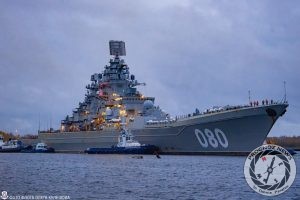
The return of the Russian battlecruiser Admiral Nakhimov has attracted considerable attention amongst naval analysts. After more than two decades in refit and modernisation, she is emerging not merely as a relic of the late Soviet era but as perhaps the most heavily armed surface combatant in the world. As she enters sea trials and approaches operational deployment with Russia’s Northern Fleet, NATO planners must ask a difficult question: how dangerous is she in the Arctic theatre?
The answer is complex. Admiral Nakhimov is undoubtedly a formidable warship. Yet she is not a war-winning vessel, nor does she fundamentally alter the balance of power in the High North. Rather, she represents a powerful but vulnerable component of a broader Russian Arctic strategy centred upon missile warfare, submarine operations and the defence of the Kola Peninsula.
The Arctic has always occupied a special place in Russian naval thinking. Most of Russia’s sea-based nuclear deterrent is based on the Kola Peninsula, near Murmansk. During the Cold War, Soviet strategy focused upon creating a protected maritime “bastion” in the Barents Sea from which ballistic missile submarines could operate under the protection of surface ships, aircraft and land-based missile systems. Contemporary Russian doctrine has returned to many of these concepts. Recent concerns expressed by Norway and the United Kingdom about Russian activity around the so-called Bear Gap reflect NATO’s recognition that the Arctic is once again becoming a primary strategic theatre.
Into this environment sails Admiral Nakhimov.
Displacing nearly 28,000 tonnes when fully loaded, she is larger than many aircraft carriers operated by medium-sized powers. Powered by nuclear reactors, she possesses effectively unlimited range and can remain at sea for prolonged periods. Her modernisation has replaced much of her Soviet-era equipment with contemporary missile systems and sensors. Most significantly, she is expected to carry a large number of vertical launch cells capable of firing a mixture of Kalibr land-attack missiles, Oniks supersonic anti-ship missiles and Zircon hypersonic missiles. Estimates suggest approximately eighty universal launch cells are available for these weapons.
The inclusion of the Zircon missile has generated the greatest concern. Russian officials claim that the missile can travel at speeds approaching Mach 9 and engage targets hundreds of kilometres away. Western analysts debate the precise performance figures, but there is little doubt that hypersonic weapons substantially compress reaction times for defenders. NATO naval commanders operating in the Norwegian Sea or North Atlantic would face a far more demanding missile defence problem if confronted by a coordinated salvo of Zircon missiles launched from multiple platforms.
Moreover, Admiral Nakhimov is not merely an offensive platform. Her air defence suite is expected to be exceptionally powerful, incorporating navalised variants of long-range missile systems comparable to the S-400 together with multiple close-in defence systems. Reports indicate that the ship may be capable of simultaneously engaging dozens of aerial targets. In theory, this allows her to act as the centrepiece of a naval task group and provide area air defence for accompanying vessels.
However, the warship’s strengths should not obscure her weaknesses.
The first weakness is that she is a single ship.
Modern naval warfare increasingly rewards dispersion rather than concentration. A vessel carrying enormous quantities of missiles appears intimidating, but it also presents a highly valuable target. NATO possesses substantial anti-ship capabilities spread across submarines, maritime patrol aircraft, strike aircraft and surface vessels. If Admiral Nakhimov were identified and tracked during a conflict, NATO would likely devote considerable resources to neutralising her.
The second weakness concerns detection.
The Arctic Ocean is often imagined as a vast empty wilderness. In reality it is one of the most intensely monitored military regions on earth. NATO surveillance assets focus heavily upon Russian Northern Fleet movements. Satellites, undersea sensors, maritime patrol aircraft and submarines collectively make it difficult for a large surface combatant to operate undetected for extended periods. Unlike a submarine, a battlecruiser cannot disappear beneath the waves.
The third weakness is economic.
Russia has invested immense resources into restoring Admiral Nakhimov. Some analysts estimate that her modernisation has cost sums comparable to constructing several modern frigates. This reflects a recurring tension in Russian defence planning. Prestige platforms can be politically attractive, but multiple smaller vessels often provide greater operational flexibility. The opportunity cost of maintaining such a massive ship is significant, particularly at a time when Russia continues to devote enormous resources to her war in Ukraine.
NATO’s own capabilities also mitigate much of the threat.
The alliance’s greatest Arctic advantage lies not in surface ships but in submarines. American, British and increasingly Norwegian undersea forces remain exceptionally capable. The Arctic environment strongly favours submarine operations, and it is these vessels rather than surface combatants that would likely determine the outcome of any naval confrontation in the High North.
Furthermore NATO air power enjoys significant advantages. Aircraft operating from Norway, Iceland, the United Kingdom and carrier groups can threaten Russian surface vessels long before they approach critical sea lines of communication. A ship as large as Admiral Nakhimov inevitably presents a conspicuous target.
Nevertheless it would be a mistake to dismiss her significance.
Even if she never fires a missile in anger, Admiral Nakhimov serves an important strategic function. She embodies Russian determination to remain a great naval power. Her presence complicates NATO planning. She provides a powerful escort for Russian submarine deployments. Most importantly, she contributes to a layered missile threat environment in which Russian submarines, aircraft, coastal batteries and surface ships collectively create risks for NATO forces operating near the Kola Peninsula.
Admiral Nakhimov should not be viewed in isolation. She is best understood as one component of an integrated Arctic military system. By herself she is dangerous. As part of Russia’s wider Northern Fleet structure she becomes considerably more dangerous.
The ultimate conclusion is therefore nuanced. Admiral Nakhimov is probably the most powerful surface combatant Russia has deployed since the end of the Soviet Union. She possesses extraordinary missile firepower and formidable defensive systems. In a regional conflict she could inflict serious losses upon NATO naval forces and would demand immediate attention from alliance commanders.
Yet she is not a strategic game-changer. NATO retains overwhelming advantages in surveillance, submarine warfare, maritime aviation and alliance-wide force integration. The battlecruiser’s true significance lies not in her ability to defeat NATO single-handedly but in her role as a symbol and force multiplier within Russia’s broader Arctic posture.
For NATO admirals operating in the Arctic, Admiral Nakhimov is not a nightmare. She is something arguably more challenging: a highly capable warship whose presence cannot be ignored, whose missiles must be respected, and whose destruction in wartime would become an immediate operational priority. In the increasingly contested waters of the High North, that alone makes her one of the most important surface combatants afloat today.
164 Views



Most Readings