Georgia at the Crossroads: The Long Road Back Towards Moscow
By Matthew Parish, Associate Editor
Saturday 20 June 2026
For much of the period following the collapse of the Soviet Union, Georgia appeared destined to become one of the most successful democratic reformers in the post-Soviet space. The country embraced market reforms, sought integration with Euro-Atlantic institutions and cultivated a national identity firmly distinct from that of Russia. The 2003 Rose Revolution seemed to place Georgia on an irreversible path towards Europe, and successive governments publicly committed themselves to eventual membership of both the European Union and the North Atlantic Treaty Organisation.
Yet in recent years Georgia has appeared increasingly to drift away from that trajectory. While few Georgians openly advocate reunification with Russia’s sphere of influence, the country’s political direction has become progressively more aligned with Moscow’s strategic interests. The transformation has been gradual rather than dramatic, taking place through a series of political decisions, institutional changes and shifts in rhetoric that collectively suggest a nation moving cautiously but steadily away from the West.
This development presents a profound challenge not only for Georgia itself but also for European policymakers who had long assumed that Georgia’s Western orientation was secure.
The shadow of 2008
Any discussion of Georgia’s relationship with Russia must begin with the brief but transformative war of August 2008. Following escalating tensions over the separatist territories of South Ossetia and Abkhazia, Russian forces entered Georgia and rapidly defeated the Georgian military.
The consequences of the conflict continue to shape Georgian politics nearly two decades later. Russia maintains military forces in both Abkhazia and South Ossetia and recognises them as independent states. Georgia regards them as territories under Russian occupation.
The war had a lasting psychological effect upon Georgian society. It demonstrated the limits of Western support and exposed the dangers of direct confrontation with Moscow. While many Georgians remained committed to European integration, the conflict also strengthened voices arguing that Georgia must pursue a more pragmatic relationship with her powerful northern neighbour.
The lesson many political leaders drew was that survival required caution.
The rise of Georgian Dream
Much of Georgia’s contemporary political evolution has occurred under the rule of the governing party, Georgian Dream.
Founded by billionaire businessman Bidzina Ivanishvili, the party came to power in 2012 promising stability, economic development and a reduction in political polarisation.
Initially Georgian Dream presented itself as both pro-European and pragmatic towards Russia. This position reflected the preferences of many voters who supported European integration but feared renewed conflict with Moscow.
Over time however, critics increasingly accused the government of weakening democratic institutions while simultaneously softening Georgia’s resistance to Russian influence.
The government rejected these accusations, arguing that it merely sought to protect Georgia from being drawn into unnecessary geopolitical confrontations.
The war in Ukraine accelerated this debate.
Ukraine and the politics of neutrality
Russia’s full-scale invasion of Ukraine in February 2022 forced governments throughout Eastern Europe to choose how openly they would oppose Moscow.
Georgia’s response proved controversial.
The government condemned the invasion and supported Ukraine diplomatically in international forums. However it refused to impose bilateral sanctions on Russia and resisted calls for stronger measures.
Officials repeatedly argued that Georgia could not afford to provoke Russia given the presence of Russian troops already stationed within territory claimed by Georgia.
This position reflected genuine security concerns. Georgia’s military capabilities remain modest compared with Russia’s overwhelming strength. Many citizens feared that an overly confrontational stance could invite retaliation.
Yet critics argued that the government’s approach went far beyond prudent caution. They contended that official rhetoric increasingly mirrored Russian narratives, particularly regarding Western influence and alleged attempts to draw Georgia into war.
The accusation was not necessarily that Georgia had become pro-Russian. Rather, it was that the government increasingly portrayed Western partners as threats while treating Russia with extraordinary restraint.
The foreign agents law
Perhaps no issue better illustrates Georgia’s political trajectory than the controversy surrounding legislation requiring organisations receiving foreign funding to register under special transparency rules.
Supporters argued that the legislation simply enhanced accountability and resembled regulations found elsewhere in the world.
Opponents viewed it very differently.
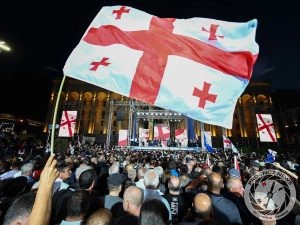
To many Georgians the law closely resembled legislation used in Russia to suppress civil society organisations, independent media and political opposition. Large-scale demonstrations erupted in Tbilisi as protesters accused the government of adopting authoritarian methods inspired by Moscow.
The symbolism was particularly powerful.
For many years Georgia’s civil society organisations had served as engines of democratic development and European integration. Measures perceived as targeting these groups therefore appeared to represent a broader challenge to Georgia’s Western orientation.
The resulting protests demonstrated that public support for Europe remains remarkably strong despite the government’s increasingly contentious relationship with Western institutions.
A divided society
One of the most striking aspects of contemporary Georgia is the widening gap between public opinion and government behaviour.
Opinion polling has consistently suggested overwhelming support amongst Georgians for membership of the European Union. NATO membership likewise retains substantial support despite the complications created by Russian opposition.
Many young Georgians identify culturally and politically with Europe. They study European languages, consume European media and view their country’s future as inseparable from that of the wider European continent.
Tbilisi itself often feels more European than post-Soviet.
Yet political power remains concentrated in institutions increasingly accused of democratic backsliding.
This divergence creates a paradox. Georgia’s population may be amongst the most pro-European in the former Soviet Union, yet her government frequently finds itself in conflict with European institutions.
The role of economic dependence
Economics also plays a significant role in Georgia’s evolving relationship with Russia.
Trade between the two countries has expanded in recent years. Russian tourists remain an important source of revenue, while remittances from Georgians working abroad continue to contribute to household incomes.
The war in Ukraine further altered economic dynamics. Large numbers of Russian citizens relocated temporarily or permanently to Georgia following mobilisation announcements and political repression inside Russia.
Many brought substantial financial resources with them. Property prices rose sharply, businesses expanded and economic activity increased.
These developments created new forms of interdependence.
Although economic engagement does not necessarily translate into political alignment, it can generate constituencies with an interest in maintaining stable relations with Russia.
The Kremlin understands this dynamic well.
Russian influence today rarely depends upon tanks crossing borders. It more often operates through economic incentives, political networks, information campaigns and strategic patience.
A changing geopolitical environment
Georgia’s slide towards Russia must also be understood within the context of broader international developments.
The European Union has faced multiple crises over the past decade, from Brexit to energy security challenges and growing political fragmentation. Enlargement enthusiasm has often appeared inconsistent.
Meanwhile Russia has demonstrated a willingness to sustain long-term pressure against neighbouring states seeking Western integration.
Moscow does not necessarily need Georgia to become an ally. Preventing full integration with Western institutions may be sufficient.
From the Kremlin’s perspective, a neutral, hesitant or internally divided Georgia represents a strategic success.
This approach reflects a wider Russian objective throughout the former Soviet space: maintaining ambiguity, delaying integration processes and preserving opportunities for future influence.
The danger of democratic erosion
The greatest threat facing Georgia may not be a dramatic geopolitical realignment but something more subtle.
Countries rarely abandon democratic norms overnight. Institutional decline often occurs gradually through the accumulation of seemingly minor changes.
Independent media encounter increasing pressure.
Civil society organisations face greater scrutiny.
Opposition parties encounter administrative obstacles.
Judicial independence becomes contested.
Elections remain formally competitive but the political environment grows less balanced.
Each individual development may appear manageable. Collectively they can transform a political system.
This pattern has become familiar across several post-Soviet states. Critics increasingly fear that Georgia may be following a similar path.
The future remains unwritten
Despite these concerns, it would be premature to conclude that Georgia has irreversibly returned to Russia’s orbit.
The country remains fundamentally different from many authoritarian states in the region. Independent voices continue to operate. Civil society remains active. Public protests attract large numbers of participants. Political debate remains vigorous.
Most importantly, a substantial majority of Georgians continue to view Europe as their preferred destination.
The struggle therefore concerns not only foreign policy but national identity.
Is Georgia fundamentally a European state temporarily constrained by geography and security concerns? Or is she destined to remain within a Russian-dominated sphere of influence because of those same realities?
The answer remains uncertain.
What is clear is that Georgia occupies one of the most strategically significant fault lines in contemporary Eurasia. Her future will depend not only upon decisions made in Tbilisi but also upon developments in Moscow, Brussels, Washington and Kyiv.
The outcome will shape far more than Georgia’s domestic politics. It will serve as an important test of whether small states situated beside great powers can successfully preserve democratic aspirations and sovereign independence in an increasingly competitive international order.
For now, Georgia stands at a crossroads. The road towards Europe remains open, but the path has become steeper and the pull from the north grows stronger with each passing year.
114 Views


Most Readings