The New Aristocracy of Intelligence
By Matthew Parish, Associate Editor
Thursday 30 July 2026
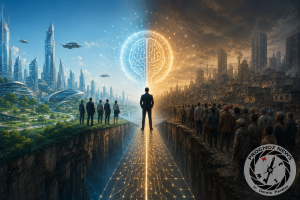
The Industrial Revolution created factory owners. The Information Age created software billionaires. The age of artificial intelligence may create something altogether different: a class of individuals whose fortunes derive not merely from owning capital or organising labour, but from designing systems capable of performing increasingly sophisticated intellectual work. If this transformation occurs at the scale many technologists anticipate, the economic consequences may be unlike anything experienced since the dawn of industrial capitalism.
Amongst those building the technologies driving this transformation, there is an unusually candid recognition that the rewards may be distributed with extraordinary unevenness. Unlike previous generations of industrialists, some of today’s technology leaders openly acknowledge that artificial intelligence may enrich a remarkably small number of individuals while offering only comparatively modest gains to the majority of society. Far from dismissing this possibility, some regard it as one of the defining political and moral challenges of the coming decades.
This observation deserves careful consideration. Historically, technological revolutions have indeed produced inequality, but they have also broadened prosperity. The steam engine generated fortunes for railway magnates, yet it simultaneously created millions of industrial jobs. Electrification enriched industrialists while transforming ordinary domestic life. The internet minted billionaires but also enabled countless small businesses, professions and entirely new industries.
Artificial intelligence may follow a different trajectory because it automates not merely physical effort but cognitive work. The scarce resource ceases to be labour itself and instead becomes ownership of algorithms, computational infrastructure, proprietary datasets and the intellectual property underpinning increasingly capable models. Once these assets exist, they can often be replicated across millions of users at negligible marginal cost. Scale becomes almost limitless.
Consequently, the rewards increasingly flow to those who build or control the platforms rather than those who merely use them.
This creates an economic phenomenon that is historically unusual. Instead of wealth increasing proportionately across society, there is the possibility of what might be called a decoupling. Ordinary professional salaries may continue to rise as productivity improves. Living standards may genuinely become better. Yet the fortunes accumulated by those controlling frontier AI systems could expand at a rate that dwarfs anything experienced by previous generations.
Perhaps even more striking is the sociological observation accompanying this prediction. The principal beneficiaries of AI are unlikely to resemble the traditional business elite. They may instead consist of highly specialised mathematicians, computer scientists and engineers whose intellectual abilities are exceptional but whose lives bear little resemblance to those of the populations affected by their inventions. Whether described humorously or critically, the point is that technological power may increasingly reside in communities that have relatively little social overlap with wider society.
This raises profound questions about democratic legitimacy. Modern representative government assumes that economic elites remain embedded within broader society through common institutions, shared experiences and overlapping interests. If technological elites become increasingly detached from the lives of ordinary citizens, mutual understanding may diminish. Political polarisation could deepen not because either side acts maliciously, but because their lived realities become almost entirely different.
History offers several precedents. Aristocracies have often emerged when ownership of a uniquely valuable resource became concentrated within a narrow class. Land ownership produced hereditary nobility. Oil generated petro-states. Intellectual property surrounding artificial intelligence may prove to be the strategic resource of the twenty-first century.
Unlike land or oil, however, intelligence scales without obvious physical limits. A successful AI model can simultaneously advise millions of businesses, governments and individuals. It can generate software, analyse legal documents, discover pharmaceuticals, optimise military logistics and perform scientific research without exhausting itself. The resulting economic leverage may exceed that of any previous technological innovation.
Yet there are reasons for cautious optimism. Artificial intelligence also promises enormous increases in productivity, reductions in administrative burden, accelerated medical research, better engineering, improved education and scientific breakthroughs that would otherwise have taken decades. If governed wisely, these gains could raise living standards across the developed and developing world alike. Even modest increases in average prosperity would represent meaningful improvements for billions of people.
The central political question therefore becomes not whether AI creates wealth, but how that wealth circulates.
Taxation, competition policy, employee ownership, public investment in education, broader access to computing infrastructure and international cooperation over AI governance may all become increasingly important. None offers a complete solution. Nevertheless, history demonstrates that societies can adapt institutions to technological revolutions, provided they recognise the scale of the transformation before social tensions become entrenched.
There is also an irony that should not be overlooked. Artificial intelligence is itself a product of profoundly collaborative human endeavour. Every frontier model depends upon decades of publicly funded academic research, open scientific publication, university education, global semiconductor supply chains and the cumulative contributions of countless engineers whose names are largely forgotten. The extraordinary fortunes that AI may create are therefore built upon an intellectual commons accumulated over generations.
Recognising that fact does not diminish entrepreneurial achievement. Rather, it reminds us that innovation has always been both individual and collective.
The coming decades are therefore unlikely to be defined simply by machines replacing workers. They will instead be defined by the emergence of a new political economy in which ownership of intelligence itself becomes the principal source of wealth. Whether that wealth strengthens liberal democratic societies or fragments them into increasingly separate economic worlds will depend less upon the capabilities of artificial intelligence than upon the wisdom with which human beings choose to govern its extraordinary success.
133 Views



Most Readings