Donbasification: How to Manufacture a Country Within a Country
By Matthew Parish
Tuesday 1 September 2026
There are some political ideas whose importance lies not in their complexity but in the fact that, once somebody has given them a name, one suddenly starts seeing them everywhere. “Donbasification” may prove to be one of them.
The expression has recently been associated in particular with Vlad Vernygora, an international-relations scholar and Ukrainian National Guard officer, and has been developed in an illuminating essay by Kate Turska, herself from Sloviansk. In their usage, Donbasification describes something substantially more sophisticated than separatism. It is the deliberate manufacture of a regional identity inside another country — an identity sufficiently distinctive, sufficiently aggrieved and eventually sufficiently alienated from the national centre that an external power can use it as an instrument for weakening, partitioning or invading the state.
This is an important concept because the conventional account of what happened in eastern Ukraine after 2014 frequently begins the story far too late. It starts with demonstrations, armed men, seizures of administrative buildings, declarations of “People’s Republics” and the arrival of Russian weapons and personnel. But by the time Igor Girkin and his armed associates appeared in Sloviansk in April 2014, much of the intellectual preparation for what followed had already been undertaken. The battlefield had first been created in people’s minds.
Inventing the Donbas
The first curiosity about the Donbas is that, historically speaking, it was never really a country at all. The word is a contraction of “Donets Basin”. It describes a geological and industrial region organised around coal mining, metallurgy and heavy industry. Its boundaries never corresponded neatly with those of Donetsk and Luhansk oblasts and the geological basin itself extends across the contemporary international frontier into Russia. Soviet geography understood the Donbas principally as an economic region — mines, steelworks, factories, railways and industrial cities — rather than as the homeland of some distinct ethnic nation.
Yet over several decades an extraordinary linguistic transformation took place. An expression describing economic geography became an expression describing people. The world began to hear of “the people of Donbas”, as though they were a nationality comparable with the Catalans, Kurds or Basques. This transformation was politically consequential. Once there existed in the public imagination a distinct “people of Donbas”, it became possible to ask whether those people had interests different from those of Ukraine. Then it became possible to suggest that Kyiv did not understand them. Then that Kyiv oppressed them. Then that they required autonomy. Then that they required protection. Finally they required Russia.
This is the anatomy of Donbasification. The genius — if one may use that word for something so destructive — lies in the fact that the process need not invent everything. Successful propaganda almost never does. Donetsk really was different from Lviv. Its industrial history was different, its patterns of migration were different, Russian was more widely spoken, Soviet culture survived more strongly and its political economy was dominated by particular networks of industrial oligarchs. There were authentic regional differences.
But Manchester is different from Oxford. Marseille is different from Strasbourg. Sicily is different from Lombardy. Texas is different from Massachusetts. Difference does not entail foreignness. Donbasification consists in taking the perfectly ordinary differences found within every substantial country and transforming them into evidence that two populations cannot properly belong to the same political community.
Russification and its circular logic
There was another historical process beneath all this — Russification. The industrialisation of eastern Ukraine involved enormous movements of population under the Russian Empire and particularly the Soviet Union. Ukrainian cultural institutions suffered repeated suppression. Russian became the language of advancement across much of Soviet professional and urban life. Education, administration, television and elite culture reinforced Russian linguistic predominance. Then came one of the strangest arguments of the post-Soviet era.
Because generations of Ukrainians had been Russified, Russia began suggesting that their use of Russian demonstrated that they were Russians. The circularity is breathtaking. First an empire promotes its own language at the expense of another. Then it points to the success of that policy as evidence that the population concerned naturally belongs to the empire. Yet language and political identity are plainly different things. Millions of Ukrainians who principally or habitually speak Russian have fought Russia since 2014. Some of Ukraine’s most fiercely patriotic cities were historically predominantly Russian-speaking. The trenches of the Ukrainian Armed Forces have never been organised according to the language soldiers use when telephoning their mothers.
There is also an inconvenient historical fact for the theory that Donbas was simply a Russian territory stranded accidentally inside Ukraine. On 1 December 1991, the inhabitants of the Ukrainian Soviet Socialist Republic were asked whether they supported independence. Donetsk oblast voted 83.9 per cent in favour. Luhansk oblast voted 83.86 per cent in favour. Every Ukrainian region produced a majority for independence.
This was not a marginal result produced by electoral ambiguity. More than four-fifths of voters in the two oblasts subsequently presented as naturally separatist had chosen an independent Ukraine. Something therefore had to happen between 1991 and 2014. That something was Donbasification.
Politics as preparation
Russia was not solely responsible for the process. Ukrainian politicians participated in it, sometimes enthusiastically. The electoral politics of the 1990s and 2000s repeatedly divided Ukraine into supposedly incompatible eastern and western camps. Political consultants discovered that frightening voters in Donetsk with stories about nationalists in Lviv was an effective electoral technique, just as politicians elsewhere found advantage in portraying eastern Ukrainian political machines as alien, corrupt or Soviet.
These caricatures reinforced one another. Russia supplied an enormous information ecosystem in which the divisions could flourish. Russian television remained influential. Russian entertainment, news and political commentary crossed the border almost without friction. Moscow did not have to persuade everybody in eastern Ukraine that they were Russian. That would have been both unnecessary and implausible.
It merely had to persuade sufficient numbers of people that Kyiv was somehow foreign to them. That is a much easier task. Donbasification therefore differs from crude annexation propaganda. It does not initially say: “You belong to us.” It says: “You do not really belong to them.” Only later does the first proposition follow from the second.
From identity to grievance
The next stage is the manufacture of grievance. Every region has grievances against its capital. Taxes are too high. Public investment is too low. Politicians elsewhere are corrupt. Local industries are misunderstood. The capital’s elites are arrogant. Regional traditions are insufficiently respected. Most democracies spend much of their existence negotiating precisely these complaints.
Donbasification changes their meaning. An economic complaint becomes an ethnic complaint. An administrative dispute becomes evidence of persecution. A disagreement about education becomes an attack upon identity. An unpopular government becomes an illegitimate foreign regime. Eventually ordinary politics becomes impossible because every political question has been converted into a question of existential identity.
This was visible in the extraordinary vocabulary surrounding Ukraine in 2014. The government in Kyiv was not merely a government with which one might disagree. It was a “junta”. Ukrainian nationalists were not political opponents. They were “fascists”. Russian speakers were not citizens with linguistic preferences. They were an allegedly persecuted community requiring protection.
Once politics is described in these terms, violence becomes easier to justify. If your taxes are too high, you vote against the government. If fascists are coming to exterminate your community, you take up a gun. That distinction is why propaganda matters.
Creating the conflict that proves the propaganda
The most sinister feature of Donbasification is its self-fulfilling character. Imagine that an external power spends years arguing that a region is alienated from its national government. It supports sympathetic politicians and media organisations. It encourages historical grievances. It promotes narratives of persecution. It cultivates local networks. Eventually it assists armed groups prepared to challenge the authority of the state. Violence follows.
The external power then points to the violence as proof that the region was always alienated.
The manufactured conflict becomes evidence for the proposition used to manufacture it.
This is approximately what happened in eastern Ukraine.
Russia could consequently present itself not as a participant in the creation of the conflict but as an outside power reluctantly intervening in an existing civil war. Western journalism sometimes inadvertently reinforced this description with expressions such as “pro-Russian separatists” that obscured the extraordinary extent of Russian organisation, leadership, equipment and ultimately direct military involvement.
The political technology had achieved its objective. Russia had helped manufacture a rebellion and then cited the existence of the rebellion as evidence that Ukraine was naturally divided.
The destruction of the thing supposedly being saved
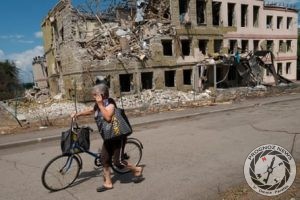
There is a terrible irony to all this. Russia justified her intervention as necessary to protect Donbas. Yet few forces in modern history have inflicted greater destruction upon Donbas than Russia. Cities supposedly liberated have been devastated. Industrial infrastructure has been destroyed. Mines have deteriorated or closed. Populations have fled. Families have been dispersed across Ukraine, Russia and Europe. Places whose names once evoked factories and football clubs now evoke artillery battles.
Mariupol became the most spectacular early example. Bakhmut followed. Avdiivka became another. Across the region, the Russian concept of liberation has repeatedly involved reducing Ukrainian settlements to ruins before planting a Russian flag over what remains.
This reveals something fundamental about imperial politics. The object was never really the welfare of the Donbas. The Donbas was an instrument.
Its purported identity was valuable insofar as that identity could be used to dismember Ukraine. Once the territory became a battlefield, the lives, houses, factories and communities of the people allegedly being rescued became expendable. The political fiction survived even while the physical place was destroyed.
Donbasification beyond Donbas
This is why the concept deserves attention outside Ukraine. Donbasification describes a potential method of geopolitical warfare. Find a region containing some mixture of linguistic, ethnic, historical or economic distinctiveness. Emphasise those differences relentlessly. Establish or support media outlets presenting national politics through the prism of regional grievance. Encourage inhabitants to believe that the central government regards them with contempt. Promote historical narratives suggesting that the region accidentally ended up within the wrong borders. Discredit national institutions. Encourage demands that the central government cannot easily satisfy. Then wait.
The method is particularly attractive because its early stages are inexpensive and deniable. Television is cheaper than tanks. Political financing is cheaper than artillery. Social-media manipulation is cheaper than occupation. And if the operation fails, little has been lost.
If it succeeds, the aggressor may eventually inherit a political crisis inside somebody else’s country.
The obvious potential targets lie across the post-Soviet world. Moldova has already experienced something resembling the model in Transnistria. Georgia suffered analogous Russian manipulation in Abkhazia and South Ossetia, although the histories of those conflicts differ substantially from Donbas. Estonia and Latvia contain large Russian-speaking populations and therefore devote considerable attention to the resilience of their national information spaces. Vernygora himself has presented Donbasification as a warning relevant to Estonia.
But the idea need not be restricted to Russian foreign policy. Any hostile state seeking to weaken a rival might attempt some version of it. The essential technique is universal: turn regional difference into regional identity, regional identity into grievance, grievance into estrangement and estrangement into a challenge to sovereignty.
Modern communications technology makes this easier, not harder. A hostile intelligence service no longer needs to control a television station. Thousands of apparently independent social-media accounts can repeat variations upon the same proposition: the capital hates you; the rest of the country despises you; your taxes subsidise them; your history is being erased; your language is threatened; politicians will never listen; you are different; you would be better off alone. No individual proposition need be decisive. The purpose is cumulative. Eventually people begin inhabiting different political realities while continuing to occupy the same country.
The antidote
The obvious response to Donbasification might appear to be aggressive centralisation — suppress regional identities, insist upon national conformity and treat every expression of local difference as potential separatism. That would be a mistake. Indeed it might accelerate the disease.
The most effective defence against Donbasification is a state sufficiently confident to accommodate regional difference without interpreting it as disloyalty. Ukraine herself has learned this lesson painfully. The distinction between Ukrainian patriotism and Ukrainian linguistic uniformity has become increasingly obvious during the war. A Russian-speaking Ukrainian soldier defending Kharkiv against a Russian-speaking invader presents a fairly decisive rebuttal to the proposition that language determines nationality. National identity is strongest when it is voluntary.
The answer is therefore not to abolish regional identity but to prevent outsiders from monopolising its interpretation. People may be simultaneously from Odesa, Kharkiv, Donetsk or Lviv and Ukrainian. There is nothing contradictory about this. Healthy states contain overlapping identities. Imperial powers prefer exclusive ones. They ask people to choose.
The lesson of Donbas
There is finally something profoundly tragic about the very word “Donbas”. A geological expression became an economic expression. The economic expression became a cultural expression. The cultural expression became a political identity. The political identity became an alleged grievance. The grievance became a separatist project. The separatist project became the pretext for an invasion. And the invasion destroyed much of the region whose supposedly unique identity had justified the entire exercise.
That sequence deserves to be studied far beyond Ukraine. The most dangerous borders are not always the ones armies cross. Sometimes they are borders first drawn inside people’s imaginations. A successful hostile power persuades citizens that their neighbours are strangers before persuading them that strangers are their compatriots. It teaches inhabitants of one region to regard the national capital as foreign. It converts normal political dissatisfaction into civilisational resentment. Eventually the victim state appears divided because enormous effort has been devoted to dividing it. Then the aggressor arrives and announces that it has merely discovered a division that was there all along.
That is the essential deceit of Donbasification. Russia did not discover two Ukraines. She spent years trying to create them. And perhaps the most important fact about contemporary Ukraine is that, notwithstanding occupation, propaganda, destroyed cities and hundreds of thousands of casualties, the project ultimately failed. The invasion intended to demonstrate that Ukraine was an artificial country instead produced one of the most intense periods of national consolidation in her modern history.
The supposed fault line between east and west did not split Ukraine apart. Russian-speaking Kharkiv resisted. Odesa resisted. Dnipro became one of the logistical centres of the Ukrainian war effort. People displaced from Donetsk and Luhansk rebuilt their lives elsewhere in Ukraine while continuing to identify themselves with their lost home towns.
Donbasification therefore contains both a warning and a paradox. An identity can be manufactured sufficiently to start a war. But starting the war may reveal that the identity was never as powerful as its manufacturers imagined.
The lesson for other countries is nevertheless severe. Nations should not wait until armed men seize municipal buildings before worrying about the integrity of their political communities. By then the important work may have been underway for years. The defence of a country begins long before the defence of its borders. It begins with ensuring that no foreign power succeeds in persuading one group of citizens that another group of citizens is their enemy.
7 Views



Most Readings



Crimea Under Pressure: Ukraine’s Long Campaign Against Russia’s Southern Bastion
96 Views