Serbia and Ukraine: an emerging new partnership?
By Matthew Parish, Associate Editor
Serbia’s relationship with Ukraine has long been marked by ambivalence, shaped by a combination of Slavic solidarity, Orthodox affinity, geopolitical calculation, and the complex legacy of the wars that tore apart Yugoslavia in the 1990s. In 2025 this relationship remains fraught with tension and contradiction. While Serbia formally supports Ukraine’s territorial integrity at the United Nations and has provided humanitarian aid to Ukrainian refugees, and has even provided arms to Ukraine via European third parties, she has persistently refused to join Western sanctions against Russia and continues to maintain ties with Moscow, although they appear to have chilled recently. Understanding Serbia’s evolving relationship with Ukraine requires an appreciation of her internal political culture, her foreign policy balancing act, and her enduring fear of isolation in a world still divided by the ghosts of empire.
At the heart of Serbia’s cautious policy lies a deep emotional and historical attachment to Russia. The two nations share a Slavic linguistic kinship and an Orthodox Christian tradition that has for centuries bound their elites and clergy together. For much of modern history, Serbia has viewed Russia as her protector against both Ottoman domination and Western encirclement. In Serbian national mythology, Russia is the great elder sister who comes to the rescue of the smaller Balkan nations whenever they face aggression from the West. The memory of Russian volunteers in the Balkan wars, Tsarist diplomatic backing at the turn of the twentieth century, and Soviet assistance during the Second World War continues to colour public perception of Moscow as Serbia’s natural ally.
This sentiment is reinforced by a shared sense of grievance against the West, particularly NATO. The 1999 NATO bombing campaign against the Federal Republic of Yugoslavia, launched to halt ethnic cleansing in Kosovo, left a deep psychological scar. Many Serbs equate NATO’s intervention with Western hypocrisy and double standards—especially as the same alliance now supports Ukraine’s sovereignty against Russian aggression. From Belgrade’s perspective, the Western narrative of defending international law in Ukraine rings hollow when the secession of Kosovo from Serbia was recognised by most of the same powers. This perceived double standard continues to underpin Serbian sympathy for Russia and suspicion of the Euro-Atlantic project.
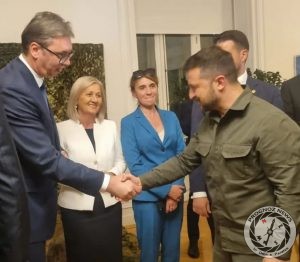
Nevertheless Serbia’s stance towards Ukraine is not entirely defined by Moscow’s orbit. President Aleksandar Vučić has cultivated an image of pragmatic neutrality, balancing between East and West with a finesse born of necessity. He met with the Ukrainiain President in Odesa in June 2025, and is reported in early November to have held a telephone call with the Ukrainian President to discuss mutual aspirations of EU membership. Serbia’s economy depends heavily on trade and investment from the European Union, which accounts for more than two-thirds of her exports and is her largest source of foreign direct investment. The country’s ambition to join the EU remains a central pillar of official policy. Vučić understands that overt alignment with Russia would jeopardise this strategic objective. Therefore while Belgrade refuses to impose sanctions on Moscow, it has also avoided any explicit endorsement of the Russian invasion of Ukraine. Serbian officials repeatedly affirm Ukraine’s territorial integrity and vote in favour of UN resolutions condemning aggression, even as they abstain from measures that might antagonise Russia directly.
This duality reflects Serbia’s broader foreign policy doctrine: a deliberate cultivation of ambiguity. Vučić seeks to portray Serbia as a bridge between East and West, a role that provides Belgrade with diplomatic leverage disproportionate to her size. By maintaining open channels with both Brussels and Moscow, Serbia enhances her regional relevance and extracts economic concessions from both sides. The policy also plays well domestically, where the electorate remains divided between pro-European modernisers and nationalist traditionalists who fear Western domination. The Ukrainian conflict thus becomes a useful stage upon which Vučić performs his balancing act: condemning war in principle while rejecting the Western punitive approach.
Yet beneath this pragmatic façade, Serbia’s attitude towards Ukraine is evolving subtly. The war has forced Belgrade to confront uncomfortable parallels between Russia’s claims over Ukraine and Serbia’s own narrative regarding Kosovo. For years, Serbian politicians have justified their refusal to recognise Kosovo’s independence on the grounds that secession violates international law and that territorial integrity must be respected. Russia’s annexations of Ukrainian territory, however, rely on precisely the opposite argument: the right (indeed the obligation) of Russian ethnic communities in southeast Ukraine to self-determination by merger with Russia. This contradiction undermines Belgrade’s long-standing diplomatic position and exposes the risks of relying on Moscow’s patronage. If Russia’s precedent were universally applied, Kosovo’s independence would gain rather than lose legitimacy. Some Serbian diplomats, aware of this irony, have begun to re-evaluate their blind loyalty to Moscow. A number of overtly pro-Russian technocrats in the Vučić administration have been quietly purged, Belgrade fearful of infilitration by Russia’s security and intelligence apparatus.
Moreover Serbia’s society is gradually changing. Younger generations, who have grown up with access to European education and digital media, increasingly identify with the West rather than with the nostalgic pan-Slavism of their grandparents. Ukrainian refugees have been received sympathetically by many ordinary Serbs, particularly in Belgrade and Novi Sad, where cultural exchanges and volunteer initiatives have emerged. Ukrainian musicians, artists and intellectuals now participate in Serbia’s vibrant cultural life, and the human dimension of the war—images of destroyed cities and displaced families—has softened some of the pro-Russian rhetoric among the urban middle class. Ukrainian refugees and Russians seeking refuge from Moscow’s wrath and the risks of conscription into the Russian Armed Forces quietly mingle together in the streets of Belgrade.
Still the Serbian political establishment remains constrained by geopolitical realities. Russia retains powerful levers of influence: she supplies the bulk of Serbia’s natural gas, supports Belgrade’s position on Kosovo in the UN Security Council, and provides investment through energy and infrastructure projects. Furthermore the Russian intelligence presence in the Balkans, particularly in Serbia and Republika Srpska (the Serbian enclave in Bosnia and Herzegovina), ensures that any abrupt shift towards the Western camp would carry domestic risks for Vučić’s government. Thus Serbia treads carefully, adjusting her rhetoric without altering her core alignment.
In the longer term, Serbia’s relationship with Ukraine will depend upon the evolution of the wider European security order. If the war in Ukraine leads to a durable Western victory and Russia’s strategic isolation, Belgrade may feel compelled to pivot decisively towards Brussels to avoid marginalisation. Conversely if Moscow retains significant influence in Eastern Europe or the conflict freezes into a negotiated stalemate, Serbia may continue her hedging strategy indefinitely. For now Belgrade prefers to remain formally neutral while exploiting her position as the only European state maintaining friendly relations with both Kyiv and Moscow.
Serbia’s motivations are therefore pragmatic rather than ideological. She seeks to preserve sovereignty in her foreign policy, avoid economic or political coercion from any side, and leverage her unique position to advance domestic stability and regional influence. Her relationship with Ukraine is shaped by empathy for a fellow Orthodox nation under siege, but tempered by her dependence on Russian support and her own unresolved territorial dispute.
Serbia’s evolving stance towards Ukraine is a mirror of her own national dilemma: torn between history and modernity, between loyalty to an imagined Slavic fraternity and the reality of a European future. Whether Belgrade ultimately chooses to side decisively with one camp or continue her delicate balancing act will depend not only on events in Ukraine, but on Serbia’s ability to reconcile her past with the imperatives of the present.
465 Views



Most Readings