Brest-Litovsk and the Recurring Geography of Eastern Europe
By Matthew Parish, Associate Editor
Friday 21 August 2026
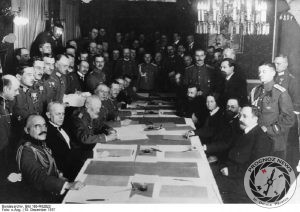
There are treaties that settle wars and there are treaties that reveal them. The Treaty of Brest-Litovsk, signed on 3 March 1918 between Bolshevik Russia and the Central Powers, belongs emphatically to the latter category. It survived for scarcely eight months. Germany’s defeat on the Western Front rendered it politically obsolete before the year was out. Yet for so short-lived an instrument, Brest-Litovsk exposed with extraordinary clarity some of the permanent questions of Eastern European geopolitics — where Russia ends, whether the nations between Russia and Germany are genuinely sovereign, what happens when Russian state power temporarily collapses and whether territorial concessions extracted from Moscow in a moment of weakness can ever be regarded by a subsequent Russian government as permanent.
These questions have returned with uncomfortable force in the twenty-first century.
Brest-Litovsk must first be understood as the consequence of catastrophe. Imperial Russia entered the First World War in 1914 with immense manpower, substantial natural resources and grand strategic ambitions. It nevertheless possessed an economy, transport system and administrative apparatus inadequate to the demands of modern industrial warfare. Military defeats compounded political incompetence. By 1917 the strain had destroyed the monarchy itself.
The February Revolution removed Tsar Nicholas II but did not solve the fundamental problem. The Provisional Government continued the war, notwithstanding the exhaustion of the Russian population and the deterioration of the army. The disastrous Kerensky Offensive of the summer of 1917 demonstrated how far Russian military effectiveness had deteriorated. Soldiers deserted, discipline collapsed and the authority of the state steadily dissolved.
The Bolsheviks understood the political consequences better than their rivals. Their promise of peace was not merely ideological. It was an instrument for taking power.
After the October Revolution, Lenin therefore confronted an unpleasant strategic calculation. The Bolsheviks had seized the capital but scarcely controlled Russia. Their government was fragile, the army was disintegrating and civil war was approaching. Continuing to fight Germany might destroy the new regime before it could consolidate itself. Lenin consequently concluded that almost any peace was preferable to continuing the war.
This was bitterly controversial amongst the Bolsheviks themselves. Leon Trotsky attempted the ingenious but ultimately impossible formula of “neither war nor peace”: Russia would cease fighting but refuse to sign Germany’s terms. Germany answered this diplomatic abstraction with military reality. Her armies resumed their advance in February 1918 and encountered little effective resistance. Lenin’s argument became irresistible. The Bolsheviks accepted what contemporaries themselves described as a dictated peace.
The resulting settlement was astonishingly severe. Article III provided that territories west of the agreed line that had formerly belonged to Russia would cease to be subject to Russian sovereignty. Russia thereby relinquished control over enormous areas of the former Romanov Empire. Poland, Finland, the Baltic territories, much of Belarus and Ukraine were removed, in one form or another, from Moscow’s authority. Estimates differ according to precisely how the losses are calculated, but Russia surrendered roughly a third of its pre-war population together with immense agricultural, industrial and mineral resources.
Yet describing Brest-Litovsk merely as Germany taking territory from Russia misses perhaps its most important feature. The lands between Berlin and Moscow were not empty spaces. They contained nations.
Ukraine and the forgotten Brest-Litovsk
Ukraine is therefore central to understanding the episode. Indeed there were effectively two Brest-Litovsk settlements.
The Ukrainian People’s Republic had separately negotiated with Germany, Austria-Hungary, Bulgaria and the Ottoman Empire and signed its own peace treaty with the Central Powers on 9 February 1918. The Ukrainian government sought international recognition and assistance against Bolshevik forces. The Central Powers wanted something more prosaic — Ukrainian food, particularly grain, to alleviate severe wartime shortages. The subsequent Russo-German treaty of 3 March obliged Soviet Russia to recognise the Ukrainian settlement and make peace with Ukraine.
This makes Brest-Litovsk particularly interesting from a contemporary Ukrainian perspective. Ukraine did not suddenly emerge from the dissolution of the Soviet Union in 1991, as a certain persistent Russian historical mythology implies. An internationally recognised Ukrainian state was attempting to secure its existence amid the collapse of empires more than seven decades earlier.
Its predicament was nevertheless formidable. Ukrainian independence existed between competing powers — Bolshevik Russia to the east, Germany and Austria-Hungary to the west and internal political divisions within Ukraine itself. German forces helped remove Bolshevik forces from much of Ukraine during the spring of 1918 but German assistance rapidly became German domination. Ukrainian sovereignty was therefore real in aspiration and international personality but severely constrained in practice.
This reveals the first enduring lesson of Brest-Litovsk: small and medium-sized states situated between great powers can acquire formal sovereignty without necessarily acquiring strategic autonomy.
The distinction remains fundamental.
The German vision of Eastern Europe
Germany’s ambitions at Brest-Litovsk went considerably beyond securing her eastern frontier. Berlin saw the collapse of Imperial Russia as an opportunity to construct a German-dominated political and economic order across Central and Eastern Europe — often associated with the broader idea of Mitteleuropa.
The concept was not straightforward annexation. A more sophisticated imperial system was possible. Poland, Lithuania, the Baltic lands and Ukraine might possess flags, governments and ostensibly independent institutions while remaining economically, diplomatically and militarily dependent upon Germany.
This was empire adapted to the age of nationalism.
There is an important distinction here. The national movements of Eastern Europe were authentic. Ukrainians, Poles, Lithuanians, Latvians, Estonians and Finns were not invented by German strategists. The disintegration of the Romanov Empire released political forces that had existed long before 1918. Germany sought to exploit these movements rather than create them.
That distinction remains relevant whenever great powers describe the smaller states around their rivals as mere proxies. A great power may support another country’s independence because doing so serves its interests. It does not follow that the independence itself is artificial.
Ukraine in 1918 had its own political aspirations even though Germany found them useful.
Ukraine today has its own political aspirations even though Western powers find an independent and European-oriented Ukraine strategically desirable.
Confusing these propositions is one of the recurrent intellectual errors of imperial geopolitics.
The impermanence of imposed peace
Brest-Litovsk contained another lesson, and Lenin understood it perfectly.
He accepted the treaty because he believed that circumstances would change.
They did.
Germany launched its great spring offensives in France in 1918, hoping that troops transferred from the Eastern Front would produce victory before American power became overwhelming. The gamble failed. Germany’s military position deteriorated catastrophically during the second half of the year and the German Empire itself collapsed in November.
Brest-Litovsk disappeared with it.
This explains something important about treaties concluded under extreme military pressure. Their durability depends less upon the elegance of their drafting than upon the geopolitical structure sustaining them.
A treaty can define a frontier. It cannot make the balance of power supporting that frontier permanent.
The Bolsheviks had conceded vast territories because they lacked the capacity to hold them. Once Germany disappeared as the enforcing power, Moscow’s attitude towards those concessions changed accordingly. Soviet Russia gradually sought to recover influence over much of the former imperial space. Ukraine became one of the principal battlefields upon which that process unfolded.
By the early 1920s Bolshevik power had prevailed across most of Ukraine and Ukraine subsequently became a constituent republic of the Soviet Union. The Baltic states, Poland and Finland retained independence for longer, although each subsequently confronted Soviet attempts at coercion or conquest in different forms.
Hence the second great lesson of Brest-Litovsk: a Russian government may accept territorial losses when compelled by immediate weakness without necessarily accepting the political legitimacy or permanence of those losses.
This is not uniquely Russian behaviour. Most great powers dislike permanent strategic contraction. Yet Russian history displays the phenomenon with particular consistency because the Russian state has repeatedly collapsed and subsequently reconstructed itself — after the Time of Troubles, after 1917 and after 1991.
Each collapse has produced a retreat of Russian power.
Each recovery has produced arguments about how much of the lost imperial space Russia is entitled to recover.
1918 and 1991
Here lies the most striking analogy.
The dissolution of the Soviet Union in 1991 resembled the collapse of Imperial Russia in 1917 in one important respect. Moscow suddenly lost political control over immense territories that its rulers had previously regarded as components of a single geopolitical system.
Ukraine became independent. So did Belarus, Moldova, Estonia, Latvia, Lithuania, Georgia, Armenia, Azerbaijan and the Central Asian republics.
For the peoples concerned, this was national independence. For many within the Russian political establishment, it was geopolitical dismemberment. These are radically different descriptions of precisely the same historical event.
The distinction helps explain much of subsequent Eastern European history. From the perspective of Estonia, Poland or Ukraine, NATO and European Union enlargement represented the consolidation of sovereignty after generations of domination by larger neighbours. From the perspective increasingly adopted by the Kremlin, Western institutional expansion represented the occupation of geopolitical space vacated by Russia during a period of exceptional weakness.
The intellectual resemblance to the Russian reaction to Brest-Litovsk is unmistakable — although the circumstances and legal arrangements are profoundly different.
The lesson is not that 1991 was another Brest-Litovsk. There was no German army dictating the dissolution of the Soviet Union and the USSR’s constituent republics possessed constitutional status and political movements of their own. Historical analogies become dangerous when converted into claims of identity.
Rather, the analogy concerns perception.
A territorial settlement that one generation regards as national liberation may be regarded by an imperial centre as temporary strategic defeat.
That difference in historical memory can remain politically explosive for decades.
The problem of the lands in between
Brest-Litovsk also illuminates the peculiar geography of Eastern Europe.
Between Germany and Russia lies a broad belt extending from the Baltic to the Black Sea. For centuries this region has contained states whose security has depended upon preventing either of Europe’s great continental powers from becoming overwhelmingly dominant.
Poland experienced repeated partition. The Baltic territories passed between competing empires. Ukraine was divided between the Russian and Habsburg realms. Belarus similarly found herself incorporated into larger political structures.
The twentieth century repeatedly demonstrated the consequences when this intermediate zone lost strategic protection.
After the First World War an extraordinary collection of independent states appeared between Germany and Soviet Russia. Finland, Estonia, Latvia, Lithuania and Poland secured independence while Ukrainian independence failed. The resulting settlement constituted something approaching a geopolitical barrier between Germany and Russia.
It proved tragically fragile.
The Molotov-Ribbentrop Pact of August 1939 represented in one sense the antithesis of Brest-Litovsk. In 1918 Germany expelled Russia from Eastern Europe. In 1939 Germany and the Soviet Union agreed to divide much of Eastern Europe between themselves.
For the countries caught between them, either arrangement was disastrous.
This leads to perhaps the most important historical principle: the security of Eastern Europe is greatest when the states between Germany and Russia are sufficiently sovereign, sufficiently strong and sufficiently connected to wider alliances that neither great power can dispose of them by agreement with the other.
This principle underlay much of the post-Cold War European security architecture.
Ukraine and the contemporary settlement
The relevance to contemporary Ukraine is consequently considerable.
Russia’s war against Ukraine can be understood partly as an argument over whether the geopolitical settlement following 1991 is permanent. Ukraine insists that it is a sovereign European state whose borders and political orientation are matters for Ukrainians themselves. The Kremlin has repeatedly advanced a conception of security in which Ukraine’s strategic alignment cannot be separated from Russian interests.
These positions are difficult to reconcile because they begin from incompatible conceptions of sovereignty.
One is essentially juridical. States are sovereign, borders possess legal significance and governments choose their alliances.
The other is substantially geopolitical. Great powers possess security zones and neighbouring states cannot exercise sovereignty in ways that fundamentally threaten the strategic interests of the regional hegemon.
Brest-Litovsk was an unusually stark manifestation of the second conception. Germany did not imagine that the political future of Eastern Europe could simply be determined by the inhabitants of Eastern Europe. Nor did Soviet Russia ultimately accept such a proposition.
The intervening century has been, in considerable measure, a struggle over whether that older conception of geopolitics can finally be superseded.
The danger of the temporary armistice
Brest-Litovsk also supplies a warning about peace negotiations.
Not every peace treaty represents reconciliation. Some represent exhaustion.
Lenin regarded Brest-Litovsk as a tactical retreat necessary to preserve the Bolshevik state. Germany regarded it as a permanent restructuring of Eastern Europe. The incompatibility between those assumptions mattered more than the treaty’s clauses.
The contemporary lesson is obvious but should be applied carefully. Whenever a war ends through territorial compromise, the essential question is not merely where the ceasefire line lies. It is whether the parties have altered the political objectives that caused the war.
If they have not, a settlement may merely postpone another contest.
This does not mean that compromise is undesirable or that wars should continue indefinitely until maximal political objectives are achieved. History teaches almost the opposite: wars frequently end through imperfect settlements. But sustainable peace requires mechanisms that change the incentives surrounding renewed conflict — credible security arrangements, economic reconstruction, political legitimacy and some expectation that renewed aggression will prove more costly than coexistence.
Brest-Litovsk possessed virtually none of these qualities.
It rested upon German military superiority.
When that superiority vanished, so did the settlement.
The limits of historical analogy
There is nevertheless another lesson — perhaps the most intellectually important one.
History does not repeat itself neatly.
Contemporary Russia is not Bolshevik Russia. Contemporary Germany is not the Kaiserreich. NATO is not the Central Powers. The European Union is not Mitteleuropa. Modern Ukraine is a consolidated nation-state of tens of millions of people, whereas the Ukrainian People’s Republic of 1918 was attempting to construct institutions amid revolution, invasion and imperial collapse.
To equate these things would be bad history.
But historical analogy is useful when it identifies recurring structures rather than superficial similarities.
Brest-Litovsk identifies several such structures: the vulnerability of states situated between larger powers; the distinction between legal sovereignty and effective strategic independence; the tendency of weakened empires to accept losses they later seek to reverse; the danger of settlements sustained solely by temporary military superiority and the decisive importance of whether Eastern European states themselves are treated as subjects of international politics or merely objects of negotiation between greater powers.
Those structures have not disappeared.
Indeed the extraordinary fact about Brest-Litovsk is how recognisable its geography remains.
The names have changed. Königsberg is Kaliningrad. Brest-Litovsk is Brest. Petrograd became Leningrad and then St Petersburg. Empires became republics, republics became Soviet republics and Soviet republics became independent states.
Yet the map continues to ask remarkably similar questions.
Can Ukraine remain permanently independent of Russian political control? Can the Baltic states be securely incorporated into a Western strategic system? Can Poland prevent her security from depending upon accommodation between larger neighbours? Can Russia reconcile herself to borders produced during a period when Russian power was exceptionally weak? Can Europe create a security order in which sovereignty matters more than spheres of influence?
Brest-Litovsk answered those questions for only eight months.
Its answers disappeared because the power behind them disappeared.
That may ultimately be its greatest lesson. Eastern European borders have seldom been secured by diplomatic documents alone. They endure when political legitimacy, national identity and a sustainable balance of power coincide. Where those three things diverge, treaties may become little more than pauses during which states prepare themselves for the next historical argument.
The objective of contemporary European diplomacy should therefore not be another Brest-Litovsk — an imposed settlement whose durability depends upon the temporary exhaustion of one participant. It should be to escape the Brest-Litovsk cycle altogether.
That requires accepting a proposition that the empires assembled at Brest in 1918 found profoundly unnatural: that the countries between great powers are not buffer zones, bargaining counters or strategic depth.
They are countries.
And until Eastern European geopolitics accepts that deceptively simple proposition, the ghosts gathered around the negotiating tables at Brest-Litovsk will remain disconcertingly alive.
52 Views



Most Readings