Tocqueville in Moscow and Beijing: What the Ancien Régime Tells Us About Russia and China
By Matthew Parish
Thursday 3 September 2026
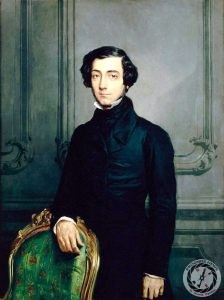
Alexis de Tocqueville is remembered in the English-speaking world principally for Democracy in America, his extraordinarily perceptive examination of the habits, virtues and dangers of democratic society. Yet for understanding the contemporary authoritarian states of Russia and China, his later and in some respects darker work, L’Ancien Régime et la Révolution — The Old Regime and the Revolution — may be the more useful book. Published in 1856, it asked a deceptively simple question. Why did one of Europe’s strongest states, possessing an elaborate bureaucracy, an ancient monarchy and apparently formidable instruments of coercion, collapse with astonishing speed in 1789?
Tocqueville’s answer was not that the French state had simply become intolerably oppressive. Nor was it that the population had become unbearably poor. His argument was considerably more subtle. Revolutions do not necessarily occur when conditions are at their worst. They may arise when an authoritarian order has begun to improve, when expectations consequently rise faster than institutions can accommodate them and when a highly centralised state has gradually destroyed the independent institutions that might otherwise have absorbed social discontent. That argument ought to make uncomfortable reading in both Moscow and Beijing.
The paradox of the strong state
The central insight of The Ancien Régime and the Revolution is that the apparent strength of an authoritarian state can conceal profound structural weakness. Pre-revolutionary France had become extraordinarily centralised. Tocqueville’s famous argument was that administrative centralisation was not created by the Revolution or Napoleon at all. It had already been constructed by the monarchy. Paris had steadily displaced provincial government, local aristocratic authority and independent institutions. Decisions that once belonged to communities, estates and local bodies increasingly belonged to officials appointed by the centre.
This produced an impressive administrative machine. But it also produced an extraordinary political vulnerability. If virtually everything is controlled by the central government, then virtually everything that goes wrong becomes the central government’s fault. A pothole becomes political. A failed harvest becomes political. An incompetent provincial official becomes the representative of the entire regime. Economic stagnation, corruption, military defeat and bureaucratic stupidity cannot easily be blamed upon autonomous municipalities, provincial governments or independent institutions because these things scarcely exist.
The state has demanded responsibility for everything — and therefore eventually receives blame for everything.
There could hardly be a more Tocquevillian description of Vladimir Putin’s Russia. The Russian Federation formally retains federal institutions, elected governors, municipalities, courts, a parliament and a multitude of other organisations. Yet over more than two decades the Kremlin has systematically reduced their political autonomy. Governors depend overwhelmingly upon Moscow. Parliament rarely represents an independent political force. Courts are weak where politically sensitive interests are concerned. National television is controlled. Independent centres of wealth have been disciplined. Civil society organisations deemed threatening can be branded undesirable or foreign agents.
This creates what appears from the outside to be an exceptionally strong state. Yet Tocqueville would surely have recognised the paradox. The Kremlin has eliminated many of the buffers between itself and Russian society. If something goes badly wrong, there are fewer people left to blame except Putin.
The danger of destroying the intermediaries
This was one of Tocqueville’s most profound concerns. France’s monarchy had gradually deprived its aristocracy and provincial institutions of meaningful political functions while often leaving their privileges intact. Society therefore became simultaneously more centralised and more fragmented. Tocqueville devoted consecutive chapters to the increasing similarity of Frenchmen and to their separation into small groups increasingly indifferent to one another.
This matters because intermediary institutions perform an important political function even in authoritarian societies. Local government, churches, professional associations, universities, aristocracies, business organisations and regional elites mediate between ruler and ruled. They resolve disputes before those disputes reach the centre. They provide alternative sources of legitimacy. Most importantly, they give citizens somewhere to conduct politics other than against the state itself.
Russia has progressively weakened precisely these sorts of institutions. The consequence may not be revolution. Indeed no serious analysis should predict the imminent collapse of Russia merely because eighteenth-century France collapsed. Historical analogies illuminate mechanisms; they do not provide timetables.
Nevertheless the structural resemblance is disturbing. The Kremlin has increasingly made itself the indispensable centre of Russian political life. Putin’s personal authority has become intertwined with the legitimacy of the state. This creates immense power while he remains successful but potentially immense fragility if he ceases to be so. The very instruments by which Putin has made himself difficult to challenge may make an eventual political crisis harder to contain.
China and the administrative state
China presents a different and perhaps more sophisticated Tocquevillian problem. The People’s Republic possesses one of history’s most formidable systems of administrative centralisation. Yet Chinese government has traditionally involved a complicated relationship between central authority and local implementation. Provincial, municipal and county officials have enjoyed substantial practical discretion even while remaining subordinate to the Communist Party hierarchy.
Under Xi Jinping, however, political authority has become increasingly concentrated at the centre and increasingly associated with Xi personally. Here Tocqueville’s analysis becomes particularly interesting. His argument was not merely that centralisation produces tyranny. It was that centralisation gradually transforms the political imagination of a society. Once intermediary institutions have been weakened, people themselves begin to imagine the state as the natural solution to social problems. Centralisation becomes self-reinforcing.
Tocqueville eventually observed that when aristocratic institutions disappear, political power naturally tends towards unity and requires considerable effort to keep divided.
Modern China exemplifies this tendency on an extraordinary scale. Economic development has produced hundreds of millions of increasingly educated, urbanised and technologically sophisticated citizens. Yet political authority has not dispersed correspondingly. Instead the Chinese Communist Party has sought to penetrate universities, corporations, neighbourhoods, media organisations and digital communications ever more thoroughly.
This creates an apparent contradiction. Chinese society has become vastly more complex while Chinese politics has become increasingly concentrated. Tocqueville might have suggested that this contradiction cannot indefinitely be resolved merely through administrative competence.
The revolution of rising expectations
Perhaps the most famous lesson associated with Tocqueville’s analysis of revolution is that people do not necessarily rebel when their circumstances are deteriorating most severely. Political instability may instead increase after conditions have improved. Once people have experienced improvement, they begin imagining further improvement. Grievances previously accepted as inevitable suddenly appear intolerable. This is one reason China is the more fascinating Tocquevillian case.
The Chinese Communist Party’s greatest achievement may also constitute its greatest long-term political difficulty. It has presided over one of the most extraordinary transformations of material living standards in human history. Hundreds of millions of people have acquired homes, education, consumer goods, foreign travel and expectations their grandparents could scarcely have imagined.
But expectations are politically dangerous things. A peasant who expects poverty may tolerate poverty. A university graduate expecting professional advancement may react quite differently to unemployment. A family accustomed to rapidly appreciating property values may experience a stagnant housing market not as normality but as catastrophe. A generation raised upon the assumption that tomorrow will be richer than today may find prolonged economic stagnation psychologically destabilising. The Chinese leadership therefore confronts a peculiar problem. Its legitimacy has rested substantially upon its capacity to deliver improvement. Yet every improvement raises the baseline against which subsequent performance is judged. Tocqueville would have recognised the trap.
Reform may be more dangerous than repression
There is another lesson from 1789 that both Moscow and Beijing might contemplate.
An authoritarian regime can sometimes survive astonishing levels of repression because repression creates predictable political behaviour. People know what they cannot say and what they cannot do. Fear establishes an equilibrium. Reform disrupts that equilibrium.
Tocqueville observed the paradox that revolutionary pressures intensified as the French monarchy attempted reform. Once government conceded that grievances were legitimate, grievances multiplied. Once discussion became possible, subjects began becoming citizens. Once reform appeared conceivable, the insufficiency of reform became intolerable. This is the dilemma that confronted Mikhail Gorbachev two centuries later.
The Soviet Union did not collapse under Stalin, notwithstanding terror on a colossal scale. Nor did it collapse during the dreary stagnation of Brezhnev. It collapsed after Gorbachev attempted to make the system more humane, transparent and responsive. Glasnost revealed grievances. Perestroika raised expectations. Limited political competition demonstrated that alternatives were imaginable. The system discovered that it was easier to prohibit political participation altogether than to permit a carefully measured quantity of it.
Putin learned this lesson. Xi Jinping appears to have learned it as well. Neither man wishes to become Gorbachev. Yet this produces another Tocquevillian trap. If reform may destabilise authoritarian government, rulers postpone reform. But postponing reform allows structural problems to accumulate. Eventually reform becomes simultaneously more necessary and more dangerous.
The lonely autocrat
There is also a human dimension to Tocqueville’s institutional analysis. Extreme centralisation does not merely isolate citizens. It isolates rulers. The more thoroughly an authoritarian leader disciplines his bureaucracy, media, business elites and political subordinates, the more difficult it becomes for him to discover what is actually happening.
Officials learn what the ruler wants to hear. Statistics become political. Bad news becomes dangerous. Policy errors survive because questioning them implies questioning the leader.
Russia’s invasion of Ukraine demonstrated the possible consequences of such an information environment. The extraordinary misjudgements underlying the original invasion — about Ukrainian resistance, Russian military competence and Western political reaction — suggest at minimum a system in which extremely consequential assumptions were insufficiently challenged.
China possesses a far more capable bureaucracy. Nevertheless the Tocquevillian danger remains. A sophisticated bureaucracy does not necessarily protect a leader against informational isolation if promotion within that bureaucracy increasingly depends upon political conformity. The paradox is cruel. The ruler centralises power because he distrusts independent institutions. But independent institutions are precisely what might tell him when he is wrong.
Equality without liberty
There is another Tocquevillian theme connecting contemporary Russia and China: the relationship between equality and centralisation. Tocqueville saw these forces as mutually reinforcing. The destruction of aristocratic distinctions could facilitate centralisation because individuals increasingly confronted the state as isolated equals rather than as members of powerful corporate bodies. Modern scholarship has accordingly described equality and centralisation in Tocqueville’s thought as capable of forming a circular relationship, each encouraging the other.
Communist systems took this logic vastly further. Both Russia and China experienced revolutions explicitly dedicated to destroying inherited hierarchies. Aristocracies, independent churches, landed elites, commercial classes and traditional institutions were smashed. The result was not political liberty but extraordinary concentrations of state power.
This is one of Tocqueville’s deepest warnings. Equality and liberty are not synonymous. A society can consist of millions of formally equal individuals confronting an overwhelmingly powerful state. Indeed equality may sometimes make despotism easier because the organisations capable of resisting government have disappeared.
Russia is not France and China is not Russia
Historical analogies must nevertheless be treated carefully. Neither contemporary Russia nor contemporary China is Bourbon France. Both possess surveillance technologies unimaginable to eighteenth-century monarchs. Modern states can monitor communications, movements, financial transactions and social networks with extraordinary precision. China in particular possesses administrative capacities Louis XVI could scarcely have conceived.
Nor does dissatisfaction necessarily produce revolution. Authoritarian regimes can decay for decades. They can become poorer, harsher and less competent without collapsing. North Korea provides the obvious extreme example. Moreover Russia and China differ profoundly from one another. Russia is substantially a personalist authoritarian system resting upon security institutions, nationalism, hydrocarbon revenues and Putin’s political authority.
China remains, despite Xi’s concentration of power, an institutionalised Leninist party-state possessing approximately a century of organisational history, millions of party members and deeply embedded mechanisms of bureaucratic control. If Putin disappeared tomorrow, the question of who ultimately governs Russia would immediately become acute. If Xi disappeared tomorrow, the Chinese Communist Party would still exist. That distinction is enormous.
The Tocquevillian warning
Nevertheless The Ancien Régime and the Revolution suggests a useful way of thinking about both regimes. The greatest threat to an authoritarian system may not arise when it appears weakest. It may arise after decades during which the state has successfully accumulated power.
Centralisation eliminates rivals but also eliminates shock absorbers. Bureaucracy expands state capacity but encourages citizens to attribute every failure to government. Economic improvement creates legitimacy but simultaneously creates expectations. Repression can preserve stability but makes eventual liberalisation hazardous. Personalisation makes decisions faster but deprives rulers of reliable information.
And when a crisis finally comes, the apparent solidity of the system may prove misleading.
This was perhaps Tocqueville’s most unsettling discovery about France. The Revolution destroyed much less of the old political machinery than revolutionaries imagined. Administrative centralisation survived because it had already prepared the landscape upon which the Revolution operated. Tocqueville went so far as to describe centralisation as itself the beginning and harbinger of the Revolution.
The old regime had therefore helped create the society that destroyed it. This may be the question that should trouble the Kremlin and Zhongnanhai alike. Putin and Xi have devoted enormous political energy to preventing revolution. They have studied the collapse of the Soviet Union, restricted independent political organisation, strengthened security institutions and concentrated authority in the centre. From the conventional perspective of authoritarian politics, these measures make considerable sense.
From Tocqueville’s perspective, matters look more ambiguous. By eliminating alternative centres of authority, they may make their states stronger today while making future crises harder to absorb. By suppressing opposition, they may ensure that dissatisfaction remains invisible until it becomes difficult to manage. By concentrating responsibility at the summit, they ensure that failures occurring anywhere within immense countries ultimately acquire political implications for the centre.
The lesson of The Ancien Régime and the Revolution is therefore not that Russia or China is destined for revolution. Tocqueville was too subtle a thinker for such mechanical historical prophecy. His lesson is more disturbing.
A regime may mistake silence for consent, centralisation for strength and the absence of organised opposition for political security. It may spend decades dismantling every institution capable of challenging the state — only to discover, when a genuine crisis arrives, that it has also dismantled every institution capable of saving it. That was one of the tragedies of the ancien régime. Whether it will also prove to be the tragedy of twenty-first-century authoritarianism remains one of the great political questions of our age.
47 Views



Most Readings