Fine City: “Territory Of Freedom”
By Kathrin Franziska Beck
Tuesday 11 August 2026
Late in the evening, it is still hot and extremely dusty in front of the Dark Stage when thousands of people suddenly kneel during Tin Sontsya’s performance. The crowd falls completely silent. In the background, photos of the fallen soldier Yuriy Romanovych Dadak are shown on the stage. Yuriy, a Ukrainian poet and soldier, was killed in action on April 1, 2022, in the Luhansk region of Ukraine. In that moment, it becomes clear that Faine Misto is more than a music festival. In a country at war, it is a place where remembrance, resistance, and music exist side by side.
The Faine Misto Festival has been held since 2013. With the start of Russia’s full-scale invasion, the festival moved from Ternopil to Lviv. Oleh, 28, is one of the administrators of the festival’s press centre. According to him, around 10,000 people are attending this year, with more than 51 bands performing across a wide range of genres over three days. Held at the Arena of Lviv, the festival allows every attendee to reach a bomb shelter within minutes. During the event, the festival is raising funds for interceptor drones to help defend Ukraine against Russian drone attacks.
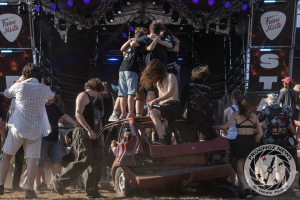
It is an extremely hot and sunny day as the Faine Misto Festival kicks off. By noon, the opening hardcore band Kotar from Sumy has already sparked the festival’s first wall of death on the Underground Stage. Beyond the music, this year’s festival also offers theatre performances, dating events, and a wide range of other activities.
Oleksandr, 43, a quiet and friendly photographer, is among those accredited to cover this year’s festival. He also serves as a junior sergeant in the Armed Forces of Ukraine, where he specializes in reconnaissance using Matrice-type drones. What does it mean to him to be at the festival? “For me, the festival is a chance to forget about the war for a while and take a mental break. It’s peaceful here in the rear, and it feels like a breath of fresh air.” Once a year, he takes all of his annual leave just to make sure he can attend the festival.
Oleksandr, callsign Nazgul, recalls one particularly dangerous mission: “In February 2026, four of my brothers-in-arms and I rescued a wounded pilot near Kostiantynivka. About two kilometres from our position, he stepped on a mine. We rushed out with a stretcher and came under heavy shelling while carrying him back, but we managed to save him. Pilots don’t usually do this kind of thing, but we didn’t hesitate. We put on our body armor and rushed to help him. His name was ‘Jesus’, so when we were interviewed later, they called it ‘the rescue of Jesus.’”
A short walk away, Andrii, Yurii and Yurii are on a familiar mission. For the sixth year in a row, they are serving as the festival’s official food-tasting team, judging dishes from food stalls across the grounds. On Sunday, they select their top three, who are then presented with an award. It is the festival’s opening day, and the event has only been underway for a few hours. By then, they have already sampled food from six stalls, though they have yet to identify a clear favourite.
In their everyday lives, both Yuriis, 50, take on demanding responsibilities far removed from the festival. One of them, wearing a red hat, supports families by helping arrange military funerals. He does this through On the Shield, a Ukrainian organization that repatriates fallen soldiers from the front and helps their families ensure a dignified farewell. For this work, he was personally awarded the Golden Heart, one of Ukraine’s highest civilian honours, by the President of Ukraine.
The other Yurii, sporting a brown beard, serves as a senior sergeant with the 42nd Brigade of the Ukrainian Armed Forces. He is currently on a short rehabilitation leave after three consecutive years on active duty. In civilian life, he works as a wedding master and has officiated over more than 1,000 ceremonies.
Does it feel strange to be here testing food despite their demanding responsibilities during wartime? Andrii answers on behalf of the group: “No. We just keep going.” Asked whether he thinks Ukrainian society will only fully understand the impact of the war once it is over, he pauses before replying: “Yes, maybe.”
Hämatom are one of only three international bands performing at this year’s festival. Just a few days before their performance, Lviv was hit by a devastating missile strike. As a result, the band’s second guitarist, Annika, decided not to travel with the rest of the band. The band’s performance creates absolute chaos in front of the stage, before the song Lichterloh turns the moment into an emotional one. The crowed raises their phones with the lights on and hold each other close.
After the final song, Hämatom guitarist Jacek jumps off the stage and into the crowd, inviting fans to touch his guitar. On the back, the words “FCK PTN” stand out in large neon-green letters. Performing for Ukrainians means a great deal to him: “For the time we are on stage, we want them to forget, even briefly, what awaits them the next day. It may seem like a small thing to us, but I believe it can mean a lot to them.”
He leaves no doubt about his stance, but his clear position has also made him a target of online hate. How does he deal with it? “This criticism never bothered me because, on this issue, there is no grey area for me. There are many topics where people disagree, but when it comes to Ukraine, it is black and white: one country is attacking another, and that is Russia.”
After the performance, it is already dark when Alexa, 23, gets an autograph from the band. She had really wanted to see them. “I expected a great show, and it was powerful and perfect.” The fact that blue-haired Alexa is from Zaporizhzhia and lives under the most difficult wartime conditions is not something you would notice at first glance. “At home, I have seen bombs falling from the sky several times.” Nevertheless, she has no intention of leaving: “It is my home.”
The final festival day begins, and fans are already back on the grounds, including Mykhailo, 31. The punk with a green mohawk moves through the festival like someone who knows, and is known by, almost everyone. He greets people with a smile wherever he goes. It soon becomes clear that there is much more to him as well.
“I joined the Armed Forces of Ukraine in 2022, and I am currently a sergeant. My brigade is defending the Vovchansk direction. I was on leave when I came to the festival. For me, it was a great opportunity to relax, at least for a while, meet new people and old acquaintances, enjoy the atmosphere, and take a break from service.” Later, as so often at this festival, he will be found in the mosh pits or surrounded by friends.
Helle, 34, the singer of the Ukrainian metal band Ignea, is attending the festival as a visitor. She has previously performed at Faine Misto five times with her band. What do festivals and live concerts mean to people in Ukraine during wartime? “All the shows are raising funds for the needs of Ukraine, so it’s not just a pure act of entertainment, as it was in pre-war times. We all live in the present moment, as we don’t know if tomorrow will come. It’s not a romanticization by any means; it’s a harsh truth, as Ukraine is attacked every day. All in all, the shows throw us some rays of light amid the darkness that is covering our current bitter days and give us energy to keep on fighting.”
You will be heading back out on tour in November. What can your international fans look forward to most? “We’re extremely excited to get back on the road, especially with our new album Monumental, scheduled for October 23. In November, we’ll bring these songs live on stage for the very first time, and that’s what makes this tour special. Fingers crossed, we survive until then and see you there.”
Among the festival visitors this year is also Hannes, 38, from Germany. How did he come to travel to the Faine Misto Festival? “In 2023, I visited the festival for the first time. I had wanted to see Lviv for a long time. Some time ago, I discovered the Ukrainian band Ignea. I liked the band so much that I decided to travel to the festival. I thought to myself: ‘This is the right time to go.’ You also hear a lot about the war, and I wanted to see it for myself.”
This year, he is spending time at the campsite with old and new friends as part of the Alkogart campground group, which is part of Faine Chernihiv. How does he like the festival? “Of all the festivals I have ever attended, Faine Misto is the best. There are different genres of music and scenes that bring people together. The interaction between the audience and the performers is also amazing.”
Hannes took two months of unpaid leave. After the festival, he will travel to Chernihiv to volunteer with Repair Together, an organization that rebuilds homes for people whose houses were destroyed by the war. “Ukraine is a country that belongs in the EU. We share similar values, and you immediately feel at home here.”
Tamila, 18, is attending Faine Misto for the first time. A member of the campground group Alkogart, she also sings in the Ukrainian band Able to See. Originally from the Chernihiv region, she dreams of performing at Faine Misto one day. Her younger sister was unable to attend the festival, so although Tamila would have loved to see Hämatom perform, she chose to attend the Ukrainian band Zwyntar’s autograph session instead to get a signed item for her sister. “I don’t think she’ll ever know that I missed Hämatom for her,” she says with a smile.
As the festival draws to a close, the sun is no longer beating down on the campground. In the background, the Ukrainian band Anna is about to take the stage. Then Oleh, 48, a tall man, appears at Hannes and Tamila’s campsite. According to Hannes, Oleh brings 10 litres of a mysterious homemade drink to the festival every year in large plastic bottles. No one seems to know exactly what it is, yet everyone drinks it. Oleh says little. Just before he leaves, he pours everyone a glass. “This is the territory of freedom,” he says with a serious expression. Refusing the drink is not an option. Then he walks away, disappearing into the crowd.
—
Kathrin Beck is Professor of Youth and Social Work in Schools in the Crisis Prevention Team at the Catholic Foundation University in Munich, Germany. She can be contacted at kathrin.beck@ksh-m.de.
93 Views



Most Readings