The Russian Revolutions, 1917 and 1989
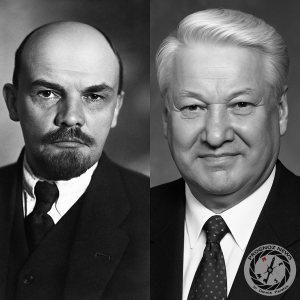
By Matthew Parish, Associate Editor
The Russian revolutions of 1917 and 1989 stand as two turning points that reshaped not only Russia herself but also the international order. Although they occurred seventy-two years apart and in radically different political, social and economic circumstances, each represented a crisis of legitimacy within the Russian state that culminated in the collapse of an established system of rule. Yet their causes, dynamics and outcomes diverged in important ways. A sober comparison illuminates how Russian political culture alternates between explosive rupture and gradual erosion, and how the forces of modernity interact with Russia’s traditions of central authority.
Both revolutions were born of long-running crises that the ruling authorities failed to resolve. In 1917 the Russian Empire had entered the First World War with grave structural weaknesses. Her industrial base was limited, her agrarian reforms incomplete and her political institutions fragile. The war amplified each fault line. Food shortages, inflation, military defeats and the profound discrediting of the monarchy produced a political collapse that swept away Nicholas II and the entire Romanov order. The February Revolution was therefore not a spontaneous outburst but the final stage of a long decay.
By contrast the Soviet Union of 1989 was not embroiled in a catastrophic war, yet she faced an economic and ideological implosion of comparable magnitude. The centrally planned economy had ceased to generate improvements in living standards. Technological stagnation, agricultural underperformance and chronic shortages undermined public faith in the system. The long war in Afghanistan further damaged the regime’s authority. Mikhail Gorbachev’s reforms, intended to revitalise Soviet socialism, instead exposed and accelerated the system’s frailties. Like the Tsarist regime, the Soviet state found herself unable to reform quickly enough to preserve legitimacy.
A second similarity lies in the speed with which both systems unravelled once their legitimacy faltered. In early 1917 the monarchy collapsed within weeks. In 1989 the Soviet Union still appeared outwardly formidable, yet within two years she had ceased to exist. In both cases the collapse was far faster than most contemporaries had imagined possible. The Russian state has often been strong until the moment she is suddenly weak, and both revolutions followed this pattern.
A third common theme is the decisive role of mass political mobilisation. In 1917 workers, soldiers and peasants formed soviets that challenged and ultimately replaced existing institutions. In 1989 mass demonstrations in Moscow, Leningrad, Tbilisi and the Baltic capitals signalled that the public sphere had escaped the control of the Communist Party. In each revolution popular pressure overwhelmed the state’s ability or willingness to repress.
Despite these parallels, the differences between the revolutions are more revealing. The revolution of 1917 was violent, chaotic and ultimately shaped by a determined revolutionary minority that seized the opportunity presented by state collapse. The Bolsheviks promised peace, land and bread to a population exhausted by war and hunger. With the October seizure of power they replaced a faltering democratic experiment with a new authoritarian regime justified by Marxist-Leninist ideology and enforced by civil war. The revolution therefore produced a new state that claimed unlimited control over society.
The upheaval of 1989 was of a different nature. It was essentially peaceful, almost entirely unplanned, and driven not by revolutionary parties but by reformers within the system and national movements on its periphery. Gorbachev sought to preserve the union by loosening control, only to find that glasnost created a public appetite for change that exceeded the Party’s intentions. Instead of extremists rising against moderates, the Soviet collapse reflected moderates losing control of a sclerotic order. The result was not a revolutionary regime but a vacuum that permitted the re-emergence of sovereign republics, most notably the Russian Federation itself.
The international contexts also diverged sharply. The Russia of 1917 was a largely agrarian empire fighting for survival in a world war. Her revolution inspired foreign intervention and contributed to years of devastating conflict. The Soviet Union of 1989 was an industrial superpower locked in a cold conflict with the West. Her collapse occurred in a global environment that favoured negotiated disengagement and produced relatively little violence within Russia’s core territories. In 1917 Russia withdrew from war; in 1989 she withdrew from an empire.
The social foundations of each revolution further distinguish them. In 1917 the peasantry and the conscript army were decisive forces. Russia was overwhelmingly rural, and the demands of land reform drove much of the revolutionary fervour. In 1989 Russia was urban, educated and internationally connected. The forces that challenged the Communist Party were intellectuals, national movements and urban workers frustrated by material shortages rather than agrarian grievances. Each revolution reflected the society from which it emerged.
Finally, the long term consequences differed dramatically. The revolution of 1917 replaced autocracy with a new ideological autocracy and restructured the economy on socialist principles. It imposed a new hierarchy rather than removing one. By contrast the collapse of 1989 dismantled central planning and created a space for a market economy, although the transition was uneven and painful. Politically the post-Soviet transition enabled a form of electoral competition, even if imperfectly realised. While 1917 produced an entirely new regime, 1989 dissolved one without providing a clear successor.
A comparison of these revolutions also highlights enduring features of Russian political culture. Both demonstrate the difficulty Russia has faced in sustaining gradual reform. In each case attempts to modernise from above proved too little or too late. Both show a tendency towards extreme outcomes, where a centralised state either controls society tightly or loses control altogether. Each collapse revealed the weakness of intermediary institutions capable of balancing authority and liberty. The abrupt rise of the Bolsheviks in 1917 and the rapid disintegration of the Soviet Union in 1989 both illustrate this lack of institutional resilience.
Moreover each revolution raised questions about Russia’s relationship with Europe. In 1917 Russia withdrew from the European war and later embraced an ideology opposed to European liberalism. In 1989 Russia re-entered the European political and economic orbit, although the relationship remained uneasy. Both revolutions thus marked turning points in Russia’s long search for a stable identity between East and West.
The Russian revolutions of 1917 and 1989 were moments of profound transformation that reshaped the nation and the wider world. They shared a pattern of long structural decay, rapid collapse and mass mobilisation. Yet they differed fundamentally in their causes, their violence, their ideological character and their consequences. The former created a new authoritarian system; the latter dissolved an old one. Together they illustrate the cyclical nature of Russian political change and the persistent challenge faced by any Russian state attempting to reform without losing control. These revolutions were separated by time and circumstance, but each was a mirror reflecting Russia’s enduring struggle to reconcile authority with modernity.
405 Views



Most Readings