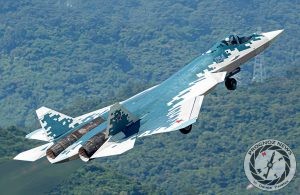
The Su-57 Felon
By Matthew Parish, Associate Editor
The Sukhoi Su-57, known in NATO terminology as the ‘Felon’, represents Russia’s most ambitious attempt to bridge the technological gap between her legacy fourth-generation fighters and the stealth-dominated air superiority aircraft of the West. Conceived in the 2000s as part of the PAK FA (Perspektivnyy Aviatsionnyy Kompleks Frontovoy Aviatsii) programme, the Su-57 was intended to replace ageing MiG-29 and Su-27 fleets and restore Russia’s credibility as a designer of world-class fighter aircraft. Yet its development has been long, costly and troubled, revealing much about the limitations of Russia’s industrial and scientific base after the collapse of the Soviet Union.
Origins and Design Philosophy
The Su-57 was first envisioned in the aftermath of the Soviet Union’s dissolution, when Moscow recognised that its 1980s aircraft—though highly manoeuvrable—were becoming obsolete against the United States’ F-22 Raptor and, later, the F-35 Lightning II. The PAK FA project, led by the Sukhoi design bureau, aimed to produce a multi-role stealth fighter with supercruise capability, high manoeuvrability, advanced sensors and the capacity to deploy a range of air-to-air and air-to-surface weapons from internal bays to reduce radar signature.
The aircraft made its maiden flight in January 2010. Its design combines stealth shaping with aerodynamic agility: a blended wing-body form, all-moving tailplanes, and thrust-vectoring nozzles. Russian designers sought to preserve the dogfighting superiority of the Su-27 family while introducing stealth features inspired by Western models. Yet the Felon’s radar cross-section remains significantly larger than that of the F-22 or F-35, partly due to manufacturing tolerances, composite material limitations, and the exposed nature of its engine nozzles.
Avionics and Armament
The Su-57’s avionics suite includes the N036 Byelka radar, a multi-band active electronically scanned array (AESA) system operating across several frequencies, and an array of infrared and optical sensors designed to provide 360-degree situational awareness. The aircraft can reportedly share targeting data between formations, reflecting an aspiration to mimic Western network-centric combat systems.
Armament includes the R-77 and R-74 air-to-air missiles, the Kh-59MK2 standoff cruise missile, and precision-guided munitions carried internally or externally depending on mission profile. It also retains a 30-mm GSh-30-1 cannon, a traditional feature of Russian fighters. A notable development goal has been the integration of hypersonic or near-hypersonic missiles such as the Kh-47M2 Kinzhal derivative for strike missions, underscoring Russia’s preference for dual-role aircraft capable of both air superiority and deep strike operations.
Propulsion Challenges
One of the most persistent difficulties in the Su-57 programme lies in propulsion. The early prototypes and production models have used the AL-41F1 engine, a derivative of the Su-35’s powerplant, which fails to deliver true fifth-generation performance. The intended next-generation ‘Izdeliye 30’ engine promises greater thrust, efficiency and stealth, but its development has suffered repeated delays. As of 2025, only limited numbers of these engines are undergoing testing, meaning that most operational aircraft remain transitional in capability.
Production and Deployment
Despite grand ambitions, serial production has been modest. Only around twenty to thirty aircraft have reportedly been delivered to the Russian Aerospace Forces, far short of initial targets. Sanctions, limited funding, and industrial bottlenecks—especially in high-precision composite manufacturing and avionics—have constrained output.
Operationally, the Su-57 has been deployed on limited missions over Ukraine since 2022, where Russia has claimed it performed long-range missile strikes without entering Ukrainian-controlled airspace. Western intelligence suggests that the aircraft has been used cautiously, possibly from deep within Russian territory, to avoid exposure to modern air defences such as the Patriot and IRIS-T systems. This reticence reflects both the small fleet size and concerns that any combat loss would damage the aircraft’s reputation.
Export Ambitions and Strategic Symbolism
Moscow has attempted to market the Su-57 abroad—to India, the United Arab Emirates, and Algeria—but without confirmed foreign orders. India’s withdrawal from the joint FGFA (Fifth Generation Fighter Aircraft) project in 2018 highlighted doubts about cost, reliability and radar cross-section performance. The Su-57’s export potential is further limited by Western sanctions restricting access to key electronic components.
Nevertheless the aircraft carries immense symbolic value. To the Kremlin, it demonstrates that Russia remains a major military power capable of designing advanced aviation systems despite international isolation. The Felon has thus become a flagship of Russian technological nationalism, used in state propaganda to project confidence and self-reliance.
Assessment and Strategic Implications
In comparative terms, the Su-57 falls short of its Western analogues. Its stealth characteristics are inferior, production numbers minimal, and integrated sensor fusion still lagging behind that of the F-35. However it represents an evolutionary step in Russian aerospace design philosophy—blending traditional emphasis on agility and weapons capacity with an attempt at stealth and digitalisation.
Strategically, the Felon serves as a testbed for technologies that may mature in future designs, such as the projected Su-75 ‘Checkmate’. It also underpins Russia’s doctrine of combining stand-off missile warfare with limited use of high-performance aircraft to penetrate defended airspace.
The Su-57 Felon embodies both the ambitions and the constraints of modern Russia. It seeks to reclaim the aeronautical prestige of the Soviet era, yet it reveals the structural weaknesses of Russia’s defence industry and economy. The aircraft’s limited deployment underscores a reality: while she can design complex systems, sustaining mass production and integrating cutting-edge electronics in wartime conditions remain formidable challenges. The Su-57 may therefore be less a weapon of air dominance than a symbol of persistence—a sleek manifestation of a nation striving to maintain great power status in the skies, even as her technological reach struggles to match her aspirations.
455 Views



Most Readings