The Price of War: Why Fuel Is Becoming More Expensive in Russia
By Matthew Parish, Associate Editor
Saturday 18 July 2026
For much of the post-Soviet period Russia enjoyed one apparent economic advantage that its citizens often took for granted: abundant, inexpensive fuel. As one of the world’s largest producers of crude oil, refined petroleum products and natural gas, Russia appeared insulated from the price shocks that periodically afflicted energy-importing nations. Today that assumption has been profoundly undermined. Across much of the Russian Federation, motorists, farmers and transport companies are confronting sharply rising prices for gasoline and diesel, while in some regions shortages have become as significant a concern as price itself. The consequences extend well beyond the forecourt, reaching into inflation, agriculture, industrial production and ultimately the Kremlin’s ability to sustain an increasingly expensive war.
The immediate causes are not difficult to identify. Since 2024, and with increasing intensity throughout 2025 and 2026, Ukraine has systematically targeted Russian oil refineries, fuel depots, storage facilities and associated logistics networks. The strategy has evolved from symbolic strikes into a sustained campaign against one of Russia’s most economically important sectors. By mid-2026 virtually every major refinery in European Russia had experienced some form of attack or operational disruption, forcing shutdowns, repairs or reduced production.
This matters because producing crude oil and producing usable fuel are very different activities. Russia continues to pump substantial quantities of crude from Siberian fields, but crude oil cannot power tractors, military vehicles or passenger cars without being refined into gasoline, diesel and aviation fuel. Refining capacity is therefore a strategic vulnerability.
A country may possess immense hydrocarbon reserves while simultaneously suffering shortages of refined products if enough refineries become damaged or inoperable.
The disruption has been compounded by sanctions. Although Western sanctions were principally designed to reduce Russia’s export revenues rather than eliminate production altogether, they have complicated access to specialist refining equipment, replacement components, advanced industrial electronics and engineering expertise. Repairs that might once have taken weeks increasingly require months. Alternative suppliers can sometimes be found through third countries, but often at greater expense and with significant delays.
Logistics have become another weakness. Fuel must travel from refineries to regional distribution centres by rail, pipeline, road tanker and coastal shipping. Ukrainian attacks have increasingly targeted storage depots, railway infrastructure, ports and tankers, meaning that even where fuel is produced it cannot always be delivered efficiently to consumers. The resulting regional imbalances have produced a patchwork economy in which some parts of Russia experience moderate price increases while others confront shortages and rationing.
The Russian government’s response illustrates the difficult choices now confronting policymakers. Moscow has repeatedly restricted or prohibited exports of gasoline and diesel in an effort to preserve domestic supplies. While such measures may temporarily increase availability within Russia, they simultaneously reduce export earnings and undermine Russia’s reputation as a reliable supplier on international markets. Recent diesel export restrictions were introduced precisely because domestic shortages had become politically sensitive.
These developments expose an irony at the heart of Russia’s wartime economy. Oil exports remain one of the Kremlin’s principal sources of foreign currency. Yet preserving export revenues requires functioning refineries, secure transport infrastructure and confidence among overseas customers. Every refinery disabled by a drone strike not only reduces domestic fuel availability but also weakens Russia’s capacity to earn hard currency from refined petroleum products.
Higher domestic fuel prices feed rapidly into the wider economy. Diesel occupies a uniquely important position because it powers freight transport, agricultural machinery, construction equipment and much of Russia’s heavy industry. Rising diesel prices therefore increase the cost of moving virtually every product across the world’s largest country. Food becomes more expensive to harvest and distribute. Construction projects become costlier.
Manufacturers pay more both for transporting raw materials and shipping finished goods. Inflation consequently spreads well beyond the energy sector itself.
Agriculture is particularly vulnerable. Russia’s grain harvest depends upon enormous fleets of diesel-powered combines operating across vast distances during relatively short harvesting windows. If diesel prices increase substantially or fuel becomes difficult to obtain, harvesting costs rise sharply and operational delays become more likely. In an economy already experiencing labour shortages because of military mobilisation and demographic decline, additional disruptions to agriculture carry considerable economic and political significance.
Industry faces similar pressures. Russia’s manufacturing base has increasingly shifted towards supporting wartime production, requiring reliable supplies of transport fuel for factories, railways and military logistics. Civilian consumers inevitably compete with defence priorities. The Russian state can allocate fuel preferentially to the armed forces, but doing so simply transfers shortages onto the civilian economy, increasing dissatisfaction among businesses and households.
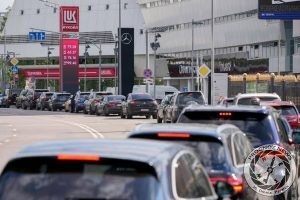
The political implications should not be underestimated. Rising fuel prices affect ordinary citizens far more visibly than fluctuations in international bond markets or changes in central bank reserves. Every visit to a petrol station reminds motorists that the economic costs of war are becoming increasingly difficult to conceal. While state-controlled media can minimise reports of sanctions or battlefield reverses, consumers cannot ignore steadily increasing prices displayed on filling station forecourts.
Nor are these pressures likely to disappear quickly. Repairing damaged refineries requires capital, specialised equipment and time. Continued Ukrainian strikes increase uncertainty, discouraging investment while forcing operators to divert resources towards physical protection and emergency repairs rather than productive expansion. Even if military operations were to diminish tomorrow, restoring the refining system to pre-war reliability would probably take years rather than months.
Russia remains one of the world’s great energy powers. Her oil reserves have not disappeared, nor has its ability to extract crude from the ground. Yet modern energy security depends not merely upon possessing resources but upon maintaining the sophisticated industrial, logistical and financial systems necessary to convert those resources into usable products. The war has demonstrated that these downstream systems are considerably more fragile than many observers once believed.
The rise in Russian gasoline and diesel prices therefore represents far more than an episode of temporary inflation. It is evidence of a deeper structural vulnerability created by the interaction of sanctions, military pressure, disrupted logistics and the enormous economic demands of prolonged war. Fuel, once amongst Russia’s greatest comparative advantages, has become an increasingly expensive reminder that even resource-rich states cannot indefinitely escape the economic consequences of sustained conflict.
53 Views



Most Readings