The Human Person in the Age of Artificial Intelligence: Reflections on Pope Leo XIV’s First Encyclical
By Matthew Parish, Associate Editor
Saturday 30 May 2026
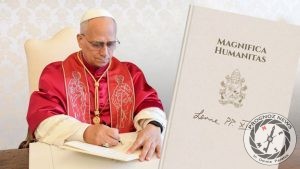
Pope Leo XIV has chosen an unusual subject for the first encyclical of his pontificate. Whereas many expected a document focused upon ecclesiastical matters, international peace or the condition of the poor, he instead turned his attention to artificial intelligence. In doing so he has recognised a reality that many political leaders, business executives and even technology developers have been reluctant to confront. Artificial intelligence is not merely another technological innovation. It is rapidly becoming a force capable of reshaping economies, social relationships, warfare, education, governance and even humanity’s understanding of itself.
The encyclical, entitled Magnifica Humanitas (“Magnificent Humanity”), consciously invokes the tradition of Pope Leo XIII’s Rerum Novarum of 1891. That earlier document addressed the social upheavals created by the Industrial Revolution. Factories, mechanisation and industrial capitalism had transformed society faster than political and moral institutions could adapt. Workers found themselves vulnerable to exploitation, whilst traditional social structures struggled to survive. Pope Leo XIII sought to articulate principles by which technological and economic progress could be reconciled with human dignity. Pope Leo XIV appears to believe that artificial intelligence represents a similarly transformative moment in history.
The comparison is illuminating. During the nineteenth century, machines increasingly replaced physical labour. During the twenty-first century, machines threaten to replace intellectual labour. The first Industrial Revolution challenged humanity’s relationship with work; the artificial intelligence revolution challenges humanity’s relationship with thought itself.
One of the most striking aspects of Pope Leo’s analysis is that he does not reject artificial intelligence. He does not present himself as a modern Luddite calling for the destruction of machines. Indeed such a position would be absurd. Artificial intelligence already assists physicians in diagnosing diseases, enables scientific discoveries, improves logistics and offers countless other practical benefits. Rather the Pope insists upon a distinction between technology as a tool and technology as a master. Artificial intelligence may serve humanity, but it must never govern humanity.
This distinction may prove to be one of the most important intellectual contributions of the encyclical. Contemporary discussions of artificial intelligence often oscillate between utopian enthusiasm and apocalyptic pessimism. Technology enthusiasts promise a future of abundance, immortality and limitless prosperity. Critics warn of mass unemployment, surveillance states and autonomous weapons. Pope Leo rejects both extremes. Instead he asks a more fundamental question: what sort of human beings do we wish to become?
The question is profoundly philosophical. Artificial intelligence systems can increasingly perform tasks that resemble human reasoning. They write essays, generate images, translate languages and answer questions. Yet the Pope insists that imitation is not identity. A machine may reproduce patterns of human communication without possessing consciousness, moral responsibility or spiritual understanding. Intelligence, in the Christian tradition, is not merely computation. It is inseparable from wisdom, judgement, empathy and moral choice.
In this respect, Pope Leo enters a debate that extends far beyond theology. The public discussion surrounding artificial intelligence frequently conflates performance with understanding. Because a machine can produce convincing text, some assume it must understand the text. Because a machine can simulate emotion, some conclude it possesses emotions. Yet these assumptions are far from self-evident. The encyclical argues that humanity risks diminishing itself by redefining intelligence according to the capabilities of machines rather than understanding machines according to the richness of human intelligence.
The Pope is particularly concerned about labour. Here the echoes of Rerum Novarum are unmistakable. Artificial intelligence promises extraordinary increases in productivity. Businesses naturally seek efficiency and profit. Yet if productivity gains are achieved through the displacement of millions of workers, then society may face a crisis more severe than any witnessed during previous technological transitions. The industrial worker displaced by a machine could often retrain for another physical occupation. The accountant, lawyer, journalist, translator or software engineer displaced by artificial intelligence may discover that the very skills acquired through years of education have become economically redundant.
This concern extends beyond economics. Work is not merely a means of obtaining income. It provides purpose, structure, identity and social connection. A society in which large numbers of people are permanently excluded from meaningful work may become economically sustainable through redistribution, yet socially unstable and spiritually impoverished. The Pope therefore argues that economic efficiency cannot become the sole criterion by which technological progress is judged. Human dignity remains paramount.
Perhaps even more provocative is Pope Leo’s discussion of power. Throughout history, technological revolutions have tended to concentrate power before they distribute benefits. Railways, telegraphs, electricity and the internet all created new centres of economic and political influence. Artificial intelligence appears likely to accelerate this tendency. The development of advanced models requires immense computational resources, vast quantities of data and enormous financial investment. Consequently, control increasingly resides within a small number of corporations and governments. The Pope warns that such concentration of power risks creating new forms of domination and even what he describes as a kind of digital colonialism.
This observation deserves serious attention. Much contemporary debate focuses upon what artificial intelligence can do. Less attention is devoted to who controls it. The question of ownership may ultimately prove more important than the question of capability. If intelligence itself becomes a commodity controlled by a handful of institutions, then political and economic inequalities may become entrenched on an unprecedented scale.
The encyclical also addresses warfare, a subject of particular relevance in contemporary Europe. Pope Leo argues that human beings must remain responsible for decisions involving life and death. The delegation of lethal decisions to autonomous systems threatens to erode moral accountability. Wars are already characterised by distance and abstraction. Artificial intelligence risks increasing that distance further, making the exercise of violence appear increasingly detached from human responsibility.
For readers in Ukraine, this aspect of the encyclical raises difficult questions. Artificial intelligence undoubtedly offers defensive advantages. It improves intelligence analysis, assists battlefield awareness and enhances precision. Yet the Pope’s warning remains relevant. The more warfare becomes automated, the greater the danger that human judgment may be displaced by algorithmic calculation. Technology can assist moral decisions, but it cannot replace moral responsibility.
At its deepest level, however, Pope Leo’s encyclical is neither economic nor political. It is anthropological. It concerns what it means to be human. The document challenges ideologies that regard humanity as an imperfect machine awaiting technological improvement. It rejects the notion that salvation can be achieved through engineering alone. Human limitations are not merely defects to be eliminated. They are part of the conditions that make freedom, morality, love and spiritual growth possible.
This may be the most controversial aspect of the Pope’s argument in an age fascinated by transhumanism and technological enhancement. Many contemporary thinkers envision a future in which artificial intelligence enables humanity to transcend biological constraints altogether. Pope Leo responds that the pursuit of limitless power without corresponding moral development risks producing not liberation but dehumanisation. The fundamental challenge is not whether machines can become more like humans. It is whether humans can remain human in a world increasingly shaped by machines.
Whether one accepts the theological premises of the encyclical is ultimately secondary. What matters is that Pope Leo has identified the central question of the artificial intelligence age. The challenge is not technological. It is moral and philosophical. Artificial intelligence forces humanity to reconsider the nature of work, authority, responsibility, knowledge and even consciousness itself.
The significance of Magnifica Humanitas therefore extends far beyond the Catholic Church. Like Rerum Novarum before it, it may come to be seen as an attempt to provide moral guidance during a period of profound technological upheaval. The industrial revolution transformed the world of labour. Artificial intelligence may transform the world of thought. Pope Leo’s message is that humanity must ensure that, amidst this transformation, it does not lose sight of the one thing that technology can never create for itself: the inherent dignity of the human person.
147 Views


Most Readings