The Panama Canal, Sovereignty and the Limits of Chinese Commercial Power
By Matthew Parish, Associate Editor
Tuesday 10 February 2026
Panama’s Supreme Court has delivered a decision on 29 January 2026 of considerable geopolitical weight, rejecting claims advanced by Hong Kong– and mainland Chinese–linked entities over port operations associated with the Panama Canal. Although framed as a matter of domestic constitutional law and administrative competence, the ruling resonates far beyond Panama City. It sits at the intersection of global trade, strategic infrastructure, Chinese overseas commercial expansion and the renewed willingness of smaller states to assert sovereign control over assets of world importance.
The Panama Canal is not merely a shipping route. She is one of the principal arteries of global commerce, carrying roughly five per cent of world maritime trade and forming a vital link between the Atlantic and Pacific oceans. Control over infrastructure adjacent to the Canal has therefore always been politically sensitive. Since the full transfer of the Canal from the United States to Panama in 1999, successive Panamanian governments have been acutely conscious that sovereignty over the waterway must be seen to be both real and enforceable, not diluted by opaque concessions or foreign political pressure.
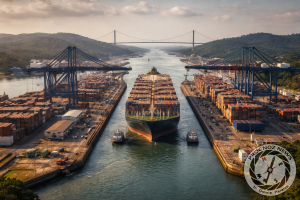
At the centre of the dispute are long-standing port concessions held by subsidiaries associated with Hong Kong business interests, most prominently those historically linked to Hutchison. These concessions, granted in the 1990s, allow the operation of container terminals at both the Atlantic and Pacific entrances to the Canal. While the companies involved have consistently argued that these are purely commercial arrangements, critics within Panama have long contended that the scale, duration and strategic location of the concessions raise constitutional questions, particularly where the operators are closely connected to a foreign power whose geopolitical ambitions increasingly intersect with maritime infrastructure.
The Supreme Court of Panama rejected arguments that these port rights enjoy any special protection under international law or bilateral investment treaties that would override Panamanian constitutional principles. In doing so the Court affirmed that strategic infrastructure connected to the Canal falls within a special category of national interest, subject to heightened scrutiny and ultimate control by the Panamanian state. The judgment emphasised that sovereignty is not extinguished by commercial concession, however longstanding or financially significant that concession may be.
Although the court avoided explicit reference to the People’s Republic of China, the political context is unmistakable. Over the past decade, Beijing has pursued a global strategy of acquiring or influencing ports, logistics hubs and transport corridors, often through ostensibly private or semi-private firms. This strategy has been formalised under the Belt and Road Initiative, but it also operates through legacy investments made before the policy acquired its current branding. Hong Kong–based conglomerates have been particularly prominent in this regard, occupying an ambiguous position between private capital and state influence.
Panama’s ruling therefore reflects a broader international reassessment of Chinese-linked control over critical infrastructure. Similar debates have unfolded in Europe, Australia and parts of Africa, where governments have begun to question whether commercial efficiency alone is an adequate criterion when infrastructure has clear military, intelligence or diplomatic significance. Ports, in particular, occupy a dual-use space: they are engines of economic growth, but also potential nodes of strategic leverage.
For Panama the stakes are unusually high. The Canal is not simply an economic asset but the foundation of the state’s international identity and fiscal stability. Any perception that control over its gateways could be indirectly exercised by a foreign power risks undermining domestic legitimacy and inviting external pressure. By asserting judicial oversight over port concessions, the Supreme Court has signalled that Panama will not treat the Canal’s surrounding infrastructure as politically neutral real estate.
The decision also carries implications for relations between Panama and China. Since switching diplomatic recognition from Taiwan to Beijing in 2017, Panama has attracted substantial Chinese investment and political attention. The court’s ruling does not reverse that policy shift, but it does impose clear limits. Commercial engagement is welcome, the judgment implies, but it must operate within constitutional boundaries defined by Panamanian law rather than by the strategic preferences of external actors.
From a wider perspective, the case illustrates the re-emergence of courts as arenas in which geopolitical contestation is expressed in legal form. Rather than dramatic expropriations or diplomatic ruptures, states are increasingly using constitutional law, regulatory review and judicial process to rebalance relationships with powerful investors. This approach carries less immediate economic shock, but it nonetheless reshapes the strategic environment over time.
Panama’s Supreme Court has not expelled foreign operators from the Canal’s ports overnight, nor has it declared Chinese investment unwelcome. What it has done is more subtle and, in the long run, more consequential: it has reaffirmed that the Canal, and the infrastructure that sustains her, ultimately answer to Panamanian sovereignty alone. In an era in which global commerce and great power competition are increasingly entwined, that assertion may prove to be a model other strategically situated states are tempted to follow.
246 Views



Most Readings