Why does Donald Trump keep firing his Cabinet members?
By Matthew Parish, Associate Editor
Friday 3 April 2026
The recurrent dismissal of cabinet officials has been a defining characteristic of the political style of Donald Trump — a style that sits uneasily within the institutional traditions of the American executive, yet follows an internal logic that is both coherent and, in its own way, deliberate. The recent turbulence surrounding figures such as Kristi Noem and Pam Bondi illustrates not merely a pattern of personnel instability, but a broader philosophy of governance rooted in loyalty, media dynamics and the centralisation of authority.
At first glance the repeated removal or sidelining of senior officials appears chaotic — even self-defeating. Cabinet ministers, after all, are meant to provide continuity, expertise and administrative competence. Their abrupt departure risks disrupting policy implementation and undermining confidence both domestically and internationally. Yet to interpret these dismissals solely as dysfunction is to misunderstand the political system in which they occur.
Trump’s approach to cabinet management is less that of a traditional head of government and more akin to a chief executive officer operating within a volatile corporate environment. In this model senior officials are not long-term stewards of institutional memory but rather contingent actors whose tenure depends upon their perceived utility to the leader’s immediate objectives. Loyalty above all becomes the principal currency.
This emphasis on loyalty is not merely personal, although it certainly has that dimension. It is also strategic. Trump has long exhibited a deep scepticism towards what he perceives as the entrenched bureaucracy of Washington — the so-called ‘deep state’. Cabinet ministers, even those initially aligned with his agenda, risk becoming absorbed into this institutional culture. Their independence, or even the appearance of it, may be interpreted as disloyalty. In such a framework, dismissal is not an aberration but a corrective measure — a reassertion of control.
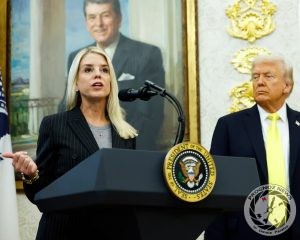
The cases of Noem and Bondi are instructive in this regard. Both figures have been closely associated with Trump’s political orbit, yet their positions have at times appeared precarious. Noem, a prominent Republican governor with national ambitions of her own, embodies a potential rival as much as an ally. Her public profile, cultivated through assertive policy positions and media visibility, creates a delicate balance: she is valuable insofar as she amplifies Trump’s message, but potentially threatening if she appears to operate independently of it.
Bondi, by contrast, represents a different archetype — that of the legal and political loyalist. Her role in defending Trump as Attorney General of the United States during moments of legal and political jeopardy has been significant. Yet even such loyalty does not guarantee permanence. In Trump’s political universe loyalty must be continually demonstrated, not merely historically established. A perceived lapse — whether substantive or symbolic — may be sufficient to prompt peremptory removal.
This leads to a second, equally important dimension of Trump’s cabinet reshuffles: their function as instruments of media management. Trump’s political career has been inseparable from the logic of continuous media attention. The dismissal of a high-profile official generates immediate headlines, reshapes the news cycle and reinforces the central narrative of a leader in constant motion. Stability in this context is less valuable than dynamism.
Each firing becomes a spectacle — a reaffirmation of executive authority performed before a national audience. It signals decisiveness, even ruthlessness, qualities that resonate with a segment of the electorate that values strength over procedural continuity. The cabinet therefore is not merely an administrative body but a stage upon which political theatre is enacted.
There is however a deeper structural implication to this pattern. Frequent dismissals inhibit the development of autonomous centres of power within the executive branch. Cabinet ministers who might otherwise accumulate influence — through expertise, networks or bureaucratic control — are kept in a state of perpetual insecurity. Their authority derives entirely from the president and can be withdrawn at any moment.
This centralisation of power has both advantages and risks. On the one hand it enables rapid decision-making and reduces the likelihood of internal dissent obstructing the president’s agenda. However it diminishes the capacity of the administration to formulate and implement coherent long-term policies. Institutional knowledge is lost, policy consistency suffers and governance becomes increasingly personalised.
In the context of figures like Noem and Bondi one observes a tension between personal loyalty and political ambition. Both women possess credentials that extend beyond their association with Trump — credentials that may, at times, place them at odds with the expectation of absolute subordination. Their trajectories highlight the inherent instability of a system in which proximity to power is both a source of opportunity and a potential liability.
The persistent firing of cabinet ministers reflects a broader transformation in the nature of executive governance under the Trump administrations. It is a shift away from institutional stability towards a more fluid, personality-driven model — one in which authority is concentrated, relationships are transactional and continuity is subordinated to control.
Whether this model is sustainable remains an open question. It undoubtedly allows for a high degree of responsiveness and adaptability, yet it also risks eroding the very structures that enable effective governance. In the short term it may reinforce the image of a decisive leader. In the long term it may leave behind an executive apparatus weakened by constant upheaval.
For Trump however such considerations may be secondary. The logic of his political style is immediate, performative and centred upon the preservation of personal authority. In that sense, the revolving door of cabinet ministers is not a problem to be solved but a feature to be maintained — an integral component of a presidency defined less by stability than by perpetual motion. That is what makes him so dangerous.
214 Views



Most Readings

Crimea Under Pressure: Ukraine’s Long Campaign Against Russia’s Southern Bastion
99 Views