Arab Reluctance and the Limits of American Diplomacy: Why the Abraham Accords Have Stalled
By Matthew Parish, Associate Editor
Sunday 31 May 2026
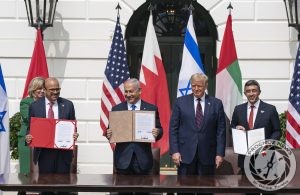
The Abraham Accords, signed in 2020, were presented in Washington as a historic transformation of Middle Eastern politics. The agreements normalised relations between Israel and several Arab states, principally the United Arab Emirates, Bahrain, Morocco and Sudan. American policymakers hoped that the accords would create a new regional architecture in which Arab governments would gradually abandon the traditional linkage between normalisation with Israel and the establishment of a Palestinian state. In Washington’s view, economic cooperation, technological partnerships and shared concerns about Iran would eventually outweigh the unresolved Palestinian question.
Six years later, however, the project appears to have reached a plateau. Despite repeated requests from successive American administrations, major Arab states have shown little enthusiasm for joining the accords. Most notably Saudi Arabia, whose participation would transform the strategic significance of the initiative, has declined to proceed. The question is not merely why Arab governments remain hesitant. The deeper question is why they appear increasingly unconvinced by American arguments.
The answer lies in a combination of changing regional realities, declining confidence in American leadership and the political impossibility of ignoring Palestinian suffering.
For decades, American diplomacy in the Middle East rested upon an assumption of overwhelming American influence. Arab governments often disagreed with Washington, but they generally accepted that the United States possessed sufficient military, economic and political power to shape regional outcomes. Today that assumption is increasingly questioned.
The chaotic American withdrawal from Afghanistan in 2021 sent shockwaves throughout the region. Many Arab leaders interpreted the episode as evidence that the United States was no longer prepared to sustain long-term strategic commitments. The lesson drawn in Gulf capitals was not necessarily that America was weak, but that she had become unpredictable.
This perception has been reinforced by shifting American priorities. Successive administrations have emphasised competition with China and concerns about the war in Ukraine. Arab leaders increasingly believe that the Middle East occupies a lower place in Washington’s hierarchy of interests than it once did. If the United States appears less invested in the region’s future, then American promises inevitably carry less weight.
Arab governments have also acquired greater strategic confidence. The oil-rich monarchies of the Gulf are no longer dependent upon American protection to the same extent as during the late twentieth century. They have diversified their diplomatic relationships, cultivating ties with China, Russia, India and numerous other powers.
This diversification has altered the diplomatic balance. During the Cold War and the decades that followed, American requests often carried an implicit message that alternatives were limited. Today alternatives abound. When Washington urges participation in the Abraham Accords, Arab leaders know they possess other economic partners, other security relationships and other diplomatic options.
Perhaps the most significant obstacle, however, is the Palestinian issue itself.
American policymakers have often underestimated the depth of Palestinian identification within Arab societies. Even where governments have become more pragmatic towards Israel, public opinion remains deeply attached to the Palestinian cause. The events following the Hamas attacks of 7 October 2023 and the subsequent war in Gaza intensified these sentiments dramatically.
Across the Arab world, images of destruction in Gaza have had profound political consequences. Governments may not be democracies in the Western sense, but they cannot entirely ignore public sentiment. Arab rulers understand that normalisation with Israel during a period of intense Palestinian suffering would be politically dangerous.
This is particularly true for Saudi Arabia. The kingdom is not merely another Arab state. She is the custodian of Islam’s holiest sites and occupies a unique position within the Muslim world. Any decision to establish full diplomatic relations with Israel would be scrutinised not only by Saudi citizens but by Muslims across the globe.
Consequently Saudi leaders have repeatedly returned to a familiar condition: meaningful progress towards Palestinian statehood. This position reflects not merely diplomatic bargaining but political necessity. Without visible concessions to the Palestinians, normalisation would risk appearing as abandonment.
Another reason Arab states are not taking American requests seriously is that Washington’s own policy often appears internally contradictory.
American officials continue to support a two-state solution in principle. Yet many Arab observers see little evidence that the United States is willing or able to pressure Israel towards meaningful concessions. If Washington cannot deliver progress on Palestinian statehood, then her appeals for normalisation lose credibility.
From an Arab perspective, the American argument increasingly resembles a request for unilateral concessions. Arab governments are asked to recognise Israel, expand cooperation and reshape regional diplomacy, while receiving few assurances that Palestinian aspirations will be addressed.
Diplomacy depends upon reciprocity. When one side appears unable to fulfil its own promises, confidence erodes.
There is also an emerging generational shift in regional politics. Younger Arab leaders tend to be less ideologically hostile towards Israel than previous generations. They are often interested in technology, investment, artificial intelligence, infrastructure and economic development. In principle, these priorities should favour the Abraham Accords.
Yet the same younger leaders are also intensely pragmatic. They judge proposals according to tangible benefits rather than ideological alignment with Washington. They ask what precisely normalisation would achieve for their countries. If the answer appears uncertain, they see little reason to incur political costs.
Meanwhile the strategic rationale centred upon Iran has become less compelling than American planners anticipated. Although concerns about Iranian influence remain substantial, several Gulf states have sought direct dialogue with Iranrather than relying exclusively upon confrontation. The Chinese-mediated rapprochement between Saudi Arabia and Iran demonstrated that regional actors increasingly prefer diplomatic flexibility over rigid alliance structures.
This development further weakens Washington’s argument. If Iran can be managed through diplomacy as well as deterrence, then the urgency of joining an anti-Iranian regional bloc diminishes.
Ultimately the difficulty facing the Abraham Accords is not that Arab governments reject cooperation with Israel. Many already cooperate quietly in areas such as security, intelligence and trade. The problem is that Washington has misjudged the political environment in which formal normalisation must occur.
American policymakers often view Middle Eastern politics through a strategic lens. Arab leaders must also consider legitimacy, public opinion, religious symbolism and regional prestige. The Palestinian issue cannot simply be bypassed because it remains deeply embedded in Arab political consciousness.
The result is that Arab states increasingly regard American requests to join the Abraham Accords as detached from political reality. Washington continues to speak as though normalisation is merely a matter of diplomatic persuasion. Arab governments see it differently. They believe that no durable regional order can emerge while the Palestinian question remains unresolved.
Until the United States demonstrates either the willingness or the ability to address that fundamental issue, her appeals for wider participation in the Abraham Accords are likely to encounter polite interest, private scepticism and public hesitation. The accords may survive and even expand incrementally. Yet the grand vision of a comprehensive Arab-Israeli realignment appears increasingly distant.
In diplomacy, as in politics generally, credibility is often more important than power. The central challenge facing American policy today is not persuading Arab states that normalisation could be beneficial. It is persuading them that Washington possesses both the influence and the determination to shape the conditions under which such normalisation can succeed.
148 Views



Most Readings