The Gripen Question: Will Swedish Fighters Change the Balance of the War in Ukraine?
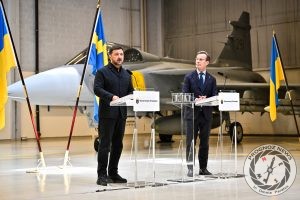
By Matthew Parish, Associate Editor
Tuesday 2 June 2026
The prospect of Sweden supplying Saab Gripen fighter aircraft to Ukraine has long occupied a curious place in discussions of military aid. Unlike the American-made F-16, whose transfer has already begun and whose integration into the Ukrainian Air Force is underway, the Swedish Gripen has remained a possibility rather than a reality. But that may change with a deal to provide the Swedish fighter to Ukraine Just days ago. Many military analysts regard it as one of the most suitable combat aircraft available for Ukraine’s unique operational environment. The question is whether the arrival of Gripens will materially alter the balance of forces in Russia’s invasion of Ukraine.
If we ask whether a squadron or two of Gripens would suddenly enable Ukraine to achieve air superiority over the battlefield, the answer is almost certainly no. If however the question is whether Gripens could significantly improve Ukraine’s ability to contest Russian air operations, protect her territory and strike military targets with greater efficiency, then the answer is much more nuanced.
The first point to understand is that modern warfare is not determined solely by the quality of individual aircraft. Russia and Ukraine are engaged in a conflict characterised by layered air defence systems, electronic warfare, drones, long-range missiles and dispersed ground operations. Neither side possesses complete control of the skies. The war has demonstrated that aircraft, even sophisticated ones, must operate within an environment saturated with anti-aircraft missiles.
Russia entered the war with one of the world’s largest air forces. On paper, she possessed overwhelming superiority over Ukraine in terms of aircraft numbers, pilot availability and logistical infrastructure. Yet Russian aviation has often failed to achieve the decisive battlefield effects many observers expected in February 2022. Ukrainian air defences, combined with Russian institutional weaknesses and operational caution, have prevented Moscow from establishing uncontested dominance over Ukrainian airspace.
Consequently the air war has evolved into a struggle fought largely from standoff distances. Aircraft frequently launch weapons without venturing deeply into hostile airspace. Drones increasingly perform missions once reserved for conventional fighter aircraft. Ground-based air defence systems remain the principal determinant of air operations.
Against this background, the Gripen offers several notable advantages.
The Swedish aircraft was designed during the Cold War specifically for a nation expecting to face a numerically superior adversary. Sweden assumed that Soviet missile strikes would rapidly destroy major air bases. Consequently the Gripen was engineered to operate from dispersed locations including stretches of highway. Ground crews could refuel and rearm the aircraft quickly using relatively small teams. These characteristics align remarkably well with Ukraine’s wartime requirements.
Ukraine faces constant Russian missile and drone attacks against military infrastructure. Any combat aircraft capable of operating from improvised locations rather than large fixed airfields possesses an inherent survivability advantage. In this respect the Gripen may actually be better suited to Ukrainian conditions than many Western fighters.
The aircraft is also comparatively inexpensive to operate. This is not a trivial consideration. Modern combat aircraft consume enormous financial resources. Ukraine must consider not only acquisition costs but also maintenance, spare parts, pilot training and long-term sustainability. A fighter that can generate more sorties for fewer resources possesses substantial operational value.
Perhaps the most important advantage lies in the Gripen’s electronic systems and missile integration.
The Gripen can employ advanced beyond-visual-range air-to-air missiles, including the Meteor missile. Meteor is widely regarded as one of the most capable air-to-air weapons in the world. Possessing an exceptionally large engagement envelope and sophisticated propulsion, it presents a serious threat to opposing aircraft. If Ukraine were supplied with significant numbers of Meteor missiles, Russian pilots would face a more dangerous operating environment.
This could potentially force Russian aircraft to remain farther from the front lines, reducing the effectiveness of glide-bomb attacks that have become an increasingly important component of Russian offensive operations. Over the past two years Russian forces have achieved considerable tactical success using glide bombs launched from relatively safe distances. Any system capable of threatening the aircraft delivering those bombs could have meaningful battlefield consequences.
Nevertheless important limitations remain.
The most obvious limitation concerns numbers. Modern air warfare is profoundly influenced by scale. A dozen aircraft can perform useful missions. Twenty aircraft can exert regional influence. Yet neither quantity is sufficient to transform an entire theatre of war stretching from Kherson to the Russian border.
Russia possesses hundreds of combat aircraft available for operations against Ukraine. Although not all are deployed simultaneously, the numerical disparity remains substantial. Even if Sweden supplied a meaningful number of Gripens, Ukraine would still confront a larger Russian air force supported by extensive ground-based air defence networks.
Pilot training represents another challenge. Operating a modern Western fighter requires more than simply learning how to fly the aircraft. Pilots must master weapons systems, tactical doctrines, electronic warfare procedures and coordination with other military assets. Ground crews require specialised training as well. These processes take time.
Ukraine has demonstrated remarkable adaptability throughout the war. Ukrainian personnel have repeatedly absorbed unfamiliar Western systems faster than many experts anticipated. Nevertheless there are practical limits to how quickly sophisticated capabilities can be introduced.
There is also the broader strategic reality that the decisive factors in the war increasingly lie beyond tactical aviation alone.
The conflict has become a contest of industrial production, manpower mobilisation, technological adaptation and international support. Drones, artillery ammunition, air defence interceptors, electronic warfare systems and long-range strike capabilities arguably exert greater influence upon daily battlefield dynamics than fighter aircraft. No single weapons system can compensate for deficiencies in these other areas.
This does not mean that fighters are irrelevant. Rather their contribution must be understood within a wider military ecosystem.
A useful historical comparison may be drawn with the arrival of HIMARS rocket systems in 2022. HIMARS did not win the war for Ukraine. What it did accomplish was to create a new operational problem for Russian commanders. Ammunition depots, command centres and logistics hubs suddenly became vulnerable at greater distances. Russia adapted, but not without cost.
Gripens could produce a similar effect in the aerial domain. They would not render the Russian Air Force impotent. They would not establish uncontested Ukrainian air superiority. However they could force Russia to operate differently, impose greater risks on Russian aviation and increase the costs associated with offensive air operations.
The psychological dimension should not be overlooked either. The introduction of another advanced Western combat aircraft would reinforce perceptions that Ukraine’s integration into the Western security architecture continues despite Russian efforts to prevent it. Military equipment carries symbolic significance as well as operational utility.
Ultimately the impact of Gripens would depend less upon the aircraft themselves than upon the package accompanying them. Numbers matter. Missile stocks matter. Pilot training matters. Integration with air defence networks matters. Intelligence support matters. An isolated aircraft platform cannot achieve strategic effects independently.
If as reported Sweden is to provide a substantial fleet of Gripens equipped with Meteor missiles, supported by sustained training and logistical assistance, Ukraine’s ability to challenge Russian air operations would improve appreciably. Russian pilots would face new threats, glide-bomb attacks could become more difficult and Ukrainian defensive capabilities would strengthen.
Yet even under the most optimistic scenario, the Gripen would remain one component of a much larger war. The balance of forces in Ukraine is determined not by a single aircraft type but by the cumulative interaction of industry, technology, manpower, economics and international political will.
Therefore the most accurate conclusion is neither that Gripens would be a war-winning weapon nor that they would be militarily insignificant. They would represent a meaningful enhancement of Ukrainian capabilities and could produce important operational effects. They would complicate Russia’s conduct of the air war and improve Ukraine’s defensive posture. What they would not do is fundamentally transform the strategic balance on their own.
In modern warfare decisive victories rarely emerge from a single technological innovation. They emerge from the successful integration of many capabilities into a coherent strategy. The Gripen could become an important part of that strategy. It is unlikely to be the factor that determines the war’s ultimate outcome.
3 Views



Most Readings