Libya’s Competing Sovereignties — Militias, Ministries and the Mirage of Unity
By Matthew Parish, Associate Editor
Thursday 4 June 2026
Since the overthrow and death of Muammar Gaddafi in 2011, Libya has become a cautionary tale of what happens when a state loses its monopoly on force but retains the outward symbols of sovereignty. Fifteen years after the revolution, Libya continues to possess ministries, embassies, a central bank, a national oil company and internationally recognised governments. Yet she remains a country in which armed groups often exercise more practical authority than the institutions they ostensibly serve. The result is a peculiar political condition: Libya possesses all the attributes of statehood while lacking many of the realities of a functioning state.
Foreign diplomats frequently describe Libya as divided between east and west. While this is true at the most superficial level, it obscures a far more complex reality. Contemporary Libya is not merely split between rival governments. She is characterised by overlapping sovereignties, competing sources of legitimacy and a continual struggle between formal institutions and informal armed power.
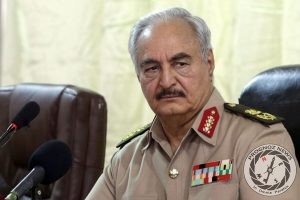
The most significant figure in this landscape is undoubtedly Khalifa Haftar, whose rise from exile to military strongman has shaped the political trajectory of eastern Libya and profoundly influenced the country’s prospects for reunification.
The Collapse of Central Authority
The fall of the Gaddafi regime created a vacuum that no national institution proved capable of filling. During his forty-two years in power, Gaddafi had deliberately weakened formal state structures. He feared the emergence of rival centres of authority and therefore concentrated power around personal loyalty networks, tribal relationships and revolutionary committees.
When the regime collapsed, Libya possessed little in the way of durable national institutions capable of maintaining order. The armed groups that had fought against Gaddafi rapidly evolved from revolutionary brigades into semi-permanent militias. Instead of being disarmed, many were incorporated into state payrolls. Rather than becoming servants of the state, they frequently became its masters.
The immediate consequence was fragmentation. Local commanders accumulated power, municipalities developed independent security arrangements and regional interests increasingly eclipsed national priorities. The central government retained international recognition but often lacked the capacity to enforce its decisions beyond limited territories.
The years following 2011 witnessed a succession of governments, constitutional experiments and internationally sponsored peace initiatives. None succeeded in establishing uncontested authority across the country.
Two Governments, Many Powers
Libya’s political geography is often presented as a contest between the internationally recognised authorities in Tripoli and the eastern administration centred around Benghazi.
The western government enjoys recognition from the United Nations and maintains Libya’s diplomatic representation abroad. It controls many of the country’s financial institutions and remains the principal interlocutor for foreign governments.
Yet the Tripoli authorities are themselves dependent upon a constellation of armed groups. Ministries function, budgets are allocated and public servants receive salaries, but much of the coercive power underpinning the system resides with militia organisations that possess their own leadership structures, economic interests and political ambitions.
In the east, a different model emerged under Khalifa Haftar. Rather than governing through a multitude of autonomous militias, Haftar sought to consolidate military authority under a hierarchical command structure known as the Libyan National Army, or LNA.
Whether the LNA constitutes a true national army is debatable. Critics argue that it remains heavily dependent upon tribal loyalties, regional alliances and personal patronage networks. Nevertheless, compared with the fragmented security environment of western Libya, Haftar succeeded in creating a significantly more centralised military apparatus.
This distinction remains one of the most important fault lines in Libyan politics.
The Making of Khalifa Haftar
Understanding contemporary Libya requires understanding the remarkable and often contradictory career of Khalifa Haftar.
Born in eastern Libya in 1943, Haftar was originally a loyal officer under Gaddafi. He participated in the 1969 coup that brought the young colonel to power and became one of the regime’s trusted military commanders.
His fortunes changed during Libya’s disastrous intervention in Chad during the 1980s. Following military setbacks, Haftar and hundreds of Libyan soldiers were captured. Gaddafi subsequently disavowed them, creating a personal rupture that would shape Haftar’s future political trajectory.
Following his release, Haftar entered exile in the United States. For many years he lived in Virginia, where he became associated with opposition movements seeking to overthrow Gaddafi. Various allegations concerning relationships with Western intelligence services have circulated for decades, although many details remain speculative and contested.
The 2011 revolution offered Haftar an opportunity to return to Libya. Initially, his role was uncertain. Multiple military figures competed for influence and the revolutionary movement itself lacked a unified command structure.
However the worsening security situation and growing public frustration with militia rule created an opening. In 2014 Haftar launched what he termed “Operation Dignity”, presenting himself as a military leader determined to restore order and eliminate extremist organisations.
His campaign coincided with widespread fears regarding jihadist groups operating in eastern Libya, particularly in Benghazi and Derna. By portraying himself as a bulwark against terrorism, Haftar attracted support from segments of the population exhausted by years of insecurity.
Haftar’s State-Building Project
Haftar’s ambitions extended beyond military operations.
Unlike many militia leaders whose influence remained localised, Haftar sought to create an alternative centre of national authority. His project combined military consolidation with institutional reconstruction.
Eastern Libya gradually developed parallel governance structures. Administrative agencies, security institutions and political bodies emerged that functioned independently from Tripoli. While not universally recognised abroad, these institutions increasingly exercised real authority over territory and populations.
Support from foreign powers strengthened Haftar’s position. Egypt viewed him as a partner against Islamist movements. The United Arab Emirates provided substantial backing. At various moments support also arrived from Russia, whose involvement added a further geopolitical dimension to Libya’s conflict.
These external relationships enhanced Haftar’s military capabilities and contributed to his emergence as the dominant figure in eastern Libya.
Yet they also reinforced the country’s fragmentation by encouraging competing centres of power.
The Battle for Tripoli
Haftar’s greatest gamble came in 2019.
Believing that military victory was within reach, he launched a major offensive against Tripoli. The operation sought to unify Libya under his authority by force.
Initially some observers predicted success. Haftar controlled extensive territory and possessed superior organisational coherence compared with many western militias.
However, the campaign ultimately failed.
The decisive factor was foreign intervention. Turkey intervened on behalf of the Tripoli authorities, providing military assistance, advisers, drones and Syrian auxiliary forces. Turkish support transformed the battlefield balance and halted Haftar’s advance.
By 2020, his forces had retreated from western Libya.
The failure of the offensive altered Libya’s political landscape. It demonstrated that neither side possessed sufficient strength to impose a nationwide settlement. Instead the country entered a prolonged stalemate.
Oil, Money and Practical Sovereignty
One of Libya’s most intriguing characteristics is that rival authorities continue to share critical economic institutions.
The country’s vast hydrocarbon reserves generate the overwhelming majority of government revenue. Despite political divisions, the National Oil Corporation has generally maintained a degree of institutional continuity. Oil revenues ultimately flow through central financial structures whose operation requires at least limited cooperation between rival factions.
This arrangement creates a paradox.
Political leaders denounce one another, maintain separate administrations and occasionally mobilise armed forces against each other. Yet they remain financially dependent upon mechanisms that presuppose a unified Libyan state.
The system survives because all major actors derive benefits from its continued operation.
Consequently, Libya experiences periodic crises without complete institutional collapse. Rival elites compete fiercely for influence while simultaneously preserving the economic framework upon which their own power depends.
The Mirage of National Unity
International diplomacy continues to focus on elections, constitutional reforms and government formation.
These initiatives rest upon the assumption that Libya’s fragmentation is primarily a political problem that can be resolved through institutional design.
The reality may be more complicated.
Libya’s challenge is not merely the absence of agreed constitutional arrangements. It is the existence of multiple centres of practical sovereignty. Militias, tribal networks, regional authorities, business interests and foreign sponsors all exercise varying degrees of influence.
Creating a unified government on paper does not automatically eliminate these competing power structures.
Indeed Libya has repeatedly demonstrated that formal political agreements can coexist with profound fragmentation on the ground.
Haftar’s enduring significance lies precisely in this context. He represents not simply a rival politician or military commander but an alternative model of governance. Supporters view him as the architect of order and stability in a country overwhelmed by militia rule. Critics regard him as an aspiring autocrat whose military ambitions threaten democratic development.
Both interpretations contain elements of truth.
Haftar has unquestionably imposed a degree of security and institutional coherence in eastern Libya. Equally, his concentration of power around military structures raises fundamental questions about pluralism, accountability and civilian control.
Libya’s Uncertain Future
The central question confronting Libya today is whether competing sovereignties can eventually be reconciled within a single political framework.
The answer remains unclear.
The country has avoided a return to full-scale civil war, yet she has also failed to achieve genuine national integration. Ministries continue to function. Oil exports continue to flow. Foreign embassies remain open. Governments come and go.
Nevertheless, beneath these outward manifestations of statehood lies a more ambiguous reality. Libya remains a nation where power is distributed among multiple actors whose interests frequently diverge. Formal sovereignty exists, but practical authority remains fragmented.
Fifteen years after Gaddafi’s fall, the dream of a unified democratic Libya has not disappeared. Yet neither has the reality of militia power, regional rivalry and competing legitimacy.
The result is a state that appears united on maps and in diplomatic communiqués but remains divided in practice. Libya’s tragedy is not that she lacks institutions. It is that the institutions she possesses are insufficient to command the loyalties, monopolise the force and reconcile the interests necessary for genuine national unity.
For now Libya remains suspended between statehood and fragmentation, between ministries and militias, between sovereignty and its illusion.
191 Views



Most Readings