Russia and the Western Far Right: A Relationship of Convenience
By Matthew Parish, Associate Editor
Monday 15 June 2026
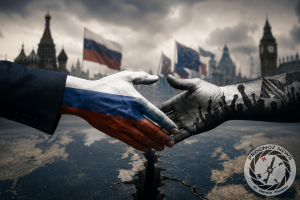
One of the most curious political developments of the early twenty-first century has been the emergence of a complex and often uncomfortable relationship between the Russian state and a range of far-right political movements across Europe and North America. The relationship is frequently misunderstood. It is often portrayed either as a vast conspiracy directed from Moscow or as an entirely fabricated phenomenon invented by Russia’s critics. The reality lies somewhere between these extremes. The relationship exists, but it is less ideological than many imagine and considerably more transactional than either side is usually willing to admit.
The Russian Federation that emerged after the collapse of the Soviet Union was not originally associated with far-right politics. During the 1990s Russia was a country desperately seeking integration with the West. Russian leaders spoke of joining European institutions, adopting democratic norms and becoming part of the international order created after the Cold War. The principal political divisions within Russia at that time concerned economic reform, the distribution of wealth and the pace of democratisation.
The transformation began gradually after 2008. As relations with the West deteriorated, Russian political elites increasingly came to view Western institutions as existential threats. The expansion of NATO, the European Union’s growing influence in Eastern Europe, the colour revolutions in former Soviet republics and what Moscow perceived as Western support for regime change abroad contributed to a profound shift in Russian strategic thinking.
As Russia’s confidence in integration diminished, she began searching for allies inside Western societies themselves. The Kremlin’s objective was not necessarily to export a coherent ideology. Rather, it sought to identify political forces capable of weakening what it regarded as hostile institutions. If NATO, the European Union and the liberal international order represented threats to Russian interests, then any movement capable of creating divisions within those structures became potentially useful.
The Western far right proved an obvious candidate.
Many far-right movements shared a deep hostility towards supranational institutions. They opposed European integration, criticised NATO, rejected liberal immigration policies and often viewed globalisation as a destructive force. These positions did not necessarily make them pro-Russian, but they frequently placed them in opposition to the same Western institutions that Moscow increasingly regarded as adversaries.
The overlap was particularly visible in Europe. Political parties from France to Germany, Austria to Italy and Hungary to Slovakia often expressed admiration for aspects of Russian governance. Some saw Russia as a defender of national sovereignty. Others viewed it as a bulwark against multiculturalism or what they described as excessive liberalism. Still others admired the image of strong leadership projected by the Kremlin.
For Moscow, these sentiments represented opportunities rather than ideological partnerships.
Indeed there is an important distinction between Russia’s interests and the worldview of many Western far-right movements. Russian foreign policy is ultimately driven by state power, strategic influence and regime survival. Western far-right movements are typically motivated by domestic concerns relating to immigration, national identity, economic protectionism and cultural change. While these agendas sometimes intersect, they are far from identical.
The relationship therefore resembles a coalition of convenience rather than a genuine alliance.
The contradictions become apparent when examined closely. Many European far-right parties emphasise national sovereignty and ethnic self-determination. Yet Russia’s interventions in Georgia and Ukraine directly challenge those same principles. Some Western nationalists oppose immigration while simultaneously supporting a Russian government that governs a vast multi-ethnic federation. Others condemn international institutions while expressing admiration for a Russian state whose geopolitical ambitions often depend upon regional dominance over neighbouring countries.
Such inconsistencies have not prevented cooperation. Political movements rarely require philosophical consistency when strategic advantage is available.
Russia’s information operations have reinforced these relationships. Russian state media, social media campaigns and online influence networks have frequently amplified political narratives that deepen divisions within Western societies. The objective has generally not been to persuade Western populations to support Russia directly. Rather, it has been to erode confidence in institutions, increase political polarisation and reduce Western unity.
From Moscow’s perspective, a divided West is a weaker West.
This strategy reflects a broader tradition of Russian statecraft. Throughout both the imperial and Soviet eras, Russian policymakers often sought to exploit existing fractures within rival societies. Contemporary information warfare represents a technological evolution of a much older practice. The internet has simply provided more efficient tools for achieving familiar objectives.
The relationship has also evolved since the full-scale invasion of Ukraine in 2022.
Before the invasion, expressions of admiration for Russia could often be found openly among segments of the Western far right. Afterwards the situation became more complicated. The invasion exposed tensions that had previously been concealed. Many nationalist movements found themselves unable to reconcile support for national sovereignty with support for Russia’s actions in Ukraine. Some shifted towards a more critical position. Others remained sympathetic to Moscow but increasingly framed their arguments in terms of opposition to Western military aid rather than explicit support for Russia.
The result has been fragmentation rather than uniformity.
It would therefore be mistaken to speak of the Western far right as a single political actor. Some movements remain sympathetic to Russia. Others have become hostile. Still others attempt to remain neutral. The diversity of positions reflects the diversity of the far right itself, which encompasses groups with profoundly different historical traditions, ideological commitments and geopolitical preferences.
What remains constant is Russia’s willingness to engage with any political force that may advance its strategic interests. The Kremlin has demonstrated remarkable ideological flexibility in this regard. Over the decades it has cultivated relationships not only with far-right groups but also with far-left movements, anti-globalisation activists, separatist organisations and populist parties of various descriptions. The common denominator is not ideology but utility.
This fact reveals perhaps the most important lesson. The relationship between Russia and the Western far right is not primarily a story about shared beliefs. It is a story about power. Russia seeks to weaken institutions it perceives as threatening. Certain far-right movements seek to weaken those same institutions for entirely different reasons. Where those objectives overlap, cooperation becomes possible.
Whether this relationship will endure remains uncertain. Political movements evolve. Strategic interests change. Russia itself may eventually undergo further transformations. Yet the underlying dynamic is unlikely to disappear. Great powers have always sought allies amongst the domestic critics of their rivals, and rival societies have always contained political factions willing to accept such support when it advances their own objectives.
The relationship between Russia and the Western far right is therefore neither an ideological crusade nor a grand conspiracy. It is something both more mundane and more enduring: a pragmatic partnership formed at the intersection of shared enemies, divergent ambitions and the timeless logic of geopolitical competition.
8 Views



Most Readings