Russia Against the Post-Cold War Order: The Evolution of an Existential Struggle Since 2008
By Matthew Parish, Associate Editor
Wednesday 17 June 2026
The year 2008 marks a useful point of departure for understanding contemporary Russian strategic thinking. While tensions between Russia and the West long predated that year, it was in 2008 that the Kremlin’s leadership began openly articulating a vision of international affairs in which Western institutions were no longer merely competitors but existential threats to the Russian state, its sovereignty and ultimately its civilisational identity. To understand the wars, confrontations and geopolitical crises that have followed, one must first understand this underlying worldview.
From the perspective of many Western policymakers, the post-Cold War era represented an opportunity to create a Europe whole, free and at peace. Institutions such as NATO, the European Union, the Council of Europe, the World Trade Organization and a dense network of international treaties were intended to establish rules-based cooperation amongst sovereign states. Enlargement of these institutions was viewed as voluntary and beneficial, allowing former communist countries to anchor themselves within prosperous and stable political structures.
The Kremlin increasingly saw matters differently.
By the early 2000s, Russia’s leadership had concluded that the expansion of Western institutions was not an accidental consequence of historical change but rather a deliberate process of strategic encirclement. The successive enlargements of NATO into Central and Eastern Europe, the integration of former Soviet republics into Western economic structures and the promotion of democratic reforms throughout the former Soviet space were interpreted in Moscow not as expressions of sovereign choice by neighbouring countries but as manifestations of Western geopolitical expansion.
The 2008 NATO Bucharest Summit became particularly significant in Russian strategic memory. The declaration that Ukraine and Georgia would eventually become members of NATO, even though no timetable was specified, was viewed within the Kremlin as crossing a fundamental red line. To many Russian officials, NATO membership for these countries would not merely reduce Russian influence. It would threaten Russia’s security architecture and diminish its status as a great power.
The brief Russo-Georgian War later that year demonstrated how seriously Moscow regarded the issue. Although the conflict was geographically limited, its strategic implications were profound. Russia showed that it was prepared to use military force to prevent what it regarded as further Western encroachment into territories it considered essential to its security interests.
Yet the Russian vision that emerged after 2008 extended beyond conventional security concerns. Increasingly, Russian political discourse framed Western institutions as carriers of an ideological project fundamentally incompatible with Russian civilisation. The Kremlin’s rhetoric began to distinguish between what it described as traditional Russian values and what it characterised as Western liberal universalism.
This distinction became especially pronounced after the protests in Russia in 2011 and 2012. Russian authorities increasingly interpreted domestic opposition movements as being linked, directly or indirectly, to Western influence. The so-called “colour revolutions” in Georgia, Ukraine and Kyrgyzstan were not viewed as spontaneous domestic political developments but as externally supported operations designed to weaken governments that resisted Western influence.
From this perspective, democratic promotion programmes, independent media organisations, civil society networks and international human rights institutions ceased to appear politically neutral. Instead, they were seen as instruments through which hostile powers could undermine Russian state authority from within.
The annexation of Crimea in 2014 represented a watershed moment in the evolution of this worldview. Following Ukraine’s Euromaidan Revolution and the departure of President Viktor Yanukovych, Russian leaders increasingly portrayed events in Kyiv as evidence of a Western-backed campaign to pull Ukraine permanently out of Russia’s sphere of influence.
The resulting confrontation transformed Russian strategic thinking. What had previously been concerns about influence and security became embedded within a broader narrative of national survival. Official rhetoric increasingly suggested that Russia was engaged in a defensive struggle against an international order designed to marginalise and ultimately dismantle Russian power.
By the late 2010s, this perspective had matured into a comprehensive alternative vision of world order.
In this vision, the post-Cold War settlement was fundamentally illegitimate because it reflected a temporary imbalance of power following the collapse of the Soviet Union. Western institutions were portrayed as mechanisms through which the United States and its allies maintained global dominance while disguising their interests behind universal principles.
Russia’s preferred alternative emphasised several themes. First was the primacy of state sovereignty over supranational institutions. Second was the recognition of great-power spheres of influence. Third was the rejection of what Moscow characterised as ideological interventionism. Fourth was the emergence of a multipolar international system in which no single power bloc could dominate others.
This worldview helps explain Russia’s increasingly close cooperation with non-Western powers. Strategic partnerships with China, Iran and various countries throughout Africa, Asia and Latin America were not merely tactical arrangements. They reflected a broader effort to build alternative centres of power capable of resisting Western influence.
The full-scale invasion of Ukraine in 2022 represented the most dramatic and consequential expression of this vision. Russian leaders repeatedly framed the conflict not simply as a dispute with Ukraine but as a broader confrontation with NATO and the collective West. Official statements frequently characterised the war as a struggle over the future structure of the international system itself.
Whether one accepts these arguments or rejects them, it is impossible to understand contemporary Russian policy without recognising the sincerity with which many within the Russian political establishment appear to hold them. To Western observers, Russia’s actions may often appear aggressive, revisionist or imperial. To many within the Kremlin, however, those same actions are presented as defensive measures against an existential challenge.
The tragedy is that these competing interpretations have become mutually reinforcing. Western governments view Russian military aggression as proof that Russia poses a threat to European security. Russian leaders view Western military support for countries such as Ukraine as confirmation that the West seeks to contain and weaken Russia. Each side’s actions validate the other’s fears.
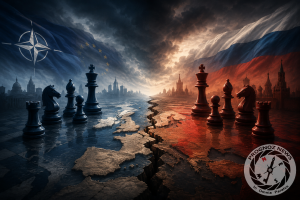
As a result, a confrontation that began with disputes over NATO enlargement and regional influence has evolved into something far larger: a clash between competing visions of international order. One vision seeks to preserve a rules-based system rooted in post-Cold War institutions. The other seeks to replace that system with a multipolar arrangement in which great powers enjoy greater freedom of action and Western influence is significantly reduced.
The durability of this conflict should not be underestimated. Even if hostilities in Ukraine eventually cease, the underlying ideological and strategic assumptions that have developed within Russian policymaking circles since 2008 are unlikely to disappear quickly. They have become embedded in official narratives, security doctrines and institutional thinking.
Consequently, the challenge facing future generations of diplomats may not simply be ending particular wars. It may be finding a way to reconcile fundamentally different conceptions of sovereignty, security and legitimacy in the international system. Until that occurs, the confrontation that emerged so clearly in 2008 is likely to remain one of the defining geopolitical realities of the twenty-first century.
75 Views



Most Readings