Heatwave
By Matthew Parish, Associate Editor
Sunday 28 June 2026
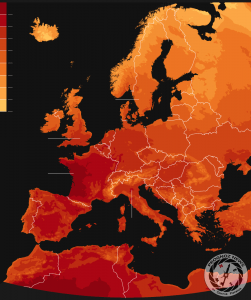
There was a time when Europeans regarded prolonged heat as a Mediterranean inconvenience rather than a continental reality. Northern Europe was associated with temperate summers, occasional rain and moderate temperatures that made the region one of the world’s most hospitable environments for agriculture, urban living and industrial development. That assumption has been steadily eroded over the past two decades. Each successive summer appears to produce a new record, a new emergency or another reminder that exceptional heat is becoming increasingly ordinary. The current heatwave affecting much of Europe is not merely another uncomfortable episode. It is another milestone in a profound climatic transition whose political, economic and social consequences will reverberate for decades.
Meteorologically, the immediate causes of the present heatwave are relatively well understood. A persistent high-pressure system has become established across large parts of western and southern Europe, suppressing cloud formation and preventing the arrival of cooler Atlantic weather systems. Under these so-called blocking patterns, clear skies allow continuous solar heating during the day while unusually warm nights prevent accumulated heat from dissipating. In some regions, hot air originating over North Africa has been transported northwards, adding further intensity to already elevated temperatures.
Such atmospheric configurations have always existed. Europe has experienced notable heatwaves throughout recorded history. What has changed is the baseline upon which these natural weather patterns now operate.
A warmer global atmosphere means that when favourable meteorological conditions arise, they now produce temperatures significantly higher than they would have generated several decades ago. The distinction between weather and climate remains important. Individual heatwaves are weather events; the increasing frequency, duration and intensity of those events reflects broader climatic change. One does not invalidate the other. Instead, natural atmospheric variability now unfolds within a warmer climatic system.
The physical mechanisms are straightforward. Greenhouse gases trap increasing amounts of thermal energy within the Earth’s atmosphere and oceans. Much of that excess energy is absorbed by the oceans, but a significant proportion contributes directly to higher land temperatures and altered atmospheric circulation. Europe has proved particularly vulnerable because it is warming faster than the global average, owing to a combination of geographical position, changing circulation patterns and feedback effects from diminishing snow cover and increasingly dry soils.
The drying of Europe’s landscapes has become one of the most important amplifiers of heat. Moist soils cool themselves naturally through evaporation. Once prolonged drought removes that moisture, incoming solar energy is converted almost entirely into rising air temperatures rather than latent heat. The result is a powerful feedback loop in which drought intensifies heat and heat intensifies drought.
Urbanisation magnifies the problem further. Europe’s great cities are increasingly subject to the urban heat island effect. Concrete, asphalt and glass absorb enormous quantities of solar radiation during the day before releasing it slowly overnight. Buildings reduce natural air circulation while the relative absence of vegetation limits evaporative cooling. Night-time temperatures remain dangerously elevated, preventing vulnerable populations from recovering after the hottest part of the day.
These elevated night-time temperatures have become one of the most serious public health concerns associated with modern heatwaves. Human physiology depends upon cooler nights to dissipate accumulated body heat. Elderly people, infants and individuals with cardiovascular or respiratory illnesses are especially vulnerable when overnight temperatures remain exceptionally high. Heat-related mortality has therefore become an increasingly significant component of European public health planning.
The consequences extend far beyond medicine.
Agriculture may prove one of the sectors most profoundly transformed. Southern Europe has already experienced repeated reductions in olive production, grape yields and cereal harvests during recent hot, dry summers. Livestock suffer thermal stress that reduces productivity, while irrigation demands increase precisely when water resources become scarcer. Farmers increasingly confront the difficult choice between investing in expensive adaptation measures or altering the very nature of what they cultivate.
Water scarcity is emerging as perhaps Europe’s most strategically important environmental challenge. Rivers such as the Rhine, the Po and the Danube have all experienced periods of unusually low water levels in recent years. Reduced river flows disrupt commercial shipping, constrain hydroelectric generation, threaten aquatic ecosystems and complicate industrial production that depends upon abundant freshwater supplies. Nuclear power stations located beside rivers may even have to reduce output if cooling water becomes too warm or too scarce.
Europe’s energy system therefore confronts a paradox. Electricity demand rises sharply as millions of households and businesses rely increasingly upon air conditioning, yet the capacity to generate that electricity may simultaneously decline because of reduced hydroelectric output and cooling constraints affecting thermal power stations. Electricity networks originally designed for more moderate climatic conditions face growing seasonal stress.
Wildfire risk has likewise expanded far beyond its traditional Mediterranean boundaries. Countries once considered relatively insulated from major forest fires increasingly confront conditions favourable to rapid fire spread. Longer dry seasons, hotter vegetation and stronger heatwaves combine to produce landscapes that can ignite with remarkable speed. Firefighting resources consequently face mounting pressure across an ever larger geographical area.
Tourism, one of Europe’s most valuable industries, may also undergo subtle but significant transformation. The traditional peak holiday months of July and August are becoming increasingly uncomfortable in parts of southern Europe. Visitors may gradually favour spring and autumn travel instead, while cooler northern destinations experience growing popularity. Such shifts would redistribute economic activity across both seasons and regions.
Insurance markets are already responding. More frequent extreme weather events generate higher claims from wildfires, storms, infrastructure damage and agricultural losses. Premiums inevitably rise, while insurers reassess risks that were once regarded as highly improbable. Financial markets increasingly incorporate climate exposure into investment decisions, affecting everything from property values to municipal borrowing costs.
The political consequences may prove equally significant.
Adaptation has moved from being a theoretical discussion to an immediate administrative necessity. Governments increasingly confront demands to redesign cities, strengthen electricity grids, expand water storage, improve emergency medical preparedness and revise building regulations. Tree planting, reflective roofing materials, green infrastructure and improved public transport all become components of climate resilience rather than merely environmental policy.
The distribution of these adaptation costs raises questions of political fairness. Wealthier regions and households generally possess greater capacity to install air conditioning, improve insulation or relocate from particularly exposed areas. Poorer communities often bear disproportionate risks while possessing fewer resources to protect themselves. Climate adaptation therefore becomes inseparable from broader questions of social policy.
The European economy itself may gradually adjust to a hotter climate. Working hours in certain industries may shift towards early mornings and evenings. Outdoor construction schedules may increasingly resemble those long familiar in the Middle East. Labour productivity may decline during prolonged periods of extreme heat, reducing economic output while increasing occupational health risks.
Migration patterns may also evolve. Internal migration towards cooler regions could accelerate over coming decades if repeated heatwaves diminish quality of life in the hottest parts of southern Europe. Meanwhile climate pressures beyond Europe’s borders may contribute further to international migration as neighbouring regions confront even more severe environmental stresses.
Technological innovation offers some grounds for optimism. More efficient cooling systems, drought-resistant crops, improved weather forecasting, advanced building materials and better urban planning can substantially reduce vulnerability. Artificial intelligence increasingly assists electricity grid management, wildfire prediction and agricultural optimisation. Human societies possess remarkable capacity for adaptation when they recognise changing realities early enough.
Yet technology alone cannot eliminate climatic risk. The atmosphere responds to cumulative emissions accumulated over many decades. Even if greenhouse gas emissions were reduced dramatically, Europe would continue experiencing elevated temperatures for years to come because of the inertia inherent within the climate system. Adaptation is therefore no longer optional but unavoidable.
Europe’s current heatwave should not be viewed as an isolated meteorological anomaly. It is one chapter within a longer story in which climatic conditions once regarded as exceptional become increasingly commonplace. The challenge is not merely surviving hotter summers but redesigning societies built for one climate so that they function effectively within another.
History demonstrates that civilisations have repeatedly adapted to changing environments. The question confronting Europe is not whether adaptation is possible but whether political institutions, economic systems and public expectations can evolve as rapidly as the climate itself. The answer to that question will shape not merely future summers but the character of European society throughout the twenty-first century.
89 Views



Most Readings