Crimea’s State of Emergency: When Occupation Begins to Consume Itself
By Matthew Parish, Associate Editor
Sunday 28 June 2026
The declaration of a state of emergency across occupied Crimea marks more than another administrative measure in a long war. It is a public acknowledgement that a territory Russia once presented as irrevocably secure has become increasingly vulnerable. For over a decade Moscow has portrayed Crimea as the great strategic prize of its confrontation with Ukraine—a permanently integrated region, protected by geography, military power and political determination. Yet emergency powers are seldom proclaimed in places where governments feel entirely confident.
Crimea has occupied a unique place in Russia’s strategic imagination since its illegal annexation in 2014. It serves simultaneously as a naval fortress, a logistical hub, a political symbol and a favourite destination for domestic tourism. Losing confidence in the peninsula’s stability would therefore represent far more than a local setback. It would call into question one of the Kremlin’s central achievements as presented to its own population.
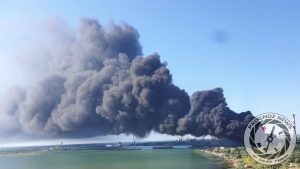
The immediate causes of the emergency lie in the cumulative effects of sustained Ukrainian attacks upon the infrastructure supporting Russian military operations. Energy facilities, transport networks and fuel supplies have all come under increasing pressure, creating rolling disruptions to civilian life as well as military logistics. Emergency declarations allow occupation authorities to accelerate administrative decisions, simplify compensation procedures and exercise greater control over economic activity while responding to the consequences of those attacks.
Yet the deeper significance lies elsewhere.
Wars are ultimately contests of endurance. Armies depend not merely upon soldiers and weapons but upon electricity, fuel, transport, communications and public confidence. Every disruption forces scarce engineering resources away from the battlefield and into repairing infrastructure. Every interruption to civilian life reminds the occupying power that rear areas are no longer immune from the conflict.
Ukraine’s long-range campaign increasingly reflects this strategic logic. Rather than seeking spectacular victories alone, it attempts to impose continuous costs upon Russia’s ability to sustain its occupation. The objective is not necessarily immediate territorial recovery, but the gradual erosion of Russia’s administrative, logistical and financial capacity to maintain control over occupied territory.
For ordinary civilians living in Crimea, however, the consequences are far less abstract. Interruptions to electricity, uncertainty over fuel supplies, restrictions upon transport and the growing militarisation of everyday life all impose burdens irrespective of political loyalties. Families, businesses and public services must adapt to conditions of unpredictability that become increasingly difficult to distinguish from those experienced nearer the front lines.
Tourism provides a particularly revealing indicator. Crimea has long depended economically upon visitors from Russia. When transport becomes unreliable, insurance costs increase and emergency measures become routine, the peninsula inevitably loses much of the attraction upon which many local livelihoods depend. Economic decline may emerge gradually rather than dramatically, yet it can prove every bit as corrosive as physical destruction.
There is also a profound psychological dimension. Governments generally avoid declaring states of emergency unless ordinary administrative mechanisms appear insufficient. Such declarations acknowledge exceptional circumstances. They tell citizens that abnormal conditions should now be regarded as normal. They institutionalise uncertainty.
Whether these measures ultimately prove temporary or become a recurring feature of life in occupied Crimea will depend largely upon the evolution of the wider war. Should Ukraine continue demonstrating an ability to penetrate Russian air defences and disrupt critical infrastructure, emergency governance may become an increasingly permanent characteristic of the peninsula.
History repeatedly demonstrates that occupations rarely fail through a single decisive military defeat. More often they become progressively more expensive, more administratively burdensome and more politically difficult to sustain. Infrastructure deteriorates faster than it can be repaired. Supply lines require ever greater protection.
Civilian administration becomes inseparable from military necessity.
Crimea may not yet have reached that point. Russia retains substantial military capabilities on the peninsula, and no immediate collapse of its position appears likely. Nevertheless the declaration of a state of emergency represents an admission that the assumptions underpinning Russia’s occupation have changed. Security can no longer be taken for granted. Distance from the front no longer guarantees safety. The costs of occupation continue to rise.
The emergency declaration is not simply a bureaucratic announcement. It is evidence that the strategic balance in Crimea is evolving. The peninsula remains under Russian control, but increasingly it must be governed as a territory under sustained pressure rather than as one that has been permanently secured.
That distinction may prove to be one of the most consequential developments of the war.
88 Views



Most Readings