Four Futures for Russia: Between Submission, Fragmentation and Isolation
By Matthew Parish, Associate Editor
Sunday 12 July 2026
Russia has often imagined herself as a civilisation apart, neither wholly European nor entirely Asian, but a great power destined to chart her own course. Throughout her history, however, periods of apparent strength have alternated with moments of profound strategic weakness. The war in Ukraine has accelerated forces that were already gathering beneath the surface: demographic decline, economic stagnation, technological isolation, institutional corruption and increasing dependence upon external partners. Whatever the eventual outcome of the fighting, Russia will almost certainly emerge from this era transformed.
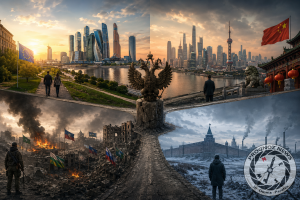
The question is not whether Russia will change, but how. Four broad futures present themselves. None is inevitable, and reality may contain elements of more than one. Nevertheless these scenarios illuminate the strategic choices facing Russia and the wider international community over the coming decades.
A Western Partner
The most dramatic transformation would involve Russia eventually seeking reintegration into the Euro-Atlantic political and economic system. Such a change would require a profound alteration in political leadership, constitutional structure and foreign policy doctrine. It would also require acknowledgement that imperial ambitions have become unsustainable in a world dominated by economic productivity rather than territorial conquest.
In this future Russia would abandon confrontation with Europe and North America, accept internationally recognised borders and redirect national resources from military expansion towards reconstruction and technological development. Western investment would gradually return. Universities would reconnect with international research networks. Energy exports would diversify under transparent commercial arrangements rather than geopolitical coercion.
The advantages would be considerable. Russia possesses enormous natural resources, an educated population and substantial scientific traditions. Combined with access to western capital markets and technology, these assets could generate sustained prosperity.
Yet the political obstacles remain immense. Much of the contemporary Russian state derives its legitimacy from presenting the West as an existential adversary. Reversing decades of propaganda would require a generational transformation in political culture. Even if Russia wished to move westwards, western governments would demand extensive reforms before trust could be rebuilt.
Nevertheless history demonstrates that remarkable political transformations are possible. Germany and Japan were once viewed as permanent military threats before becoming stable democratic allies. While Russia’s path would undoubtedly differ, history cautions against assuming that today’s geopolitical alignments must endure forever.
A Chinese Vassal State
A second possibility is considerably more visible already. Russia may become progressively dependent upon China economically, technologically and diplomatically until genuine strategic autonomy largely disappears.
The relationship between Moscow and Beijing is often presented as one of equals united against western influence. In reality the imbalance grows steadily larger. China’s economy dwarfs Russia’s. Chinese manufacturing dominates global supply chains. Russian exports increasingly consist of discounted raw materials while sophisticated manufactured goods flow in the opposite direction.
Dependence creates leverage. Infrastructure, banking systems, telecommunications and energy exports may gradually become integrated into Chinese strategic planning. Russia would continue to possess formal sovereignty but increasingly find its policy choices constrained by Beijing’s interests.
This would represent a striking historical irony. For centuries Russian leaders sought recognition as one of Europe’s principal powers. Instead they could find themselves occupying a subordinate position within an Asian-centred geopolitical order.
Such dependence would probably preserve territorial integrity and governmental stability more effectively than other scenarios. Yet it would come at the price of diminished strategic independence. Russia would exchange one perceived external threat for quiet subordination to another, albeit one expressed through investment, trade and technology rather than military occupation.
Civil Conflicts and Fragmentation
The third future is the most dangerous.
Russia is a federation encompassing extraordinary ethnic, religious, linguistic and regional diversity. Strong central authority has historically contained these differences. Should central institutions weaken significantly, latent tensions could re-emerge.
Economic crisis, declining public services, elite competition or disputed political succession could all trigger instability. Wealthier regions might seek greater autonomy over natural resources. Ethnic republics could revive dormant nationalist aspirations. Armed groups returning from prolonged warfare might become instruments in local power struggles.
History offers sobering precedents. The collapse of the Soviet Union occurred with comparatively limited violence inside Russia itself, but the dissolution of Yugoslavia demonstrated how rapidly multinational states can descend into prolonged conflict once central authority evaporates.
Civil conflict in Russia would present unprecedented international challenges. The country possesses the world’s largest nuclear arsenal, extensive chemical industries and enormous energy infrastructure spread across eleven time zones. Maintaining security over these assets during political fragmentation would become an urgent international priority.
Such instability would not necessarily culminate in complete disintegration. More likely would be prolonged low-intensity conflicts, shifting regional alliances and recurring constitutional crises. Even limited fragmentation would fundamentally reshape Eurasian geopolitics for generations.
Isolated Autarky
The final scenario involves neither reconciliation with the West nor subordination to China, but determined self-isolation.
Russia could continue pursuing economic self-sufficiency, restricting foreign investment, replacing imports where possible and cultivating limited commercial relationships with a small circle of politically sympathetic states. Political control would remain highly centralised. Information would become increasingly regulated. National identity would revolve around resilience against external pressure.
There is historical precedent. The Soviet Union maintained significant autarkic characteristics throughout much of the Cold War, while contemporary North Korea represents an extreme version of similar thinking.
Modern technological realities, however, make complete autarky increasingly difficult. Advanced semiconductor manufacturing, artificial intelligence, biotechnology and aerospace engineering depend upon deeply international supply chains. Even large economies struggle to reproduce every component domestically.
An isolated Russia might survive for decades, particularly given her abundant natural resources and agricultural capacity. Yet living standards would probably continue to lag behind comparable developed economies. Innovation would slow. Population decline might accelerate as talented younger citizens sought opportunities abroad whenever possible.
Isolation can preserve political systems for considerable periods. It rarely generates sustained prosperity.
Between the Four Paths
These four futures are analytical models rather than precise predictions. Russia’s actual trajectory may combine elements of several simultaneously.
A period of autarky could gradually evolve into increasing dependence upon China. Internal instability might eventually encourage political reform and renewed western engagement. Conversely attempts at western integration could collapse, producing renewed isolation.
The decisive variables will include leadership succession, economic performance, demographic trends and the evolution of the international security environment. Equally important will be choices made outside Russia. Western governments, China and neighbouring states will all influence the incentives available to future Russian leaders.
Perhaps the greatest uncertainty concerns Russian society itself. States are ultimately collections of individuals whose attitudes evolve over time. Generations shaped by war, sanctions and international isolation may think differently from those that follow them. Political assumptions regarded as permanent today may appear surprisingly fragile twenty years hence.
An uncertain future
Russia stands at one of the great historical crossroads of its modern existence. The assumptions that shaped its foreign policy for decades have been subjected to immense strain. The next generation may witness a country fundamentally unlike the one that emerged from the collapse of the Soviet Union.
Whether Russia becomes a cooperative European partner, a junior partner to China, a state fractured by internal conflict or a heavily fortified autarky will depend upon decisions that have yet to be made and circumstances that cannot yet be foreseen.
The future is unlikely to reward nostalgia for imperial grandeur. Instead it will favour whichever path best enables Russia to provide security, prosperity and dignity for its own citizens while coexisting peacefully with its neighbours. The tragedy of recent years has been that these objectives were never mutually exclusive. The challenge for Russia’s future leaders will be to recognise that enduring national strength is measured less by the territory one dominates than by the confidence others place in one’s stability, institutions and willingness to live within the rules that govern an interconnected world.
93 Views


Most Readings