Tramhaus in Lviv: When European Post-Punk Finds a City That Understands It
By Matthew Parish, Associate Editor
Monday 3 August 2026
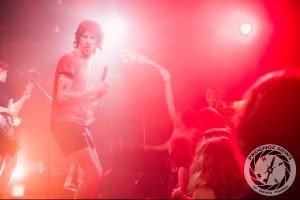
There are concerts that are merely performances and there are concerts that become conversations with the cities that host them. The appearance of the Rotterdam post-punk band Tramhaus at the Nyzhnii Zal beneath Lviv’s Puppet Theatre on 1 July 2026 belonged emphatically to the latter category. As part of the band’s June–July European tour, their first visit to Ukraine carried with it a significance extending well beyond the ordinary rhythms of international touring. The proceeds were donated to the Musicians Defend Ukraine and Music Saves Ukraine charities, reminding the audience that culture in wartime is never detached from civic responsibility.
Lviv has long been Ukraine’s cultural capital. Yet in recent years it has acquired an additional identity: that of a sanctuary where artistic life continues despite the uncertainties imposed by war. Concert halls, theatres and underground venues have become places of quiet resilience. They do not deny the realities outside their walls. Rather they demonstrate that civilisation survives precisely because people continue to create, to perform and to listen.
Nyzhnii Zal is uniquely suited to this purpose. Hidden beneath the Puppet Theatre, its subterranean atmosphere already evokes the aesthetic from which post-punk emerged nearly half a century ago. Post-punk has never been music of comfort. It is music of tension, ambiguity and intellectual restlessness. It rejects polished certainty in favour of emotional honesty, embracing dissonance where earlier generations preferred resolution. In a country living through war, such emotional vocabulary requires no translation.
Rotterdam may seem geographically distant from western Ukraine, but the two cities share something fundamental. Both are places whose identities have been forged through adversity. Rotterdam rebuilt itself after catastrophic destruction during the Second World War. Lviv has remained physically more fortunate, yet it has become the cultural heart of a nation fighting for its survival. It is therefore unsurprising that a Rotterdam band should find an audience in Lviv prepared to understand music that refuses sentimentality while never surrendering hope.
Tramhaus have rapidly established themselves as one of Europe’s most compelling young post-punk groups. Formed in Rotterdam, their sound draws upon punk, shoegaze, noise rock and more melodic influences without becoming imprisoned by any of them. Their performances have earned a reputation for extraordinary energy, driven as much by emotional intensity as technical precision. The band’s line-up—lead singer Lukas Jansen, guitarists Nadya van Osnabrugge and Micha Zaat, bassist Julia Vroegh and drummer Jim Juijten—functions less as a hierarchy than as a collective organism, each musician contributing to a constantly shifting sonic architecture.
Watching such a band perform in Ukraine inevitably alters one’s perception of the music itself. Songs written in peacetime acquire different meanings when played before an audience whose everyday lives have been shaped by air raid alarms, uncertainty and sacrifice. Lyrics concerning alienation or anxiety cease to be abstract reflections upon modern existence. They become part of an immediate lived experience.
This is one reason why benefit concerts possess a significance extending beyond fundraising. The financial contribution to organisations such as Musicians Defend Ukraine and Music Saves Ukraine is important, but the symbolic contribution may be even greater. Every international artist who chooses to perform in Ukraine makes a declaration that the country remains connected to Europe’s cultural bloodstream. Isolation is among the strategic objectives of every aggressor. International artistic exchange quietly frustrates that objective.
One should not underestimate the courage involved. Touring musicians willingly entering a country at war make calculations that transcend commercial logic. Their decision affirms that art remains worth carrying across borders even when those borders have become synonymous with conflict. Such gestures remind audiences that solidarity is not measured only in military equipment or diplomatic communiqués. It is equally expressed through guitars carried into underground venues, through amplifiers assembled on temporary stages and through audiences gathering despite uncertainty.
The nearly full capacity of Nyzhnii Zal spoke eloquently about Lviv itself. Wartime audiences are often among the most attentive audiences anywhere. Entertainment is no longer taken for granted. Music becomes something approaching necessity. Every performance is appreciated with an intensity that can be difficult to reproduce in societies where peace has rendered cultural life routine.
There is also a pleasing symmetry in post-punk finding such fertile ground in contemporary Ukraine. The genre originally emerged from societies confronting economic uncertainty, political disillusionment and profound social change. Today’s Ukraine faces challenges of an altogether different magnitude, yet it shares the conviction that creativity remains indispensable precisely when circumstances become most difficult. Art ceases to be decoration. It becomes an affirmation that human dignity survives even amidst violence.
Photography has a particular role in preserving such moments. Max Maier’s images do more than document a concert. They preserve evidence of a society continuing to live intellectually and emotionally despite extraordinary pressures. Decades from now, historians examining Ukraine during these years will naturally study military campaigns and diplomatic negotiations. Yet they may also look at photographs from evenings such as this and conclude that they reveal something equally essential: not merely how Ukraine defended its territory, but how it preserved its civilisation.
Tramhaus’s performance therefore deserves to be remembered not only as another successful stop on a European tour. It represented the meeting of two traditions of resilience—one musical, one national. The post-punk movement has always insisted that uncertainty need not extinguish creativity. Ukraine has demonstrated that war need not extinguish culture.
Perhaps that is why the concert felt so entirely appropriate beneath the streets of Lviv. Underground spaces have always carried symbolic power. They suggest both refuge and emergence. People descend into them seeking safety, conversation and music. They ascend again into the night reminded that civilisation is sustained not only by armies and governments but by artists willing to perform, audiences willing to gather and cities determined to remain unmistakably alive.
116 Views



Most Readings