Fire on the Western Horizon: Russia’s Overnight Assault on Lviv and Ukraine
By Matthew Parish, Associate Editor
Thursday 30 July 2026
For much of the war, Lviv has occupied a distinctive place in the Ukrainian imagination. It has never been immune from Russian missiles, yet its position close to the Polish frontier has allowed it to function simultaneously as a cultural capital, a humanitarian sanctuary, a diplomatic centre and the principal logistical gateway through which military assistance and civilian aid have entered Ukraine. Every Russian strike upon Lviv therefore carries significance beyond the immediate destruction it causes. It is an attack upon one of the principal arteries that keeps the Ukrainian state alive.
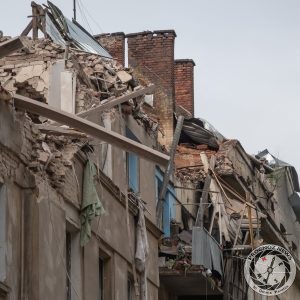
The overnight attacks of 30 July 2026 demonstrated that once again. Russian missiles and drones struck targets across Ukraine in one of the broadest nationwide bombardments seen in recent months. Kyiv, Kryvyi Rih, Poltava, Dnipro, Lviv and numerous other regions came under sustained attack. Residential buildings were destroyed, civilians were killed and injured and emergency workers spent the morning searching through shattered apartment blocks. In Lviv, missiles struck residential neighbourhoods, wounding dozens of people including children and leaving families to sift through the remains of homes that only hours earlier had seemed comfortably distant from the front lines.
The military significance of these attacks should not be overstated in isolation. Russia continues to describe such operations as strikes against military-industrial infrastructure, logistics and defence production. As throughout the war, however, the distinction between military and civilian damage has become increasingly blurred. Even where industrial facilities may be intended targets, missiles that fall into densely populated urban environments inevitably destroy homes, schools and public infrastructure. The strategic objective appears broader than the destruction of any individual factory. It is the systematic erosion of Ukrainian resilience.
Lviv illustrates this strategy particularly clearly. Since February 2022 the city has become indispensable to Ukraine’s connection with Europe. Supplies entering from Poland pass through the region. Foreign diplomats continue to maintain substantial operations here. International organisations use the city as a base for humanitarian assistance. Universities, cultural institutions and businesses displaced from eastern Ukraine have relocated westwards. A successful strike upon Lviv therefore resonates psychologically in a manner entirely disproportionate to the number of missiles employed.
The Kremlin understands this symbolism. Throughout the conflict Russia has repeatedly attempted to demonstrate that nowhere inside Ukraine is beyond reach. The destruction of electrical infrastructure during earlier phases of the war sought to make winter itself into a weapon. More recent attacks increasingly seek to convince Ukrainians that even the country’s safest cities remain vulnerable. Such operations are intended not merely to destroy infrastructure but to erode confidence in the state’s ability to protect its citizens.
Yet experience over the last four years suggests that this calculation has repeatedly failed. The immediate aftermath of Russian attacks almost invariably reveals a society that responds with remarkable administrative competence. Firefighters, ambulance crews, municipal workers and volunteers move with extraordinary speed. Railways resume operation. Damaged roads are reopened. Electricity is restored with astonishing efficiency considering the circumstances. Businesses reopen. Cafés fill once more. Life resumes not because the destruction is insignificant but because Ukrainians have collectively concluded that surrendering normality would hand Russia precisely the victory it seeks.
There is nevertheless a harder reality that Ukraine’s partners cannot ignore. The overnight assault once again highlighted the continuing shortage of advanced air defence systems and interceptor missiles. Even highly capable systems cannot protect every city simultaneously across a country the size of Ukraine. Every successful interception preserves lives, but every gap in coverage leaves another community exposed. President Volodymyr Zelenskyy has again argued that delays in supplying additional air-defence capabilities carry a direct human cost measured not in abstract military statistics but in destroyed homes and civilian casualties.
The attacks also carry implications beyond Ukraine’s borders. Reports that a missile or missile debris entered or fell within Polish territory once again underline the proximity of this war to NATO. Poland responded by scrambling fighter aircraft while investigating the incident, illustrating how every major Russian bombardment now possesses the potential to create dangerous international incidents extending beyond the immediate battlefield.
For observers outside Ukraine, there is a danger that such attacks become routine through repetition. Daily casualty figures begin to blur together. Destroyed apartment buildings resemble those photographed weeks or months before. Yet normalisation is itself one of war’s greatest deceptions. Every shattered building represented years of labour by ordinary families. Every victim had an individual history, ambitions and relationships. Every child injured in Lviv or elsewhere in Ukraine carries psychological consequences that will long outlast the final ceasefire.
Russia’s overnight assault therefore deserves to be understood not merely as another entry in the military chronology of the war but as part of a continuing contest over endurance. Moscow continues to wager that sustained pressure upon Ukrainian cities will eventually exhaust both domestic morale and international support. Ukraine continues to answer that wager through persistence, reconstruction and refusal to concede political independence despite repeated bombardment.
The people of Lviv know better than most that security is never guaranteed. Our city has endured empires, occupations and wars across centuries. It has repeatedly stood at the frontier between competing visions of Europe. The missiles that arrived before dawn on 30 July 2026 were another chapter in that long history. They inflicted suffering, grief and destruction. They did not alter the city’s identity. If anything, they reinforced the determination that has characterised Ukraine throughout this war: that civilisation is measured not by the absence of violence but by the refusal to allow violence to dictate the future.
58 Views



Most Readings