Nuclear Risk in Wartime: The Precarious Fate of Ukraine’s Reactors
By Matthew Parish, Associate Editor
Friday 14 August 2026
There is something peculiarly unsettling about fighting a modern industrial war across a country filled with nuclear reactors. Artillery shells, cruise missiles and drones are designed upon the assumption that things struck by them may explode, burn or collapse. Nuclear power stations are designed upon precisely the opposite assumption: that certain things must never be permitted to explode, burn or collapse. Ukraine has therefore become the site of an experiment that nobody wished to conduct — what happens when a sophisticated civilian nuclear industry finds itself embedded inside the geography of a prolonged high-intensity war.
The answer, so far, is simultaneously reassuring and alarming. Ukraine has not suffered a major wartime nuclear accident. Her operating nuclear stations have proved remarkably resilient and their personnel have continued working under conditions that their designers can scarcely have contemplated. Yet this success should not be confused with safety. Europe has instead been accumulating nuclear risk in small increments — a severed transmission line here, an exploding drone there, a damaged substation, a frightened workforce, an inaccessible emergency facility, a temporary loss of cooling water. None has yet produced catastrophe. The disturbing question is how many such increments can be accumulated before one does.
Ukraine entered the full-scale Russian invasion as one of the world’s most nuclear-dependent countries. Before the war it possessed fifteen reactors across four operating nuclear power stations: Zaporizhzhia, Rivne, Khmelnytskyi and South Ukraine. Zaporizhzhia alone has six VVER-1000 reactors and is Europe’s largest nuclear power station. Since Russia occupied Zaporizhzhia in March 2022 its reactors have ceased generating electricity, leaving the other nine reactor units at Ukraine’s three government-controlled plants as the foundation of the country’s nuclear generating system.
Indeed the paradox of the war is that nuclear power has become more important to Ukraine precisely as nuclear installations have become more exposed to wartime danger. Russian attacks have inflicted extensive damage upon thermal generation, hydroelectric facilities, substations and transmission infrastructure. Nuclear generation, inherently difficult to destroy because reactors are massive reinforced structures and because Ukraine has understandably protected them carefully, has consequently acquired an ever larger proportion of the surviving electricity market. By 2026 nuclear energy could provide as much as 80 per cent of Ukrainian domestic electricity consumption under some conditions.
This creates one of the strangest strategic dilemmas of the war. Nuclear power stations are simultaneously amongst Ukraine’s most resilient energy assets and amongst those whose failure would have the most frightening consequences.
The Zaporizhzhia precedent
The centre of the problem is the Zaporizhzhia Nuclear Power Plant at Enerhodar. Russian forces seized it in the first weeks of the full-scale invasion. This was historically extraordinary. Never before had a major operational nuclear power station become occupied territory in a large conventional war. The International Atomic Energy Agency consequently found itself addressing circumstances for which the international nuclear regulatory system had never really been designed. Nuclear safety law assumes states, regulators, engineers and emergency services. It does not comfortably accommodate trenches, artillery batteries, occupying armies and contested front lines.
It is important not to exaggerate the immediate danger. Zaporizhzhia is not another Chornobyl waiting inevitably to happen. Its six reactors are of a fundamentally different design from the RBMK reactor destroyed in April 1986 and all have long been shut down. Shutdown reactors generate vastly less heat than operating reactors. The passage of time since shutdown has further reduced decay heat. A runaway reactor excursion of the Chornobyl type is therefore not the principal danger.
But “shut down” is an unfortunately misleading phrase in nuclear engineering. Nuclear fuel does not become harmless when a control-room operator stops producing electricity. Used fuel continues generating decay heat and radioactive materials must remain contained. Cooling systems, instrumentation, electrical equipment and trained personnel remain necessary. Spent-fuel stores must likewise remain protected. A dormant nuclear station is consequently not a dead industrial building. It is an enormous radioactive installation that requires continuing maintenance.
Electricity is therefore one of the central vulnerabilities. Nuclear reactors normally generate electricity, but they also need electricity. Pumps, control systems, instrumentation and cooling arrangements depend upon reliable power supplies. When the external grid disappears, emergency generators must take over. Those generators require fuel, maintenance and functioning switching equipment. Each additional layer of redundancy buys time — but redundancy is not infinity.
By June 2026 the British government, summarising IAEA reporting, said that Zaporizhzhia had experienced sixteen losses of off-site power since the beginning of the conflict. It also noted repeated power losses during April and May and the plant’s continuing dependence upon a single power line. This is precisely how nuclear danger should be understood. The six reactors need not be struck by a missile for the plant to become unsafe. Destroy enough of the surrounding infrastructure and the safety problem eventually arrives at the reactor gates.
The same principle applies to water. Nuclear safety depends upon the ability to move heat somewhere else. The destruction of the Kakhovka dam in 2023 profoundly altered the hydrological environment upon which Zaporizhzhia had originally depended. Alternative arrangements have kept the plant supplied. Yet in July 2026 military activity again disrupted water supplies to the plant and neighbouring Enerhodar, although wells remained available for cooling. Once again nothing catastrophic happened. Once again another supposedly peripheral system demonstrated that it was not peripheral at all.
The invisible nuclear battlefield
This illustrates the most important lesson of Ukraine’s nuclear war. The reactor building is only the visible centre of a much larger organism.
A nuclear power station depends upon electrical substations, high-voltage transmission lines, reservoirs, pumping systems, roads, telecommunications, warehouses, spare parts, fire brigades and highly specialised human beings. Wartime nuclear safety therefore cannot sensibly be reduced to an injunction saying “do not bomb the reactor”. A missile striking an electrical substation 100 kilometres away may matter more to nuclear safety than a small drone exploding against a relatively robust structure within the nuclear compound.
This is becoming particularly significant for the three stations remaining under Ukrainian control. In May 2026 military activity caused a fire at the Dniprovska 750-kilovolt substation, affecting the electricity system associated with the South Ukraine plant and with Zaporizhzhia. IAEA Director General Rafael Grossi emphasised the nuclear-safety importance of substations supporting nuclear facilities. Earlier incidents had likewise affected off-site electricity supplies at Chornobyl, Khmelnytskyi and South Ukraine.
This creates a potentially dangerous strategic ambiguity. Russia may attack Ukraine’s electricity network for entirely conventional military reasons. Electricity sustains railway systems, factories, communications, military production and civilian morale. Yet precisely the same electrical network sustains nuclear safety. There is no neat technical boundary separating a legitimate military electricity grid from a special nuclear electricity grid. The closer attacks move towards the substations and transmission infrastructure serving nuclear plants, the thinner that distinction becomes.
Ukraine therefore confronts a peculiar inversion of conventional strategic thinking. Ordinarily a power station exists to protect the grid from electricity shortages. In wartime Ukraine, parts of the grid must also be protected to protect the power station.
Chornobyl refuses to disappear
Then there is Chornobyl — a place where no electricity is generated but where history has left Ukraine with a permanent nuclear liability.
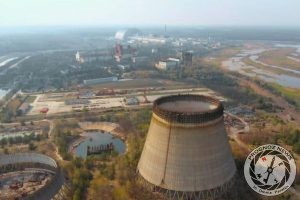
The ruins of Reactor No. 4 still contain intensely radioactive material from the 1986 catastrophe. The enormous New Safe Confinement erected over the old Soviet sarcophagus was intended to isolate that material while the hazardous remains were progressively dismantled. War has turned even this elaborate engineering solution into another potential target.
In February 2025 a drone struck the New Safe Confinement. There was no major radiological release, but subsequent IAEA assessment concluded that the structure had suffered serious damage requiring extensive repair. In June 2026 another drone attack damaged a building associated with spent nuclear fuel storage near the Chornobyl complex; according to Ukrainian authorities and the IAEA there was again no abnormal radiation release.
The temptation is to treat such incidents as reassuring because disaster did not follow them. This is exactly the wrong conclusion.
If a man crosses a railway line sixteen times without being struck by a train, we do not conclude that railway lines are safe places upon which to stand. We conclude that he has repeatedly survived an unnecessary risk. Ukraine’s nuclear installations have survived a growing catalogue of incidents without a significant radiological release. This demonstrates the robustness of nuclear engineering and the professionalism of the people maintaining these facilities. It does not demonstrate that warfare around nuclear installations is tolerable.
Indeed Chornobyl presents a different category of hazard from Zaporizhzhia. There is no operating reactor there to melt down. Instead there are enormous inventories of radioactive material requiring containment over periods vastly longer than any war. Military planners think in hours, days and campaigns. Radioactive isotopes oblige humanity to think in decades, centuries and occasionally millennia. The collision between these timescales is one reason warfare and nuclear installations make such uncomfortable companions.
The human reactor component
There is also an aspect of nuclear safety that is easily overlooked because it cannot be photographed from a satellite: people.
Nuclear power plants are extraordinarily complicated institutions. Their safety depends upon operators making correct decisions, engineers noticing abnormalities, maintenance teams replacing deteriorating equipment, managers enforcing procedures and regulators retaining independence. All of this assumes a working environment characterised by concentration, predictable shift patterns and institutional trust.
War supplies none of those things.
At Zaporizhzhia personnel have worked under occupation while control of the installation has become entangled in the political and legal dispute between Russia and Ukraine. Elsewhere Ukrainian nuclear workers perform their duties amid air-raid alerts, missile attacks, disrupted electricity supplies and the ordinary psychological burdens of living in a country at war. IAEA teams themselves have repeatedly had to take shelter during attacks.
Human reliability is part of nuclear engineering whether engineers like the expression or not.
A reactor may possess four redundant safety systems, but if experienced technicians leave, communications fail, spare parts become unavailable or exhausted operators make mistakes, the practical value of technical redundancy diminishes. Nuclear safety culture was developed painstakingly after Three Mile Island, Chornobyl and Fukushima. It depends upon openness, reporting, procedural discipline and the willingness to admit mistakes. Military occupation and wartime secrecy cultivate almost exactly the opposite institutional instincts.
This may ultimately prove the greatest long-term risk at Zaporizhzhia. Reactors and pipes can often be inspected. The gradual degradation of an organisation is harder to measure.
What would a Ukrainian nuclear accident look like?
Public discussion frequently invokes another “Chornobyl”. This is understandable but technically unhelpful. The more plausible accident scenarios in contemporary Ukraine would look different.
At Zaporizhzhia, prolonged loss of electrical power combined with failures of cooling arrangements could eventually threaten fuel integrity. Damage to spent-fuel facilities might disperse radioactive material locally. Fire or explosive damage could compromise systems necessary for confinement. At an operating Ukrainian reactor, a wartime incident causing sudden shutdown combined with extensive damage to external and emergency power systems would be more serious because recently operating fuel produces substantially greater decay heat.
The severity of any release would depend upon the particular reactor, its operating state, the systems damaged, weather conditions and the effectiveness of emergency intervention. A nuclear accident is therefore not a binary phenomenon in which either nothing happens or half of Europe becomes uninhabitable. There is an enormous spectrum between those outcomes.
That fact should reassure Europeans against apocalyptic speculation while making governments more serious about realistic contingencies. A radiological incident might require local evacuation, agricultural restrictions and exclusion zones without remotely resembling 1986. Even such a comparatively limited accident could nevertheless have immense political and economic consequences.
The psychological effects might exceed the radiological ones. European memories of Chornobyl remain powerful. News that radioactive material had escaped from a Ukrainian nuclear station during fighting could produce panic hundreds of kilometres beyond any scientifically justified evacuation zone. Borders might become congested. Agricultural products could be rejected. Governments would face intense pressure to distribute iodine tablets whether medically appropriate or not. Financial markets would react long before radiological laboratories had established what had actually happened.
Russia and Ukraine would immediately accuse one another. Reliable attribution might take weeks. Nuclear accident would thereby become information warfare.
Nuclear deterrence in miniature
There is consequently a strange form of deterrence surrounding Ukraine’s reactors. Neither Russia nor Ukraine has any rational interest in causing a major radiological release. Fallout respects neither trenches nor passports. Depending upon weather patterns, contamination originating in southern Ukraine might travel towards Russian-occupied territory, Russia itself, Belarus, Moldova, Romania or deeper into Europe.
Yet deterrence works imperfectly when catastrophe can result from cumulative accident rather than deliberate decision.
Nobody needs to decide to cause a nuclear accident. A drone may strike the wrong transformer. An air-defence missile may fall where nobody intended. A transmission line may be severed simultaneously with the failure of a backup generator. A repair crew may be unable to cross a battlefield. A tired operator may misunderstand an instrument reading. Each event may be individually unlikely. War manufactures enormous numbers of unlikely events.
This is why conventional nuclear deterrence theory offers only limited comfort. The Cold War problem was principally how to prevent rational governments from deliberately launching nuclear weapons. The Ukrainian reactor problem is how to prevent complicated technological systems from failing amid thousands of partially uncontrolled acts of violence.
The distinction is profound. Deterrence can influence presidents. It cannot deter shrapnel.
The international rules are inadequate
International humanitarian law contains protections for installations containing “dangerous forces”, including nuclear electrical generating stations. The principle is obvious enough: some civilian infrastructure possesses such catastrophic potential that belligerents should exercise exceptional restraint around it.
Ukraine has demonstrated how difficult this principle is to apply to modern warfare. A nuclear station occupies territory. Territory possesses military significance. Roads approach it, transmission lines depart from it and soldiers may operate nearby. Once an army occupies such a facility the distinction between protecting the installation and exploiting its protected status becomes dangerously blurred.
The international community therefore needs rules considerably more practical than general exhortations not to attack nuclear plants. A workable wartime nuclear regime ought to establish substantial demilitarised perimeters around reactors, prohibit the storage of weapons or deployment of offensive forces within them, guarantee protected routes for maintenance personnel and emergency equipment and treat substations and transmission lines essential to nuclear safety as extensions of the protected installation.
The IAEA must also be guaranteed unrestricted access. Its role in Ukraine has been invaluable precisely because nuclear disputes otherwise collapse immediately into reciprocal allegations. An international technical presence cannot stop a missile, but it can establish facts, encourage repairs and create a small zone in which engineers rather than propagandists define reality.
The reactors after the war
There is finally a problem that will survive any armistice.
When the shooting stops, Ukraine will remain a nuclear state in the civilian sense. Indeed nuclear energy may become still more important during reconstruction. The country’s thermal generating system has been devastated and rebuilding an electricity network around nuclear baseload generation may be economically attractive. Ukraine has already pursued plans for additional capacity at Khmelnytskyi and has sought to reduce inherited dependence upon Russian nuclear technology and fuel-cycle services.
But the war will leave an immense inspection requirement. Transmission infrastructure must be reconstructed. Equipment exposed to abnormal operating conditions will need assessment. Chornobyl’s damaged confinement structures require substantial repair. Zaporizhzhia presents the greatest challenge of all. Before its reactors could conceivably return to operation, their physical condition, maintenance history, staffing, cooling arrangements, electrical connections and regulatory status would require exhaustive examination.
There must be no political rush to restart them.
A nuclear reactor is not a flagpole. Restoring Ukrainian sovereignty over Zaporizhzhia, if and when that occurs, would be a political event of tremendous significance. Restarting six reactors would be an engineering decision and must remain one. The two questions should never be confused.
There is also an uncomfortable possibility that some or all of Zaporizhzhia’s reactors may never operate again. Years of shutdown, occupation, disrupted maintenance and deterioration of supporting infrastructure may eventually make refurbishment economically irrational even if technically possible. Europe may therefore discover that the largest nuclear power station on the continent has become one of the most expensive monuments of the war.
Living beside the atom
Ukraine’s experience contains lessons extending far beyond Ukraine. Nuclear power is enjoying renewed international interest because it offers large-scale low-carbon electricity and reduces dependence upon imported fossil fuels. Yet much of the world’s nuclear infrastructure was designed during an era in which industrialised states assumed that major interstate war would not take place around civilian reactors.
That assumption can no longer be maintained.
Future reactor design must therefore incorporate wartime resilience more seriously: protected backup generation, dispersed electrical connections, multiple cooling options, hardened control infrastructure and reserves of essential equipment. National energy systems containing nuclear power must similarly avoid single points of failure in the surrounding grid. Governments need radiological emergency plans capable of functioning during simultaneous military attacks, mass population displacement and telecommunications disruption.
Above all, nuclear security must cease to be imagined exclusively as protection against terrorists stealing radioactive material. Ukraine has revived an older and larger danger — armies fighting around the machinery of the atomic age.
There is nevertheless a reason for measured optimism. Four years of full-scale warfare have demonstrated that modern nuclear installations possess substantial resilience. Ukrainian engineers have kept reactors operating while missiles crossed the skies above them. Emergency systems have functioned. International inspectors have remained present. Repeated losses of electrical infrastructure have been repaired. Catastrophe has been avoided.
But fortune is not a safety system.
The most dangerous conclusion Europe could draw from Ukraine is that because nothing truly terrible has yet happened, the risks have been exaggerated. The proper conclusion is almost the reverse. An unprecedented experiment has been conducted in real time and the safety margins have repeatedly been tested. Zaporizhzhia has lost off-site power again and again. Chornobyl’s protective structures have been struck. Substations serving operating reactors have burned. Water supplies have been interrupted. Yet engineers, emergency systems and sometimes sheer good luck have prevented these incidents from combining into something worse.
Ukraine has already taught the world once what happens when control over nuclear energy is lost. In 1986 that loss of control arose from defective reactor design, institutional secrecy and human error. Forty years later the country faces a different nuclear danger — not an unstable Soviet reactor but stable modern reactors surrounded by an unstable world.
The distinction is comforting only up to a point. Nuclear engineering is founded upon layers of defence, each intended to compensate for the failure of another. War does something nuclear engineers understandably dislike: it attacks many layers at once.
Ukraine’s reactors remain standing. Their containment structures remain intact. Their operators continue their work and Europe’s lights remain on. But around them missiles fly, electrical grids fracture and front lines move. The atom is patient. The war is not. The task of Ukraine and its international partners is to ensure that the former never becomes hostage to the latter.
15 Views



Most Readings