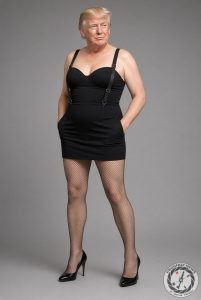
Donald Trump’s Secret Life as a Sex Worker
By Matthew Parish, Associate Editor
Friday 14 August 2026
A work of political satire. The events, conversations, kompromat, criminal characters and clandestine occupations described below are fictional.
There were, Donald Trump had always believed, two kinds of prostitution.
There was the disreputable sort, in which money changed hands in return for services of an intimate character. Donald had never understood the economics of this. It sounded exhausting, involved an unacceptable degree of customer satisfaction and, worst of all, appeared to require the service provider actually to provide the service.
Then there was the respectable sort.
This was called geopolitics.
Donald had been practising it for years.
His rates were excellent.
For a flattering telephone call, he might reconsider an alliance. For a ceremonial banquet and somebody describing him as a historic statesman, he could become remarkably philosophical about borders. A sufficiently elaborate red carpet might induce him to discover ancient ethnic complexities in a country whose name he had previously been unable to pronounce.
His clients tended to be men with large palaces, small parliaments and an unusually high number of bodyguards.
Vladimir Putin was the exception.
Putin never paid cash.
Putin merely smiled.
That was worse.
The envelope arrived at Mar-a-Lago on a Tuesday morning.
It contained no return address. Inside was a photograph of Donald sitting in a Moscow hotel suite in 2013.
Nothing scandalous was happening.
This was precisely what worried him.
He was sitting on a sofa wearing a dressing gown, eating a cheeseburger and watching himself being interviewed on television.
On the back someone had written:
WE HAVE THE OTHER PHOTOGRAPHS.
Donald stared at it for several minutes.
“What other photographs?” he demanded.
His aide looked uncomfortable.
“That’s generally how kompromat works, sir.”
“Kompromat?”
“Russian blackmail material.”
“I know what kompromat is. Nobody knows more about kompromat than me. I invented kompromat. People come up to me — very tough intelligence people, tears in their eyes — and they say, ‘Sir, nobody has ever been compromised as beautifully as you.’”
The aide nodded.
Donald examined the photograph again.
“Do I look fat?”
“Presidential, sir.”
“Good.”
Three thousand miles away, in a basement beneath the Kremlin, Colonel Yuri Anatolyevich Zubov of the Federal Security Service opened a folder marked TRUMP, DONALD J. — ACTIVE MEASURES / VARIOUS.
The folder had become embarrassingly large.
Most of its contents were useless.
The problem with blackmailing Donald Trump was that behaviour which would destroy an ordinary politician’s career merely became another Tuesday on cable television.
Financial embarrassment did not work.
Sexual embarrassment did not work.
Political embarrassment certainly did not work.
The Russians had gradually discovered that the only thing Donald genuinely feared was being made to look poor.
Accordingly, the most sensitive document in the entire Russian intelligence archive was not a lurid videotape.
It was a spreadsheet.
The Ukrainian invitation arrived the following Thursday.
The President of Ukraine invited Donald to Kyiv.
Donald declined.
He was invited to Lviv.
Donald declined again.
They suggested Odesa.
“No,” Donald said firmly.
His advisers were puzzled.
“You’ve been to places under greater security threats.”
“It isn’t the missiles.”
“What is it?”
Donald lowered his voice.
“The gangsters.”
His advisers exchanged glances.
“Russian gangsters?”
“No. Ukrainian gangsters.”
“Why would Ukrainian gangsters want to meet you?”
Donald looked genuinely offended by the stupidity of the question.
“Everybody wants to meet me.”
There was, however, a more complicated problem.
During the wild privatisation years of the 1990s, Donald had encountered so many men from the former Soviet Union with improbable fortunes, leather jackets and opinions about reinforced concrete that he could no longer remember which ones were Russian, Ukrainian, Georgian, Armenian or merely from Brighton Beach.
He therefore regarded travel east of Vienna as a dangerous form of school reunion. “You land in Ukraine,” he explained, “and suddenly some guy called Volodymyr comes up and says, ‘Donald! You remember me from Atlantic City!’ Then he wants twenty million dollars.”
“Does anyone actually have such a claim?”
“That’s not the point.”
“What is the point?”
“There could be paperwork.”
Donald shuddered.
Missiles could be intercepted.
Paperwork was forever.
The Ukrainians eventually discovered his weakness.
They announced that if Donald visited Kyiv, they would name something after him.
This produced immediate interest.
“A street?”
“Possibly.”
“A very big street?”
“That would depend upon negotiations.”
“A tower?”
“Kyiv has zoning laws.”
“Terrible laws. Very anti-development.”
The Ukrainians then mentioned that they might instead name a particularly successful drone after him.
Donald became thoughtful.
“What does it do?”
“It flies several hundred kilometres and explodes.”
“Beautiful.”
“It is inexpensive, difficult to intercept and manufactured in large quantities.”
“Very Trump.”
“And when several arrive together, they overwhelm Russian air defences.”
Donald sat upright.
“You could put my name on that?”
“We could discuss licensing.”
This was the most persuasive argument Ukrainian diplomacy had yet devised.
Moscow panicked.
Within hours, Donald received another envelope.
This one contained a photograph of Putin and Donald standing together at a summit.
On the back:
REMEMBER WHO YOUR FRIENDS ARE.
Donald telephoned Putin.
“Vladimir, this has got to stop.”
“What must stop?”
“The photographs.”
“What photographs?”
“You know.”
“I possess many photographs, Donald.”
“That sounds threatening.”
“I was describing a normal feature of government archives.”
“That sounds even more threatening.”
Putin sighed.
For years he had cultivated an image of omniscience. Now he was discovering its principal disadvantage: everybody assumed he had secret recordings of everything.
“Donald,” Putin said, “I assure you that Russia does not possess compromising material concerning you.”
There was a silence.
Donald sounded hurt.
“Nothing?”
“Nothing.”
“Not even something small?”
“No.”
“Xi probably has something.”
Putin pinched the bridge of his nose.
Meanwhile, Ukrainian intelligence had devised an altogether cheaper psychological operation.
They created no forged documents. They fabricated no recordings. They hacked nobody.
They merely issued a press release.
UKRAINE PREPARED TO PUBLISH COMPLETE DETAILS OF TRUMP VISIT
There were no details because there was no visit.
This nevertheless caused pandemonium.
“What details?” Donald demanded.
“We don’t know, sir.”
“Find out.”
“There aren’t any.”
“Then why are they complete?”
“Because—”
“Get me Kyiv.”
Within an hour he was speaking to the Ukrainian President.
“I hear you have details.”
“We have many details.”
“What kind?”
“Ukrainian details.”
Donald went pale.
Eastern European details were notoriously detailed.
“Are these financial details?”
“We cannot discuss details before your visit.”
“Are gangsters involved?”
“In Ukraine?”
“Yes.”
“We are fighting Russia, Donald. We have quite enough gangsters already.”
This was unfair.
Ukraine had spent three decades trying, painfully and imperfectly, to escape the post-Soviet world of oligarchs, corrupt prosecutors, envelopes of cash and men called Sergei who owned both aluminium factories and private armies.
Russia had spent the same three decades turning that world into a system of government.
That was the joke history had played upon them.
The supposedly chaotic frontier state was slowly constructing European institutions while the former superpower had transformed itself into a petrol station guarded by nuclear weapons and managed by an intelligence service.
Ukraine had elections.
Russia had choreography.
Ukraine had investigative journalists.
Russia had windows.
Ukraine had comedians who became presidents.
Russia had a president who had made the entire country a comedy, although nobody inside it was permitted to laugh.
Eventually Donald agreed to travel to Lviv.
He imposed conditions.
No gangsters.
No mysterious businessmen.
No hotel rooms previously occupied by Russian citizens.
No restaurants with private rooms downstairs.
No photographers from Moscow.
No documents requiring signature after midnight.
And absolutely nobody was to mention the words Moscow, hotel, 2013 and video in the same sentence.
The Ukrainians agreed immediately.
They had a war to fight.
They did not have time for American neuroses.
Donald arrived aboard an aircraft surrounded by security, journalists and enough hairspray to violate several European environmental directives.
To his surprise, nobody blackmailed him.
Nobody threatened him.
Nobody produced a videotape.
Nobody from the Ukrainian mafia appeared demanding repayment of an obscure casino debt.
Instead he met soldiers.
Some were twenty years old. Some were fifty.
One had been an accountant.
Another had been a schoolteacher.
A third had run a small logistics company before Russia destroyed his warehouse.
They showed Donald photographs of towns that no longer existed.
The jokes stopped for a while.
Then a Ukrainian officer produced a small drone.
“This one has your name.”
Donald brightened.
On the fuselage someone had written in marker pen:
THE DONALD
“What does it cost?”
The officer told him.
Donald blinked.
“That cheap?”
“Yes.”
“And it destroys Russian equipment?”
“Yes.”
Donald inspected it with newfound admiration.
“That’s tremendous business.”
The officer smiled.
“Sometimes freedom is cost-effective.”
That evening another envelope arrived at Donald’s hotel.
Secret Service agents nearly evacuated the building.
Inside was a single photograph.
It showed Donald holding the drone.
On the back somebody had written:
NOW WE HAVE KOMPROMAT TOO.
Donald stared at it.
Then he laughed.
For once, the photograph did not show him flattering a dictator, attending some mysterious gathering of billionaires or standing beside a man subsequently wanted in six jurisdictions.
It showed him in Ukraine.
Behind him flew the blue and yellow flag.
For the first time in his long and extraordinarily profitable career as geopolitics’ most expensive escort, Donald wondered whether he had been selling his services to the wrong customers.
“Send this one to Vladimir,” he said.
His aide hesitated.
“The photograph?”
“Yes.”
“What should I write on it?”
Donald thought.
Then he smiled.
MY RATES HAVE GONE UP.
And somewhere beneath the Kremlin, Colonel Zubov opened the enormous Trump file, contemplated the photograph for several seconds and reached for a red stamp.
ASSET STATUS: COMPLICATED.
Outside, Ukraine’s drones flew east.
They required neither flattery nor kompromat.
Only coordinates.
9 Views

Most Readings