Reforming the Ukrainian Police: From Militsiya to a European Police Service
By Matthew Parish, Associate Editor
Thursday 20 August 2026
There are few institutions through which a citizen experiences the character of the state quite so intimately as the police. Presidents appear on television, ministers issue decrees and parliamentarians quarrel in Kyiv. A policeman, by contrast, stands at the roadside, enters the apartment after a domestic dispute, investigates a burglary, checks a document and decides whether the person before him is a citizen to be protected or a subject to be controlled. Police reform is therefore about something substantially more important than uniforms, salaries, patrol cars and organisational charts. It concerns the relationship between the Ukrainian state and the Ukrainian citizen.
Ukraine has been trying to reform that relationship for more than thirty years.
The history has been uneven. There have been spectacular successes, disappointing reversals and a persistent difficulty familiar throughout the post-Soviet world — institutions may be renamed rather more rapidly than institutional cultures can be changed. Yet the Russian invasion has introduced another extraordinary dimension. Ukraine is attempting simultaneously to fight an existential war, police a society under martial law, investigate perhaps the largest collection of war crimes in Europe since 1945 and transform its law-enforcement institutions sufficiently to qualify for membership of the European Union.
That is a formidable undertaking.
The Soviet inheritance
Independent Ukraine inherited not really a police service at all but the Soviet militsiya. The distinction was more than semantic.
The Soviet conception of policing was essentially hierarchical. The policeman represented the authority of the state. His function was not principally to provide a public service but to maintain order as defined by the state. Prosecutors, security services, police and political authorities existed within an institutional culture in which independence between branches of government was weak and informal political influence was normal.
After independence in 1991 much of this machinery survived.
Ukraine became democratic but many of the everyday practices of law enforcement remained recognisably Soviet. Traffic police acquired a particularly notorious reputation for petty bribery. Criminal investigations could be coercive. Police stations were places many ordinary Ukrainians preferred to avoid. Personal connections could matter more than formal procedures. Senior appointments were vulnerable to political influence while comparatively poor salaries encouraged corruption lower down the hierarchy.
None of this was uniquely Ukrainian. Similar problems afflicted virtually every post-Soviet state. What distinguished Ukraine increasingly from Russia and Belarus was that Ukrainian society became unwilling to tolerate them.
The Orange Revolution of 2004 was one expression of that impatience. The Revolution of Dignity a decade later was another — and far more consequential — one.
Maidan changed everything
The events of 2013–2014 transformed the political meaning of police reform.
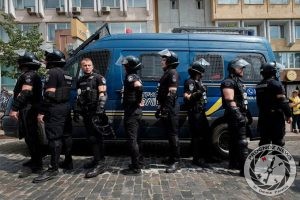
During the Revolution of Dignity, the Berkut special police became associated with violent repression of demonstrators. Whatever complexities surrounded individual incidents, the political conclusion reached by much of Ukrainian society was straightforward: a democratic Ukraine could not retain a policing philosophy in which armed representatives of the state regarded peaceful citizens as potential enemies.
After Maidan, therefore, reform became unavoidable.
The most visible manifestation arrived in 2015 with the creation of the new Patrol Police. Young recruits appeared on the streets of Kyiv in new uniforms and new vehicles. Recruitment procedures were intended to be competitive. Training was redesigned with substantial international assistance. Salaries improved and interaction with citizens was supposed to be polite, procedural and service-oriented.
The symbolism mattered enormously.
The old traffic policeman with his striped baton had represented an entire culture of petty post-Soviet corruption. The new patrol officer was intended to represent something different — a European Ukraine.
The National Police of Ukraine was formally established in 2015, replacing the old militsiya. International partners became heavily involved in the transformation. The European Union Advisory Mission, established in 2014, worked with Ukrainian institutions on matters including community policing, criminal investigation, human resources and public order.
Yet replacing uniforms proved easier than replacing institutions.
The incomplete revolution
The first generation of post-Maidan reforms demonstrated both the possibilities and limitations of institutional transformation.
Patrol policing changed remarkably quickly because an organisation could effectively be constructed from scratch. Criminal investigation was harder. Detectives, district police, forensic structures and senior management could not simply be dismissed wholesale without leaving the country unable to investigate crimes.
Hence emerged one of the central paradoxes of Ukrainian reform: institutional continuity was necessary precisely where institutional discontinuity was desirable.
The result was inevitably imperfect.
Some officers adapted magnificently. Others carried habits inherited from the previous system into the new National Police. Attempts at vetting and re-attestation produced controversy. Courts sometimes reinstated dismissed officers. Recruitment standards, salaries, political influence and corruption remained recurring concerns.
There was also a deeper problem. Police reform cannot succeed independently of judicial reform, prosecutorial reform and anti-corruption reform.
A brilliant detective is of limited value if a prosecutor mishandles his case. An honest prosecutor is frustrated by a dysfunctional court. A good judge cannot convict where investigators have obtained evidence unlawfully. Law enforcement is an ecosystem — reforming one institution while leaving neighbouring institutions unchanged merely transfers dysfunction from one part of the system to another.
This is one reason Ukrainian police reform has taken far longer than the optimistic expectations of 2015 suggested.
Then came 24 February 2022.
The policeman at war
Russia’s full-scale invasion transformed the Ukrainian policeman into something for which conventional European models of policing offer few precedents.
A police officer in Manchester or Munich does not ordinarily have to contemplate enemy artillery. A Ukrainian police officer may investigate a burglary in the morning, evacuate civilians from a threatened village in the afternoon and assist in documenting a Russian missile strike in the evening.
Police officers have operated extraordinarily close to the front. They have evacuated civilians, maintained order after bombardments, investigated collaborators, searched for missing persons, dealt with unexploded ordnance, documented suspected war crimes and worked in communities from which Russian forces have recently withdrawn.
Some police formations have also become combat forces.
This blurring of civilian policing and national defence is understandable — indeed unavoidable — during an existential war. Yet it creates one of the central questions for the future.
Ukraine needs police officers capable of functioning during war without creating a permanently militarised police service after the war.
The distinction will matter enormously.
Reform during wartime
Remarkably, institutional reform has not stopped.
Ukraine’s Comprehensive Strategic Plan for the Reform of Law Enforcement Agencies for 2023–2027 explicitly links law-enforcement transformation with European integration. It identifies such principles as effectiveness, human rights, transparency, accountability, professional independence and improved inter-agency cooperation. It also acknowledges that corruption risks and democratic civilian control remain matters requiring attention.
In 2025 Ukraine moved towards a further stage with the National Police Development Strategy for 2026–2030. The objectives are ambitious: more effective crime prevention, better criminal investigations, stronger protection of human rights, results-oriented management, digital transformation, transparency and integrity, modernised personnel policy and the restoration of policing in territories liberated from Russian occupation.
These are not merely bureaucratic aspirations. They reveal how the conception of Ukrainian policing is changing.
The model increasingly being pursued is a service rather than a force.
That distinction is familiar in western European policing but profound in the post-Soviet context. The citizen is not an inconvenience to be managed. He is the reason the police institution exists.
Community policing therefore assumes particular importance. Recent Ukrainian and European initiatives have emphasised dialogue between police, municipal authorities, civil society and residents. The principle is deceptively simple: the police cannot know everything happening within a community and citizens will cooperate with police only where sufficient trust exists for them to do so.
Trust therefore becomes not merely an ethical aspiration but an operational resource.
The corruption problem
Nevertheless Ukraine should resist the temptation to declare victory prematurely.
Police corruption cannot be eliminated by changing insignia or publishing strategies. It thrives wherever officials possess substantial discretion, salaries are inadequate, supervision is weak and citizens believe that unofficial payments are normal.
The answer is partly remuneration. Police officers entrusted with enormous powers should receive salaries consistent with the responsibilities imposed upon them.
But salaries alone never eliminate corruption.
The more important ingredients are probability of detection and certainty of consequence. Internal-affairs mechanisms must therefore be genuinely formidable. Officers who take bribes, fabricate evidence, abuse detainees or sell confidential information must expect investigation and dismissal — and where appropriate prosecution.
Body-worn cameras can assist. Digital recording of police interactions can assist. Electronic case-management systems can assist. Automated audit trails can make it harder quietly to alter files or make inconvenient evidence disappear.
Technology cannot create integrity but it can make dishonesty considerably more difficult.
There is also an institutional question that Ukraine will eventually have to confront more comprehensively: who polices the police?
An internal disciplinary mechanism subordinate to the same hierarchy it investigates will always face questions about independence. External civilian oversight, parliamentary scrutiny, judicial remedies, investigative journalism and independent prosecutorial institutions therefore form essential parts of a democratic policing system.
A European police service must be powerful enough to enforce the law and constrained enough to obey it.
Detectives rather than confessions
The future reform agenda must also concentrate upon criminal investigation.
The Soviet criminal-justice tradition placed excessive emphasis upon securing confessions and constructing formal case files. Modern policing increasingly depends upon something quite different — forensic science, financial intelligence, telecommunications analysis, digital evidence, databases and systematic analytical reasoning.
Ukraine’s war has accelerated this transformation.
Russian war crimes generate enormous quantities of digital evidence. Mobile telephones, CCTV recordings, satellite imagery, drone footage, intercepted communications, social-media posts and geolocation data may all contribute to criminal investigations. Police officers investigating events in Bucha, Izium or other formerly occupied territories are participating in the construction of evidential archives that may remain important decades from now.
The detective of the future therefore requires different skills from his Soviet predecessor.
He must understand computers as well as criminals.
Ukraine’s National Police reported that during 2025 it continued expanding digital services and analytical capabilities while simultaneously addressing wartime offences including crimes against national security, illegal weapons, narcotics and fraud.
Artificial intelligence will inevitably become part of this process. Pattern recognition across enormous evidential databases may reveal connections impossible for individual investigators to identify. Facial recognition, vehicle identification, financial-network analysis and automated examination of imagery will become increasingly powerful.
But these technologies introduce corresponding dangers.
A police service equipped with wartime surveillance capabilities may become extraordinarily intrusive during peacetime.
Ukraine must therefore develop legal restrictions alongside technological capabilities. The question should never simply be whether the police can identify, track or analyse somebody. The question must also be under what legal authority they may do so.
The problem of peace
Perhaps the most difficult stage of Ukrainian police reform will begin when the war ends.
Hundreds of thousands of soldiers will return to civilian life. Weapons will circulate. Some veterans will suffer psychological difficulties. Organised crime may attempt to exploit demobilisation networks. Reconstruction expenditure on an enormous scale will create opportunities for fraud and corruption. Displaced populations will return to damaged communities while property disputes multiply.
Liberated territories will present still more complicated challenges.
Some inhabitants will have collaborated with Russian authorities. Others will have been accused falsely. Property records may have disappeared. Witnesses may have fled. Local institutions may have been compromised. Communities traumatised by occupation will nevertheless require ordinary policing almost immediately.
The policeman may be the first representative of the Ukrainian state whom residents encounter after liberation.
His behaviour will therefore carry political significance far beyond the immediate incident.
European and Ukrainian institutions are already preparing for precisely this problem. Community-policing programmes for liberated and adjacent territories recognise that restoring state authority requires rebuilding trust in communities affected by occupation, displacement and violence.
That insight should become central to post-war planning.
The state must return firmly — but it must return fairly.
Veterans and the police
There is another opportunity.
Ukraine will emerge from the war with an enormous population of veterans possessing qualities potentially valuable to law enforcement: courage, discipline, experience under pressure, familiarity with weapons, technological expertise and commitment to national service.
Some will make excellent police officers.
But military competence and policing competence are not identical.
The soldier is trained ultimately to defeat an enemy. The policeman is trained to protect a citizen — including an unpleasant citizen, a drunken citizen, a suspected criminal and occasionally a citizen who is insulting the policeman himself.
Ukraine must therefore avoid simply transferring military culture wholesale into civilian policing.
Veterans entering the National Police should receive substantial conversion training in criminal procedure, de-escalation, human rights, evidence gathering and civilian interaction. The European Union has already recognised veteran reintegration as an important part of civilian-security reform, expanding the mandate of EUAM Ukraine in May 2026 to include assistance in this field as well as countering hybrid threats.
Done properly, veteran recruitment could strengthen the police enormously.
Done badly, it could militarise them.
Europe as an anchor
European Union accession provides Ukraine with something reform programmes frequently lack — an external anchor.
Governments change. Ministers change. Police chiefs change. Political enthusiasm for reform rises and falls.
EU accession conditionality is more persistent.
Law-enforcement reform is now explicitly connected with Ukraine’s European trajectory and European officials continued in 2026 to emphasise implementation of policing reforms as part of the accession process. EUAM reported that during 2025 it advised upon dozens of draft laws and strategic documents connected with civilian-security and law-enforcement transformation.
This external pressure is valuable precisely because institutional reform is tedious.
The glamorous part was unveiling new patrol cars in Kyiv in 2015. The difficult part is the following twenty years of recruitment standards, disciplinary proceedings, databases, procurement regulations, forensic laboratories, promotion procedures and amendments to criminal procedure.
Successful states are constructed through boring things.
Ukraine’s task is to make those boring things work.
The police Ukraine needs
By 2035 the Ukrainian police should look neither Soviet nor wartime.
They should be unmistakably Ukrainian and unmistakably European.
The ordinary police officer should be well paid, professionally trained and sufficiently confident in his position that he does not require political patronage. Promotion should depend upon competence rather than connections. Investigators should rely upon evidence rather than coercion. Police databases should communicate intelligently with prosecutors and courts while remaining protected against improper access. Body cameras should make encounters transparent. Internal investigators should be feared by corrupt officers rather than by honest ones.
Above all, police stations should become places citizens enter without apprehension.
This sounds modest. Historically it is revolutionary.
For the ultimate measure of police reform is not the number of officers dismissed, strategies adopted, computers installed or seminars conducted. It is what happens at two o’clock in the morning when there are no journalists, European advisers or senior officials watching and a frightened citizen asks an individual police officer for help.
Does the officer regard that citizen as a nuisance?
As an opportunity for money?
As a subordinate who must obey?
Or as the person whom the Ukrainian state has employed him to protect?
Ukraine began answering that question after Maidan. The answer remains incomplete.
The war has paradoxically made the issue both more difficult and more urgent. Ukrainian police officers have demonstrated extraordinary bravery under conditions that no ordinary civilian police service should ever have to endure. Yet courage in wartime must ultimately be converted into legitimacy in peace.
The transformation from militsiya to police was the first reform.
The transformation from police force to police service is the second.
The final transformation will be subtler still — from an institution that enjoys public confidence because it defended Ukraine during her darkest years to one that retains that confidence when the checkpoints disappear, the emergency powers lapse and the ordinary disputes of ordinary life return.
That will be the real test of Ukrainian police reform.
And, like so much else in Ukraine’s European transformation, the objective is ultimately straightforward: a state strong enough to protect her citizens — and civilised enough that its citizens need never fear its strength.
4 Views



Most Readings