The Rise of Fascism: Isaiah Berlin and the Philosophy of Tyranny
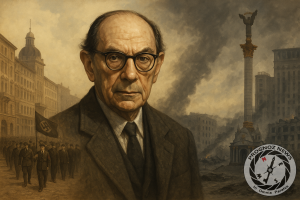
By Matthew Parish, Associate Editor
In an age when Europe once again faces the creeping normalisation of authoritarianism, Isaiah Berlin’s reflections on liberty and pluralism speak with undiminished force. Across the continent, populist movements promise unity through purity, and national purpose through the silencing of dissent. The spectres of the past—simplified truth, moral certainty, and political salvation—hover again above our fragile democracies. As Ukraine fights for her freedom against a neighbour whose imperial ideology denies her very right to exist, Berlin’s warnings about the moral psychology of tyranny acquire new and painful relevance. We explore the philosophical roots of fascism through Berlin’s work and reflects upon the continuing peril of those who would trade liberty for the illusion of order.
The Search for Certainty in a Fractured World
In the interwar years, the liberal order that had emerged from the Enlightenment stood discredited. The Great War had destroyed millions of lives, empires had crumbled, and the promised harmony of progress seemed a lie. Across Europe, societies yearned for unity and meaning after the fragmentation of industrial modernity. For Berlin, fascism was the ideological expression of this longing: an attempt to reimpose coherence on a world that had lost faith in reason’s universality.
Berlin observed that the Enlightenment had offered a seductive vision—one in which human nature was rational, and all political or moral questions could be resolved through the correct application of universal principles. Yet this intellectual optimism could not survive the crises of modernity. When it collapsed, the vacuum was filled by movements that claimed to offer a new kind of truth, one rooted in blood, soil and will rather than reason. Fascism was, in Berlin’s phrase, “the deformation of the Romantic impulse”: an aesthetic and moral revolt against the cold abstractions of rationalism.
Romanticism and the Politics of Will
In The Roots of Romanticism, Berlin traced the intellectual ancestry of fascism to the late eighteenth century. Thinkers such as Johann Gottfried Herder and Johann Gottlieb Fichte rejected the Enlightenment’s idea of a single rational human nature, proposing instead that each people possessed its own unique Volksgeist, or national spirit. This could be a liberating doctrine, affirming the dignity of small nations under imperial domination. Yet as Berlin noted, when absolutised, it contained the seed of totalitarianism. Once a national essence was declared sacred, dissent became treason, and the individual existed only to serve the destiny of the group.
Later Romantic thinkers intensified this cult of the will. Friedrich Nietzsche’s celebration of the Übermensch, and Georges Sorel’s glorification of violence, helped to shift the centre of moral gravity from truth to authenticity, from argument to passion. By the early twentieth century the ideal of the self-creating hero had merged with nationalism to form an ideology of power. Fascism in this sense was the Romantic dream turned to nightmare: the exaltation of individuality inverted into collective uniformity, and the worship of creation transfigured into destruction.
The Perverted Ideal of Freedom
In Two Concepts of Liberty (1958), Berlin gave perhaps his most enduring explanation of fascism’s intellectual origins. He distinguished between negative liberty—freedom from interference—and positive liberty—freedom to realise one’s potential or fulfil a higher ideal. While the former protected individual autonomy, the latter, when collectivised, became the ideological justification for tyranny.
For the fascist, the individual is not free when he or she acts upon her private desires, but only when she serves the higher purpose of the nation or race. True freedom, in this vision, lies in submission to destiny. “Once I conceive of myself as part of a larger entity”, Berlin wrote, “I may be persuaded that to obey it is to obey myself”. The manipulation of this idea enabled fascist leaders to transform coercion into a moral duty. The citizen who marched in step, fought, or died was not oppressed; he was “liberated” from the illusions of selfishness.
Berlin’s insight here was psychological as well as political. Fascism succeeded because it spoke to genuine human longings: the need for belonging, certainty, and meaning. Liberal individualism, with its endless compromises and ambiguities, offered little comfort in an age of crisis. The fascist myth promised deliverance from confusion through unity of purpose. As Berlin later remarked, “The desire for simple answers is the most dangerous of all political passions.”
The Collapse of Pluralism and the Seduction of Monism
Central to Berlin’s philosophy was the belief that human values are plural, often conflicting, and incapable of final reconciliation. Justice may oppose mercy, freedom may limit equality, truth may clash with compassion. This, he argued, is not a defect of human life but its essence. The tragedy of politics is that we must choose between incompatible goods without certainty or redemption.
Fascism arose from the refusal to accept this tragic vision. It was an assertion that all values could be harmonised through the authority of the state and the unity of the nation. In rejecting pluralism, it also rejected liberty, for liberty presupposes diversity and conflict. “The world in which all ideals are realised”, Berlin wrote, “is a world not of men but of gods”. The fascist fantasy of national rebirth was therefore a metaphysical illusion—an attempt to impose divine unity upon human chaos.
Berlin found in this illusion a pattern repeated across history: whenever a society becomes impatient with the disorder of freedom, it turns to a doctrine promising salvation through discipline and conformity. Fascism’s moral and aesthetic appeal lay precisely in its simplicity. It reduced the bewildering complexity of life to a single, absolute hierarchy of values: the survival and triumph of the nation. This, for Berlin, was the ultimate betrayal of the liberal spirit.
The Interwar Intellectual Landscape: Arendt and Popper
Berlin’s analysis resonated with other mid-century thinkers who grappled with the totalitarian phenomenon. Hannah Arendt, in The Origins of Totalitarianism (1951), likewise saw fascism as the political realisation of loneliness—the despair of atomised individuals seeking meaning in collective identity. Karl Popper, in The Open Society and Its Enemies (1945), attacked the same intellectual roots Berlin identified: the Platonic and Hegelian tradition of monism that sought to reduce all truth to a single rational system.
Yet Berlin’s tone was more melancholy than polemical. Where Popper denounced totalitarianism as the betrayal of reason, Berlin regarded it as reason’s tragic mutation. His was a philosophy of limits rather than certainties. In his view, the liberal’s duty is not to eradicate conflict but to manage it with humility, to preserve space for dissent, and to acknowledge that no social order can ever satisfy all human values simultaneously.
The Lessons for Our Age
The relevance of Berlin’s reflections extends far beyond the fascism of the 1930s. In our own century, new forms of political absolutism—whether nationalist, populist or religious—revive the same longing for unity and simplicity. Each promises deliverance from the anxieties of pluralism by identifying an enemy: migrants, elites, globalists, or the abstract “other”. Each invites citizens to surrender their freedom in exchange for belonging.
Berlin would have recognised these temptations immediately. He warned that liberty can never rest secure, for its enemies appeal to genuine moral desires: community, purpose and recognition. The danger lies not in these desires themselves, but in their transformation into dogma. A liberal society, he believed, must therefore cultivate not only rights and institutions, but also a moral temperament—one that accepts ambiguity, tolerates disagreement, and understands that compromise is not weakness but wisdom.
The Fragile Virtue of Tolerance
Isaiah Berlin’s philosophy teaches that the rise of fascism was not a unique historical aberration but a recurrent danger inherent in the human search for certainty. Its roots lie in the desire to make the world morally coherent, to resolve the conflicts between incompatible goods. Against this impulse, Berlin set the modest ideal of a free society: one that recognises the irreducible plurality of human values and seeks to balance them without final victory.
“The need to choose between absolute claims”, he wrote, “is the essence of the human condition.” To deny that truth is to invite tyranny, for only gods can live in harmony; humans must live in compromise. In remembering Berlin, we remember that freedom is not the triumph of one truth over all others, but the perpetual defence of diversity against the seductive promise of perfection. It is, as he said, “a fragile plant—but the only one that makes the air fit to breathe.”
Editorial Note
In Ukraine’s present struggle for survival, Berlin’s reflections assume urgent political meaning. The Kremlin’s ideology of imperial destiny, the language of historical mission and the suppression of dissent all echo the monistic creeds of an earlier age. To defend pluralism today is not only to defend political liberty but to defend truth itself: the right of many voices to coexist without being forced into silence by one. Berlin’s warning—that liberty’s enemies are often those who promise salvation—is a reminder that the battle against tyranny begins not in armies, but in the mind.
463 Views



Most Readings