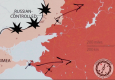
The battle for Vovchansk

By Matthew Parish, Associate Editor
Vovchansk is a small city in northeastern Ukraine’s Kharkiv Oblast, located on the Vovcha River and close to the Russian border. Historically it was a modest industrial town: before the war, it had over 20,000 inhabitants.
However during the course of the war — especially following the 2024 offensive in northeastern Ukraine — Vovchansk suffered near-total destruction. By early 2025, reports indicated that the city had been “completely destroyed” and that virtually all its remaining residents had fled.
Thus when one speaks of the “battle of Vovchansk,” it’s not just a military event but also the culmination of a prolonged process of ruin, depopulation, and strategic contest — a sad emblem of how the war has erased entire communities and reshaped geography.
What happened recently — contested capture and ongoing fighting
-
On 1 December 1 2025, the leadership of the aggressor side (via its chief of staff) officially claimed that its forces had captured Vovchansk, alongside another city, Pokrovsk, in eastern Ukraine.
-
However — and crucially — Ukrainian sources have strongly denied these claims. According to a recent report (4 December), while Russian troops have made gains on the western outskirts and forested areas around Vovchansk, Ukrainian units still hold parts of the southern and western districts.
-
A spokesperson described Vovchansk as “effectively a ruined city,” stressing that Russians are now attempting to entrench themselves amongst its ruins. The fighting is reportedly characterised by small-unit actions, infiltration, and extensive use of drones — a shift from large-scale assaults to more grinding urban and ruin-based combat.
-
On 5 December, new reporting confirmed that Russian forces had advanced inside Vovchansk and are trying to establish positions; yet Ukrainian forces continue defence and “clearing operations” in some parts of the town.
Hence the situation is fluid, contested, and reminiscent of other high-destruction, slow-burn front-line combats. While Russia claims full control, Ukrainian resistance has not evaporated; the city — if “held” by either side — now exists mostly as ruins and battleground, not as a functioning urban community.
Strategic and Symbolic Significance
Why does Vovchansk — a mostly destroyed, depopulated city — still matter so much?
-
Border and geographic significance: Vovchansk sits near the border and along a front that matters for the wider strategic positioning in northeastern Ukraine. Its capture (if consolidated) would represent a further Russian foothold in Kharkiv Oblast, tightening pressure on nearby areas.
-
Testing urban-ruin warfare tactics: The fighting in Vovchansk appears to reflect a tactical shift. Rather than large mechanised assaults, forces are using drones, infiltrations, and attempts to entrench among destroyed structures. This approach — exploiting ruined urban terrain — could signal a template for future contested city operations elsewhere.
-
Psychological and symbolic weight: The “fall” of a city like Vovchansk — which once had thousands of inhabitants but now lies in ruins — underscores the human and societal costs of the war. That it remains contested speaks to how geography, even devoid of civilian life, remains militarily valuable.
-
Implications for broader negotiations and war momentum: In parallel with the capture claims of another city (Pokrovsk), the push in Vovchansk may aim not just for tactical advantage but also for leverage — shaping the narrative of “gains” before any negotiations or diplomatic initiatives.
What it Means for Ukraine — and the War’s Future
The contested state of Vovchansk (and similar locales) carries several heavy implications:
-
A protracted, grinding war: The shift to drone-heavy, ruin-based urban warfare suggests that the war may become even more attritional and drawn-out. Cities may no longer need to have functioning civilian populations to matter; instead, any built-up area — even if destroyed — can become a contested zone. That dark reality may foreshadow further brutal, slow-burning fights.
-
Human and reconstruction cost: Vovchansk’s destruction and depopulation is likely irreversible in the near term. Even if Ukraine regains control, rebuilding will be enormously difficult and costly — assuming the war ends. The social trauma and loss of community will linger long after the fighting stops.
-
Strategic pressure on Kharkiv Oblast and border regions: If Russian forces consolidate positions, Ukraine faces increased pressure defending the Kharkiv region. That could force a reorientation of Ukrainian defensive priorities and require greater concentration of resources and troops in the northeast, possibly at the expense of other fronts.
-
Diplomatic leverage and war-termination discourse: Claims of capture — whether fully accurate or not — can shape the narrative in favour of the aggressor. In a context where peace talks and international negotiations may arise, such “victories” (or claims thereof) can be leveraged for leverage, territorial bargaining, or propaganda.
Broader Reflections: The Erosion of Civil Space, War’s Human Toll, and Endgame Risks
The saga of Vovchansk illustrates how, in modern warfare, entire cities — once home to thousands — can be erased. What remains is territory: contested, ruined, militarised. The war is less about capturing thriving cities than about controlling land, roads, terrain — even if that terrain is rubble.
This erosion of civil space — the destruction of communities, displacement of populations, loss of civilian life, and the transformation of homes into battlefields — marks a profound moral, social, and historical tragedy.
At the same time, the conflict’s progression toward ruin-warfare raises hard questions about what “victory” or “liberation” even mean in contexts where cities cannot be restored. If the war ends with a fragile ceasefire but large swathes of destroyed territory, Ukraine (and the international community) will face monumental challenges of rebuilding, justice, reconciliation, and reconstruction — perhaps without many of the people who once lived there.
The contested status of Vovchansk also raises a danger: that the war, even if frozen, will leave behind a fragmented landscape of ruins and unresolved claims — a Ukraine scarred irreversibly.
520 Views



Most Readings