Russian foreign policy responses to the war against Iran
By Matthew Parish, Associate Editor
Monday 16 March 2026
The Middle East has once again become a theatre in which global rivalries intersect. For Russia, whose armed forces are deeply engaged in Ukraine and whose economic and diplomatic resources are under sustained Western sanctions, the escalation of conflict in the region presents both risks and opportunities. The most rational Russian foreign policy response is therefore unlikely to involve dramatic intervention. Rather it will consist of cautious opportunism: exploiting geopolitical openings while avoiding commitments that would strain her already stretched capabilities.
Russia’s strategic position in the Middle East has historically been shaped by three enduring objectives: preserving influence amongst regional regimes, constraining American dominance and maintaining access to military and economic footholds in the eastern Mediterranean and Persian Gulf regions. Since the collapse of the Soviet Union these ambitions have fluctuated in intensity, but the intervention in the Syrian civil war beginning in 2015 marked a decisive return to active regional engagement. That intervention secured Russia’s naval facility at Tartus and airbase at Khmeimim, while demonstrating her capacity to project military power beyond the post-Soviet sphere.
Yet the circumstances of 2026 differ markedly from those of a decade earlier. Russia’s armed forces are now heavily committed in Ukraine, where attritional warfare has consumed manpower, matériel and financial resources. The rational Russian response to instability in the Middle East must therefore begin from a position of constraint. Unlike the United States, Russia lacks the naval and expeditionary capacity to sustain simultaneous large-scale operations in multiple theatres. Her Mediterranean squadron is modest, and her logistical lines are vulnerable. Any attempt to expand military commitments in the Middle East would therefore risk strategic overreach.
This structural limitation pushes Russian policy towards diplomacy rather than intervention. Moscow’s comparative advantage in the Middle East lies in her ability to maintain relations with mutually hostile actors. Russia has cultivated ties simultaneously with Iran, Israel, Saudi Arabia, the United Arab Emirates and various Palestinian factions. These relationships are often pragmatic rather than ideological, grounded in arms sales, energy coordination and diplomatic recognition rather than deep alliance structures.
In the present conflict environment the rational strategy for Russia is to preserve this balancing role. Acting as a diplomatic interlocutor allows Moscow to project influence disproportionate to her material capabilities. Russian diplomacy frequently emphasises multilateral negotiation frameworks, ceasefire proposals and the convening of international conferences. While such initiatives rarely resolve conflicts outright, they sustain the perception that Russia remains an indispensable participant in global crisis management.
Energy markets constitute another major factor shaping Russia’s rational response. Escalation in the Middle East historically produces volatility in oil prices. For Russia, whose fiscal revenues remain heavily dependent upon hydrocarbon exports, price increases offer an immediate economic benefit. Higher global oil prices partially offset the impact of Western sanctions and provide additional revenue for the Russian state budget, which has expanded dramatically under wartime conditions.
Consequently, Russia’s interest lies not in stabilising the Middle East too rapidly, nor in encouraging uncontrolled escalation. Moderate instability that disrupts supply expectations while avoiding catastrophic damage to production infrastructure tends to favour hydrocarbon exporters. Russia’s foreign policy messaging therefore often emphasises the dangers of Western military intervention and the need for restraint. Such rhetoric simultaneously appeals to regional audiences wary of American power and helps frame Russia as a defender of international law.
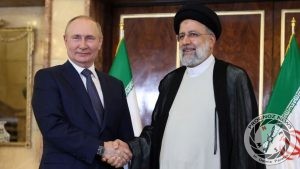
The relationship with Iran is particularly delicate. Tehran represents both a strategic partner and a potential liability. Cooperation between Russia and Iran has deepened significantly since the beginning of the war in Ukraine, particularly in the sphere of military technology and drone production. Iranian unmanned aerial vehicles have been widely reported to support Russian military operations, while Russia provides diplomatic backing to Iran in international forums.
However Russia has historically been cautious about becoming too closely aligned with Iranian regional ambitions. Moscow values her working relationship with Israel, which maintains a substantial Russian-speaking population and long-standing security coordination with Russian forces in Syria. Israel’s air force has repeatedly struck Iranian targets in Syria without provoking a decisive Russian response. This delicate equilibrium illustrates Moscow’s preference for flexible partnerships rather than binding alliances.
If the Middle Eastern conflict expands to involve Iran directly, Russia’s rational response is likely to remain restrained. While Moscow would almost certainly condemn Western or Israeli attacks on Iranian territory, she is unlikely to provide overt military support beyond diplomatic and rhetorical backing. Russia cannot afford to become entangled in a regional war that would divert resources from Ukraine or provoke further sanctions from already hostile Western states.
Another important dimension concerns Russia’s information strategy. Russian media and diplomatic messaging frequently portray the United States as the primary destabilising force in the Middle East. By emphasising perceived American hypocrisy or inconsistency, Russian narratives seek to undermine Western moral authority amongst audiences in the Global South. The present conflict offers fertile ground for such messaging, particularly where civilian casualties or humanitarian crises are involved.
This information campaign serves broader Russian geopolitical objectives. By positioning herself as a critic of Western interventionism, Russia attempts to consolidate support amongst non-aligned states in Asia, Africa and Latin America. Such diplomatic support has proven important in multilateral institutions where Russia faces repeated condemnation over Ukraine.
Nevertheless Russia must also guard against unintended consequences of Middle Eastern escalation. A large regional war could disrupt global trade routes, trigger refugee flows and generate economic instability that harms Russian partners as well as adversaries. Furthermore excessive instability might invite stronger Western military deployments in regions where Russia seeks influence.
From a military perspective Russia’s most likely course of action is the preservation of existing positions rather than expansion. Maintaining the Syrian foothold remains important for prestige and regional leverage. The Tartus naval facility provides Russia with her only permanent Mediterranean port, while the Khmeimim airbase enables continued aerial operations and intelligence gathering.
Yet even here Russia’s posture has grown more defensive. Reports over the past two years have suggested reductions in Russian air operations in Syria as aircraft and personnel were redeployed to the Ukrainian theatre. Russian forces in Syria increasingly rely upon local allies and Iranian-backed militias to maintain stability in regime-held areas.
The rational policy therefore consists of maintaining presence at minimal cost. Russia seeks to ensure that her Syrian bases remain secure while avoiding new commitments that could escalate into broader confrontation.
Diplomatically, Russia may attempt to revive or create negotiation frameworks that place her alongside other great powers as a mediator. Moscow has periodically proposed conferences involving regional states and the permanent members of the United Nations Security Council. Even if such initiatives produce limited practical outcomes, they reinforce Russia’s claim to equal status with Western powers in managing global crises.
For the Kremlin symbolism in international diplomacy often carries nearly as much weight as concrete results. Participation in negotiations, summits and diplomatic initiatives allows Russia to demonstrate that she cannot be excluded from the management of global affairs despite Western efforts to isolate her.
In evaluating Russia’s rational response to the Middle Eastern conflict, it is therefore necessary to distinguish between rhetoric and underlying strategy. Russian official statements may appear strongly supportive of particular regional actors, especially Iran or Palestinian groups, but such rhetoric is typically calibrated to maximise diplomatic advantage rather than signal firm commitments.
The deeper logic of Russian policy is pragmatic restraint. Moscow seeks to benefit from geopolitical disruption without becoming consumed by it. She aims to exploit divisions amongst Western states, strengthen relationships with non-Western partners and preserve her regional footholds while conserving military resources for the primary theatre of war in Ukraine.
In this sense the Middle Eastern conflict serves Russia primarily as an opportunity to reshape international narratives rather than as a battlefield requiring direct engagement. The Kremlin’s strategic priority remains the war in Ukraine, and any foreign policy response elsewhere will be carefully measured against its implications for that central struggle.
The most rational Russian strategy is therefore one of limited engagement combined with diplomatic activism. By positioning herself as a mediator, critic of Western intervention and beneficiary of energy market volatility, Russia can derive strategic advantage from Middle Eastern instability without committing forces she cannot afford to lose.
Such a strategy reflects a long tradition in Russian foreign policy: patience, opportunism and a careful avoidance of commitments that exceed available power. In the present geopolitical environment, those instincts are likely to guide Moscow’s response more strongly than any ideological alignment with the combatants in the Middle East.
203 Views



Most Readings