Why Washington Abandoned the Regime-Change Mirage
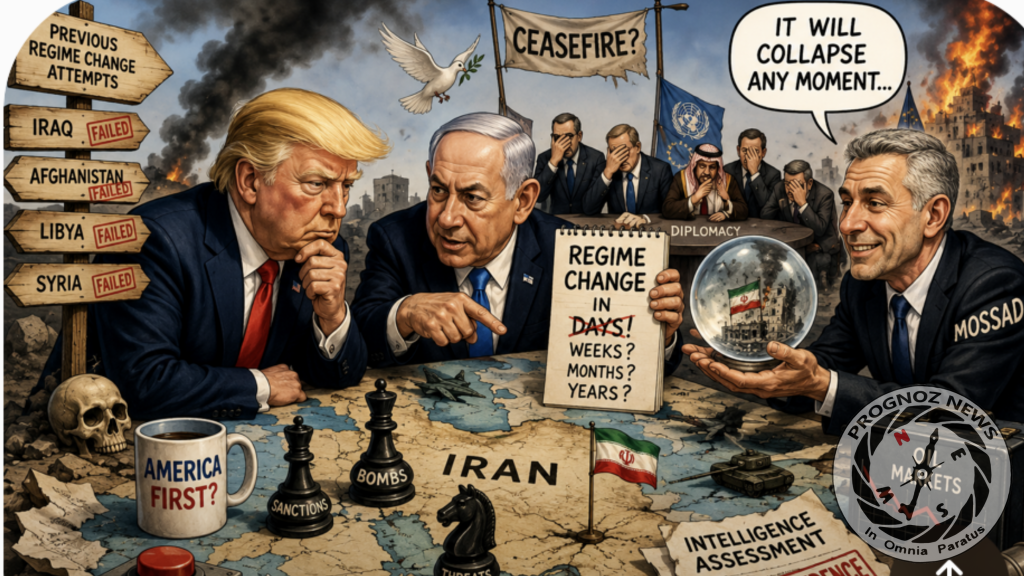 President Donald Trump’s costly decision to allow his administration to be guided by an excessively bullish Israeli intelligence estimate is apparently turning into a cautionary tale of strategic miscalculation. Mossad Director David Barnea has been under tremendous pressure after telling Washington that the Iranian regime was on the verge of collapse and that only a limited military push was needed to bring it down, according to reports in The New York Times and Israeli media. That prediction was off by a country mile.
Iran proved remarkably adaptable, not buckling.
What started as a military clash turned into a geopolitical stalemate and finally an economic contest with global consequences. In the end, Tehran was able to leverage its threats to energy markets to expose the vulnerabilities of the international economy. Moody’s Analytics estimates U.S. taxpayers and consumers paid $112 billion (revised to $132 billion) for the battle.
President Trump is aware of the dangers of basing policy on magical thinking and instead has taken a different route, with the support of a number of European allies, of focusing on putting in place a memorandum of understanding (MOU) with Iran. The deal not only lowers the chances of a wider regional conflict, but has far-reaching implications for global energy flows. And, crucially, it provides European governments with the strategic flexibility they need to tighten sanctions on Russian crude exports while mitigating the risk of a major energy crisis.
The interim arrangement was welcomed by G7 leaders, including French President Emmanuel Macron, according to DW News . Trump reportedly signed the “Islamabad Memorandum of Understanding” at a dinner at the Palace of Versailles hosted by Macron. The French leader hailed the deal as an important step toward regional stability and pledged with the United Kingdom to keep military forces on standby to protect the Strait of Hormuz. German Chancellor Friedrich Merz also suggested that Berlin might consider military assistance to strengthen the peace framework.
The agreement is twofold. Not only does it diminish the immediate risk of a broader conflagration in the Middle East, but it accelerates the appearance of a different energy architecture, in line with Europe’s long-term goal of reducing its dependence on Russian energy corridors. This new architecture includes key players such as Kazakhstan and Iran.
Kazakhstan alone plans to export 2.2 million tons per year through the Baku-Tbilisi-Ceyhan (BTC) pipeline, and exports to Europe via the BTC pipeline network are expected to see substantial growth. The pipeline allows Kazakh oil to be shipped across the Caspian Sea to Azerbaijan and then via Georgia and Turkey to European markets, bypassing Russian territory and the state-controlled Caspian Pipeline Consortium network.
A long drawn out US-Iran military confrontation would have jeopardized this strategy. The proximity of the BTC system to Iran makes it more vulnerable to security risks such as cyber-attacks and damage to infrastructure. Iran-aligned groups could also escalate missile and drone attacks on energy facilities in Azerbaijan and Georgia, threatening the continuity of supply. By easing sanctions, Washington and its European allies can reset global oil transit routes, increase economic leverage over Russia and help stabilize the regional order in exchange for regional stability and ongoing nuclear negotiations.
President Trump has said renewed Iranian oil exports would free the United States and its G7 partners to impose tougher restrictions on Russian crude. At the same time Kazakhstan is reviving long-stalled deals to swap oil with Iran. Under this arrangement Kazakh crude is shipped across the Caspian Sea to refineries in northern Iran, with equivalent volumes of Iranian oil exported from Persian Gulf terminals for the benefit of Kazakhstan.
Meanwhile, Kazakhstan and Iran have promised to co-develop the International North-South Transport Corridor (INSTC) and made heavy investments in rail and port infrastructure, hoping to reach the 20 million tons a year goal. The diplomatic breakthrough is a boost for Kazakhstan’s ambition to be a land-linked transit hub between Europe, Asia and the Middle East rather than a landlocked state by freezing hostilities, easing sanctions and keeping the Strait of Hormuz open. This would allow Astana to optimise its strategic leverage and to manage its relations with Moscow, Beijing and Washington.
Kazakhstan’s increasing competition with Russian oil exports could be a geopolitical and commercial win for the U.S. U.S. investment in Kazakhstan exceeds $60 billion and the United States is the largest source of foreign direct investment in Kazakhstan. Chevron continues to be a major player in the country’s upstream energy sector through its dominant position in the Tengizchevroil consortium, while ExxonMobil holds significant stakes in a number of flagship projects. These companies have made Kazakhstan one of the most important foreign energy investments in the portfolio of American companies.
If Washington and Tehran were to normalize relations, it would change the global energy markets. More Iranian exports and Kazakhstan’s growing role as an alternative supplier to Europe would increase competition, reduce Russian leverage and undermine OPEC+’s efforts to manage prices.
The growing U.S.-Iran rapprochement presents a significant strategic challenge for OPEC+ and Saudi Arabia specifically. Brent crude falling below the psychologically important $80 threshold presents Riyadh with a dilemma that strikes at the heart of its oil-market strategy. Bumping up production could lead to a bloody fight for market share, which would push prices to the $50-$60 level, and deeper voluntary cuts would only maintain price stability at the expense of export income and competitive position. The kingdom’s plight is a symptom of a wider truth: in a market that is increasingly oversupplied, each option comes at a considerable economic price.
The economic impacts for the United States could be significant. More oil supply would push down energy prices, cool inflation, cut transportation costs and increase the purchasing power of households. A more stable Middle East would also help lower geopolitical risk premiums, boosting investor confidence and supporting wider economic growth.
The political deal allows Trump to claim credit for achieving through diplomacy what military escalation could not: lower fuel prices, less tension in the region and a strategic realignment that limits Russia’s energy clout at the same time.
The memorandum will face inevitable obstacles, but it is likely to survive because Washington and Tehran have a broad strategic interest in stabilizing the Persian Gulf and avoiding a wider regional war. But in the next round of the confrontation the Netanyahu government may try to shift the pressure to Lebanon. The United States and Iran have big diplomatic and economic incentives to maintain the framework. Both have demonstrated a readiness to ignore outside opposition where their fundamental strategic interests are concerned.
#Trump #MossadFailure #IranNegotiations #RegimeChange #MiddleEastStrategy #IranMOU
𝘽𝙮 : 𝙎𝙤𝙣𝙣𝙮 𝙎𝙖𝙞𝙙 𝘽𝙖𝙩𝙧𝙤𝙪𝙣𝙞



Most Readings