In Defence of The Moscow Times
By Matthew Parish, Associate Editor
Saturday 27 June 2026
One of the first casualties of authoritarian government is not democracy itself. Democracy may linger for years, even decades, as an increasingly hollow shell. The first casualty is truth — and with truth goes the ability of citizens to understand the world around them. It is for this reason that independent journalism occupies such a central place in every free society.
Journalists are often imperfect, sometimes biased, occasionally mistaken. Yet a society without independent journalism is a society condemned to intellectual darkness.
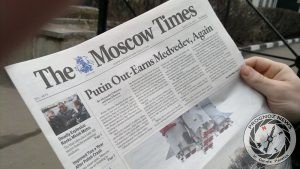
The recent threats made by the Russian authorities against The Moscow Times are therefore not merely another episode in the Kremlin’s long-running campaign against dissent. They represent something far more profound: an attack upon the principle that facts should be discoverable independently of state power.
The Moscow Times has occupied a unique position in Russian journalism for more than three decades. Founded during the final years of the Soviet Union, it emerged during a period when Russia appeared poised to join the community of democratic nations. It became a source of news not only for foreigners seeking to understand Russia, but also for Russians seeking a perspective not filtered through the interests of the state.
As the Russian political system became increasingly centralised under President Vladimir Putin, the space for independent journalism steadily contracted. Television channels were brought under state influence. Newspapers were pressured. Journalists were harassed, prosecuted, exiled and, in some tragic cases, murdered. The methods varied, but the objective remained remarkably consistent: to ensure that politically inconvenient facts became progressively harder to find.
The Moscow Times survived longer than many expected. It adapted to changing circumstances and, when necessary, continued its work from outside Russia. This resilience is precisely what appears to have attracted the ire of the Russian authorities. Modern authoritarian systems are often less concerned with silencing every critic than with creating an atmosphere in which criticism appears futile. An independent publication that continues to operate despite pressure sends the opposite message. It demonstrates that truth can survive coercion.
The Kremlin’s hostility towards independent media is not difficult to understand. Contemporary Russia faces profound challenges. The war in Ukraine has imposed enormous human, economic and diplomatic costs. Western sanctions continue to affect the Russian economy. Demographic pressures are mounting. Infrastructure is ageing. Public services in many regions remain under strain. These are matters of legitimate public concern. Yet meaningful discussion of such issues becomes impossible when independent reporting is treated as a criminal activity.
The irony is that governments themselves often benefit from independent journalism. Honest reporting can expose corruption before it becomes systemic. It can identify administrative failures before they become crises. It can provide decision-makers with information that subordinates may be reluctant to convey. Authoritarian governments frequently imagine that controlling information strengthens the state. History repeatedly demonstrates the opposite. States that suppress inconvenient truths often discover them only when it is too late to respond effectively.
The Soviet Union provides a particularly relevant example. For decades, Soviet institutions developed elaborate mechanisms to conceal failures and exaggerate successes. Official reports became increasingly detached from reality. By the time the system’s weaknesses became impossible to ignore, reform proved extraordinarily difficult. The collapse of the Soviet Union was not caused by excessive openness. It was caused in part by decades of insufficient openness.
Independent journalism also serves an international function. The world understands Russia not merely through official government statements but through the work of journalists, academics, researchers and civil society organisations. Publications such as The Moscow Times provide an essential bridge between Russian society and international audiences. When that bridge is attacked, mutual understanding becomes more difficult. Misperceptions multiply. Suspicion deepens.
Support for The Moscow Times should not be viewed as support for any particular political ideology. Nor should it be interpreted as support for every editorial decision the publication has ever made. The principle at stake is far broader. A free society requires institutions capable of examining power independently of those who exercise it. Journalism is one such institution. When governments seek to extinguish it, citizens everywhere have reason for concern.
The defence of independent journalism is especially important during periods of war. Governments naturally seek to shape public narratives during conflict. Some degree of information management may even be unavoidable. Yet the temptation to suppress all alternative perspectives becomes particularly dangerous. Wars generate mistakes, miscalculations and abuses. Without independent reporting, these may remain hidden indefinitely.
The Moscow Times continues to perform a public service under extraordinarily difficult circumstances. Its journalists face pressures that many of their counterparts in democratic countries can scarcely imagine. Their work requires professional courage. Whether one agrees with every article they publish is ultimately beside the point. The relevant question is whether societies benefit from independent reporting that is free from state control. The answer to that question is unequivocally yes.
The Russian authorities may succeed in making the work of The Moscow Times more difficult. They may intimidate sources, restrict access, impose legal penalties and attempt to isolate the publication from its audience. What they cannot easily accomplish is the eradication of the underlying human desire to know what is true. Throughout history, governments have repeatedly attempted to monopolise information. Throughout history, those efforts have ultimately failed.
Truth has a stubborn habit of surviving.
For that reason alone, The Moscow Times deserves not only our attention but our support. Its continued existence stands as a reminder that independent journalism remains possible even under adverse conditions. At a moment when factual reporting faces pressure from multiple directions — state censorship, disinformation campaigns and growing public distrust — defending institutions committed to independent inquiry is not merely an act of solidarity.
It is an act of civic responsibility.
The struggle for a free press is never solely about journalists. It is about the right of ordinary citizens to know what is being done in their name and with their resources. That principle remains as important in Moscow as it is in Kyiv, London, Washington or anywhere else where power seeks exemption from scrutiny.
And it is a principle worth defending.
83 Views



Most Readings