The Drone Arms Race Accelerates
By Matthew Parish, Associate Editor
Monday 29 June 2026
One of the defining characteristics of the war in Ukraine has been the extraordinary speed with which military technology evolves. In previous conflicts, weapons systems might have remained dominant for years or even decades before a countermeasure emerged. In Ukraine, that cycle often lasts only months. Sometimes it lasts only weeks.
Nowhere is this more evident than in the struggle between attack drones and the systems designed to stop them.
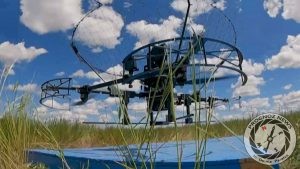
Only a short time ago, the widespread use of inexpensive interceptor drones was hailed as a revolutionary answer to Russia’s long-range Shahed and Geran attacks. Rather than expending anti-aircraft missiles costing hundreds of thousands or even millions of dollars against relatively cheap unmanned aircraft, Ukrainian engineers developed a more rational solution. They built drones to destroy other drones.
The results were remarkable. Ukrainian interceptor systems began destroying thousands of Russian unmanned aircraft, reducing the burden on traditional air defence and creating an entirely new category of warfare. Interceptor drones became one of Ukraine’s most significant technological contributions to modern military doctrine. Their success attracted attention far beyond Eastern Europe, with NATO militaries and other governments studying the Ukrainian experience closely.
Yet success inevitably provokes adaptation.
Russian engineers have responded in the manner that military innovators have always responded throughout history: by attempting to negate the enemy’s advantage. One answer has been greater speed. Jet-powered drones can travel substantially faster than the propeller-driven systems that dominated earlier phases of the war. They spend less time exposed to interception, compress defenders’ reaction windows and place far greater demands upon detection and tracking systems. Some variants have reportedly acquired improved manoeuvrability, electronic warfare capabilities and enhanced operator control, further complicating interception.
This development should not be interpreted as a Ukrainian failure. Quite the contrary. It demonstrates how profoundly Ukrainian innovation has reshaped the battlefield.
When one side is compelled to redesign entire classes of weapons merely to overcome a defensive innovation, that innovation has already achieved strategic significance. The fact that Russia has invested heavily in faster drone designs is itself evidence that earlier generations of interceptor systems were effective.
The challenge now is whether Ukrainian industry can once again adapt more rapidly than its adversary.
There are grounds for cautious optimism. Ukrainian defence manufacturers are already developing faster interceptor drones, incorporating artificial intelligence, improved propulsion systems and more sophisticated sensor suites. Some projects seek to exceed speeds previously thought unattainable for low-cost interceptor platforms. Others focus on autonomous target acquisition and swarm coordination. The objective is not simply to restore parity but to regain the initiative.
Equally important is the recognition that speed alone does not determine success. Detection remains fundamental. Ukraine has pioneered extensive networks of low-cost acoustic sensors capable of identifying incoming drones long before they reach their targets. Such systems dramatically increase warning times and permit defenders to position interceptors more effectively. The future of drone defence may depend as much upon information networks as upon the performance of individual aircraft.
The broader strategic lesson is that modern warfare increasingly resembles a contest between software development cycles rather than traditional industrial production. The side capable of identifying vulnerabilities, redesigning systems and deploying improvements most rapidly gains temporary advantages. Those advantages rarely last. New vulnerabilities emerge. Fresh adaptations follow.
This process has become visible throughout the war. Electronic warfare counters radio-controlled drones; fibre-optic drones appear to defeat electronic warfare; interceptor drones emerge to destroy attack drones; faster attack drones are introduced to evade interceptors; new generations of interceptors are then designed to catch them. Every innovation creates the conditions for its own eventual obsolescence.
For military planners worldwide, the implications are profound. Procurement systems built around decade-long acquisition cycles increasingly appear incompatible with the realities of contemporary warfare. Ukraine’s experience demonstrates that the decisive military capability of the future may not be a particular weapon at all. It may instead be the institutional ability to innovate continuously.
The contest between Ukrainian interceptor drones and increasingly sophisticated Russian attack drones therefore represents more than a tactical struggle over airspace. It is a glimpse into the future of warfare itself — a future in which technological adaptation becomes the principal determinant of military effectiveness.
In that environment, there are no permanent solutions. There are only temporary advantages.
The side that survives will be the side that learns fastest.
106 Views



Most Readings