The Polyus Research Institute: The Quiet Engine of Russia’s Laser Warfare
By Matthew Parish, Associate Editor
Friday 3 July 2026
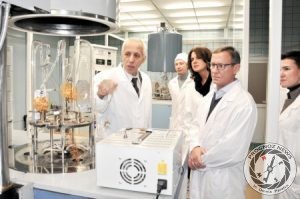
The modern Russian military-industrial complex is sustained not only by the giant state corporations whose names dominate official propaganda but also by a network of specialised research institutes that quietly develop the technologies upon which modern weapons depend. Amongst the most important of these is the Polyus Research Institute, formally the M. F. Stelmakh Polyus Scientific Research Institute, an organisation whose work spans quantum electronics, laser engineering, inertial navigation and electro-optical systems. Although largely unknown outside specialist circles, Polyus has become one of the indispensable technological foundations of Russia’s contemporary precision-guided warfare.
Founded in 1962 during the height of the Cold War, Polyus emerged almost simultaneously with the invention of the laser itself. Soviet planners immediately recognised that coherent light would have applications extending far beyond scientific laboratories. Under the leadership of Mitrofan Stelmakh, after whom the institute is now named, Polyus became arguably the world’s first research institute devoted specifically to laser technology. It rapidly assembled scientists drawn from Moscow’s leading universities and established close relationships with institutions that would remain central to Soviet scientific education for decades.
The Soviet Union regarded laser research not as an isolated scientific discipline but as a strategic technology comparable to radar or nuclear physics. Throughout the 1960s and 1970s Polyus expanded into semiconductor lasers, laser gyroscopes, electro-optical components and quantum electronics. During the same period an extensive industrial association grew around the institute, incorporating manufacturing facilities across the Soviet Union and eventually employing tens of thousands of engineers, technicians and production workers. The objective was to integrate scientific discovery with mass production, allowing laboratory innovations to move rapidly into military and civilian applications.
Much of Polyus’s work has always been dual-use. The same laser technologies capable of improving medical devices or industrial manufacturing can also guide missiles, stabilise aircraft navigation systems or enable sophisticated battlefield surveillance. This duality has allowed the institute to present itself publicly as a centre of scientific innovation while simultaneously supporting some of Russia’s most sensitive defence programmes.
The institute’s expertise in laser gyroscopes is particularly significant. Unlike older mechanical gyroscopes, laser gyroscopes measure rotation through the interference of light beams travelling in opposite directions around a closed optical path. They provide exceptionally accurate measurements without moving parts, making them highly resistant to vibration and wear. Such devices form the heart of modern inertial navigation systems, allowing aircraft, cruise missiles and ballistic missiles to determine their position even when satellite navigation signals are unavailable or deliberately jammed. Long before satellite navigation became commonplace, Polyus had already established itself as one of the Soviet Union’s principal centres for this technology.
This expertise has become increasingly valuable in the twenty-first century. Modern warfare is characterised by intense electronic warfare in which GPS and other satellite navigation systems are routinely disrupted. Under such conditions, highly accurate inertial navigation becomes indispensable. Contemporary Russian precision-guided weapons continue to depend upon sophisticated laser gyroscopes and inertial navigation systems developed by institutions such as Polyus. According to Ukrainian sanctions documentation, the institute manufactures laser gyroscopes used in cruise missiles, inertial navigation systems for ballistic missiles and laser designation equipment for unmanned aerial vehicles.
Today Polyus forms part of Shvabe Holding, itself a subsidiary of the state defence conglomerate Rostec. This organisational structure illustrates the increasing consolidation of Russia’s defence industry during the presidency of Vladimir Putin. Rather than maintaining independent research institutes, Moscow has progressively integrated scientific research, industrial production and state ownership into vertically organised holdings designed to coordinate military procurement more effectively. Polyus therefore occupies an important position within a much larger ecosystem that connects research laboratories directly to missile manufacturers, aerospace companies and military procurement agencies.
Western sanctions imposed following Russia’s full-scale invasion of Ukraine have increasingly focused on institutions such as Polyus rather than solely upon weapons manufacturers. This reflects a growing appreciation that advanced military capability depends upon sustained scientific research as much as upon factories assembling missiles or aircraft. Restricting access to specialised electronic components, semiconductor manufacturing equipment, precision optical materials and advanced machine tools may therefore have greater long-term strategic consequences than merely limiting production of finished weapons.
Yet sanctions also reveal one of the enduring strengths inherited from the Soviet scientific system. Russia possesses substantial domestic expertise in optics, quantum electronics and laser engineering. Although sanctions complicate access to foreign technology, they do not eliminate decades of accumulated scientific knowledge. Institutes like Polyus continue to train specialists, supervise postgraduate education and maintain research programmes that sustain technological capabilities even under considerable economic pressure.
The prominence of Polyus has occasionally emerged unexpectedly into public view. Reports in late 2025 described an explosion that destroyed a vehicle belonging to one of the institute’s scientists, highlighting the growing risks faced by personnel associated with Russia’s strategic military research infrastructure. Regardless of the circumstances surrounding that incident, it demonstrated that research institutes once regarded as obscure technical organisations are increasingly viewed as integral components of Russia’s war effort.
The Polyus Research Institute also illustrates a broader characteristic of Russian military modernisation. While public attention often focuses on spectacular new missiles, drones or aircraft, the decisive technologies frequently lie beneath the surface. Precision guidance, optical sensing, navigation, laser designation and quantum electronics seldom attract headlines, yet they determine whether modern weapons actually perform as intended. These enabling technologies are less visible than the platforms they support but often prove more difficult to replace.
The history of Polyus therefore mirrors the evolution of Russian military science itself. Born during the optimism of the early space age, expanded through the industrial ambitions of the Soviet Union, diminished but not destroyed after the collapse of communism and ultimately incorporated into the centralised defence-industrial structures of modern Russia, it represents remarkable institutional continuity across radically different political systems.
As warfare increasingly depends upon precision, automation and advanced sensing technologies, institutions devoted to quantum electronics and laser engineering are likely to become even more strategically important. The battlefield of the future may be populated by autonomous systems, electronic warfare and artificial intelligence, yet these technologies will still depend upon accurate navigation, reliable sensors and precise optical systems. The significance of the Polyus Research Institute extends far beyond its laboratories in Moscow. It represents one of the quiet engines of Russian military capability, demonstrating that scientific infrastructure accumulated over generations can remain as strategically valuable as armies themselves.
132 Views



Most Readings