Afghanistan: the Erasure of Half a Nation
By Matthew Parish, Associate Editor
Saturday 18 July 2026
When the Taliban returned to power in Afghanistan in August 2021, many foreign governments hoped that experience might have tempered ideology. Taliban spokesmen assured the international community that women would enjoy rights “within the framework of Islamic law”, education would continue, and Afghanistan would seek constructive engagement with the outside world. Those assurances have proved to be among the most swiftly abandoned political promises of the twenty-first century.
Nearly five years later, Afghanistan has become the site of one of the most systematic reversals of women’s rights witnessed in modern history. The deterioration has not occurred through spectacular acts of violence alone. Rather it has been implemented through an unrelenting succession of decrees, administrative regulations and social controls that have gradually excluded women from almost every aspect of public life. Each restriction, viewed in isolation, might appear merely another conservative regulation. Taken together, they amount to the construction of an entirely different society—one in which women are expected to exist largely unseen, unheard and economically dependent.
The most visible casualty has been education. Girls have been excluded from secondary schools and universities, making Afghanistan the only country in the world where women are comprehensively barred from higher education. An entire generation now approaches adulthood without the educational opportunities their mothers, in many cases, briefly possessed during the two decades preceding the Taliban’s return. This is not merely an educational policy but an attempt to shape the country’s future intellectual landscape by preventing women from participating in it.
Employment restrictions have followed naturally. Women have been dismissed from many positions in government, prohibited from working in numerous professions and increasingly excluded from international organisations operating inside Afghanistan. While limited exceptions remain in certain areas of healthcare and humanitarian assistance, these exceptions exist only because the practical necessities of Afghan society have made total exclusion impossible. The result has been the destruction of countless professional careers painstakingly built over two decades.
The consequences extend far beyond individual injustice. Afghanistan was already among the poorest countries in Asia before 2021. Removing millions of educated women from the workforce has deprived families of income, businesses of skilled employees and the national economy of an enormous proportion of its productive capacity. No economy can prosper after voluntarily excluding half its educated population from meaningful employment.
Economic deprivation and political repression reinforce one another. A woman unable to earn an income is more dependent upon male relatives. Dependence diminishes autonomy. Autonomy lost in the household is seldom recovered in the political sphere.
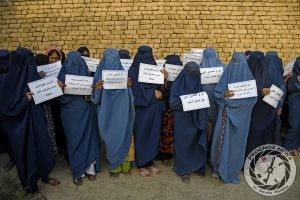
The restrictions have also transformed everyday social life. Women face severe limitations on travel, movement and participation in public spaces. Dress regulations are rigorously enforced by morality officials, while recent reports continue to document arrests and intimidation of women accused of violating prescribed standards. Even peaceful demonstrations demanding education and employment have been met with force.
These measures are not random expressions of religious conservatism. They form a coherent political philosophy in which female visibility itself is regarded as a threat to social order. Public life becomes exclusively masculine, while women are relegated to domestic existence, their participation in civic affairs reduced to near invisibility.
The healthcare consequences are particularly alarming. Restrictions upon female education inevitably produce shortages of female doctors, nurses and midwives. Yet conservative social norms simultaneously require many women to receive medical treatment only from female practitioners. The contradiction is devastating. International organisations warn that the educational bans threaten the long-term availability of female healthcare professionals, with profound implications for maternal health and child welfare.
Marriage and family life have likewise become areas of increasing concern. Human rights organisations have warned that recent legal developments further weaken protections against child marriage and domestic abuse while strengthening male authority within the household. Such measures reinforce a broader legal architecture in which women possess diminishing practical access to justice.
The international community has struggled to formulate an effective response. Diplomatic isolation has failed to moderate Taliban policy. Humanitarian assistance remains indispensable because millions of ordinary Afghans depend upon it for survival. Yet every humanitarian engagement risks conferring a degree of legitimacy upon authorities whose policies fundamentally violate internationally recognised human rights.
This tension has become increasingly apparent as governments seek practical cooperation with the Taliban over migration, security and humanitarian access while simultaneously condemning the regime’s treatment of women. Such engagement reflects geopolitical necessity rather than moral approval, but Afghan women understandably fear that their rights may gradually become subordinated to broader diplomatic calculations.
Some legal scholars and international organisations have increasingly employed the phrase “gender apartheid” to describe Afghanistan’s system of governance. The term remains politically and legally contested, but its underlying observation is difficult to dispute. Afghanistan’s legal framework no longer merely discriminates against women; it systematically separates them from public participation through comprehensive legal and administrative barriers.
Yet perhaps the greatest danger lies in the gradual normalisation of these conditions. International crises compete constantly for attention. Wars erupt elsewhere. Elections dominate headlines. Economic crises demand political energy. The slow erosion of women’s freedoms risks becoming background noise within the international system.
For Afghan women themselves, however, there is nothing gradual about the consequences. Every year that girls remain excluded from education permanently alters the trajectory of their lives. Every year outside the workforce reduces future economic opportunity. Every year spent under legal exclusion diminishes the possibility of rebuilding institutions capable of sustaining equality in the future.
History demonstrates that legal rights can be dismantled far more rapidly than they are constructed. Afghanistan illustrates this lesson with painful clarity. The achievements of two decades were not overthrown by military conquest alone. They have been dismantled through thousands of administrative decisions, each narrowing the boundaries of women’s existence until exclusion itself becomes ordinary.
No nation can permanently flourish while systematically suppressing the talents, aspirations and economic contributions of half its population. Afghanistan’s tragedy is therefore not confined to its women alone. It represents the self-imposed impoverishment of an entire society. Until Afghan women once again possess the freedom to learn, to work, to travel, to speak and to participate fully in public life, Afghanistan’s prospects for lasting prosperity, political stability and international respect will remain gravely diminished.
61 Views



Most Readings