Yevhen Khmara’s Hardest Mission Yet
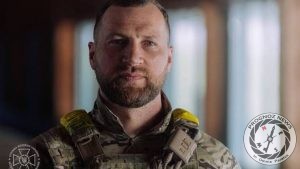
By Matthew Parish, Associate Editor
Saturday 18 July 2026
Ukraine’s appointment of Major General Yevhen Khmara as acting Minister of Defence marks another significant transition in the country’s wartime leadership. It also represents something more profound than a routine change of minister. In selecting a senior Security Service of Ukraine (SBU) officer rather than a career politician or conventional military administrator, President Volodymyr Zelensky has chosen a man whose career has been defined by intelligence, special operations and operational secrecy.
Whether those qualities translate successfully into the management of one of Europe’s largest wartime bureaucracies is now amongst the defining questions facing Ukraine.
The Ministry of Defence today bears little resemblance to the institution that existed before Russia’s full-scale invasion. It has become the purchasing authority for an armed force numbering hundreds of thousands of personnel. It manages procurement worth tens of billions of dollars, oversees relations with dozens of allied governments, coordinates domestic defence industries and must simultaneously satisfy the demands of soldiers at the front, politicians in Kyiv and international partners financing much of the war effort.
The position requires strategic judgement as much as administrative competence.
Yevhen Khmara arrives with considerable operational credentials. Having risen through the SBU’s Alpha special operations formations before leading both the Special Operations Centre “A” and subsequently the Security Service itself in an acting capacity, he has spent much of the war immersed in intelligence-led operations rather than conventional military administration. His career has coincided with the transformation of Ukrainian special operations into organisations capable of conducting extraordinarily sophisticated missions against Russian targets.
That background may prove especially valuable.
Modern warfare increasingly blurs the traditional distinctions between intelligence agencies, cyber operations, drones, sabotage, precision strike and conventional military manoeuvre. Ukraine has arguably become the world’s foremost laboratory for integrating these capabilities. A minister who understands intelligence collection and covert operational planning may therefore be unusually well suited to directing future procurement priorities.
Yet operational brilliance and ministerial success are not the same thing.
The Ministry of Defence is fundamentally an institution of management.
It must negotiate industrial contracts, supervise logistics extending across an entire continent, reassure foreign donors that their assistance is being properly accounted for and maintain confidence among domestic manufacturers competing for government orders.
This demands patience with bureaucracy that many operational commanders understandably find frustrating.
Indeed, one of Khmara’s greatest challenges may be resisting the temptation to manage the ministry as though it were a special operations headquarters.
Special operations reward secrecy, speed and centralised decision-making.
Large procurement systems require transparency, documentation and institutional process.
Finding the correct balance between operational agility and administrative accountability will determine much of his success.
International confidence will be equally important.
Ukraine’s military depends upon an unprecedented coalition of supporting states, each possessing its own procurement rules, export control regimes and domestic political constraints. Defence ministers increasingly spend as much time travelling between European capitals, Washington and international defence conferences as they do inside their own ministries.
The minister has therefore become Ukraine’s principal defence diplomat.
He must persuade governments to continue supplying increasingly sophisticated weapons while simultaneously convincing taxpayers across Europe and North America that their financial assistance is producing measurable military results.
This requires diplomatic skills distinct from those cultivated within the intelligence services.
Perhaps the greatest long-term challenge concerns industrial mobilisation.
The war has demonstrated that victory depends not merely upon courage or battlefield innovation but upon industrial production. Drones, artillery ammunition, missiles, electronic warfare systems and armoured vehicles must all be manufactured continuously in quantities sufficient to sustain prolonged conflict.
Ukraine has already demonstrated extraordinary ingenuity in developing domestic defence technologies despite constant Russian missile attacks.
The next stage is scaling these innovations into an industrial system capable not merely of supplying today’s battlefield but of establishing Ukraine as one of Europe’s principal defence manufacturing centres after the war.
That transformation requires cooperation between government, private industry, foreign investors and allied manufacturers.
The Defence Minister occupies the centre of that network.
There is also an important institutional relationship to manage.
Ukraine’s armed forces are commanded by professional military officers whose operational priorities will not always coincide with the ministry’s financial or political constraints. An effective defence minister neither micromanages battlefield decisions nor becomes merely an accountant. Rather, he provides strategic direction while ensuring that commanders receive the resources necessary to execute their missions.
Maintaining constructive relationships between the civilian ministry, the General Staff, the Security Service and Ukraine’s expanding defence industry may become one of Khmara’s most delicate responsibilities.
The broader political environment adds further complexity.
His appointment follows a period of substantial governmental reshuffling that has inevitably attracted domestic and international attention. Whatever the reasons for those changes, continuity in defence policy will now matter almost as much as innovation. Ukraine’s allies need reassurance that procurement programmes, industrial partnerships and strategic priorities remain stable despite changes in personnel.
The burden resting upon Yevhen Khmara’s shoulders is therefore immense.
He inherits neither a peacetime ministry nor an established bureaucracy functioning under ordinary conditions. He inherits an institution operating under constant missile attack while supporting one of the most technologically dynamic wars in modern history.
Success will not be measured solely by battlefield victories.
It will also be measured by whether Ukraine continues attracting international confidence, expands domestic defence production, preserves institutional integrity and prepares her armed forces for what increasingly appears likely to be a prolonged strategic confrontation with Russia.
The qualities that brought Yevhen Khmara to the Ministry of Defence—discipline, operational experience and familiarity with complex security operations—are substantial assets. Whether they prove sufficient for the broader demands of political leadership, industrial mobilisation and international diplomacy remains to be seen.
History has repeatedly shown that wars are won not only by outstanding generals but by effective institutions.
Ukraine now asks one of her most experienced security professionals to ensure that those institutions continue to evolve quickly enough to meet the extraordinary demands of the conflict they were created to fight.
89 Views



Most Readings