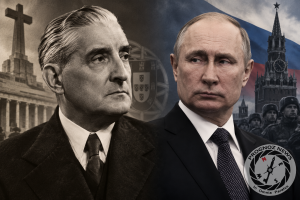
Salazar and Putin: Two Faces of Authoritarian Conservatism
By Matthew Parish, Associate Editor
Sunday 19 July 2026
Portugal’s long twentieth century dictatorship under António de Oliveira Salazar and contemporary Russia under Vladimir Putin are frequently grouped together as examples of conservative authoritarianism. The comparison is not without merit. Both men emerged from periods of perceived national humiliation and institutional weakness, promising order in place of chaos, stability in place of uncertainty and national renewal in place of decline. Yet beneath these superficial similarities lie profound differences in ideology, ambition and historical consequence. Salazar sought to preserve a fading empire through caution and restraint. Putin seeks to restore a vanished empire through military force and geopolitical confrontation. Their respective regimes illuminate two distinct models of authoritarian government separated by almost a century.
Salazar assumed effective control of Portugal in 1932 after years of political instability that followed the collapse of the Portuguese monarchy and the turbulent First Republic. A professor of economics before entering politics, he regarded political conflict as a symptom of moral and financial disorder. His answer was the Estado Novo—the “New State”—a corporatist dictatorship grounded in Catholic social doctrine, fiscal conservatism and administrative discipline.
Vladimir Putin likewise came to power after a period of national upheaval. The collapse of the Soviet Union, the economic dislocation of the 1990s and the weakness of the Russian state under Boris Yeltsin convinced many Russians that democracy had produced only humiliation and insecurity. Putin’s promise was not ideological purity but restored competence. He would make the state function again, rebuild military power and restore Russia’s status as a great power.
Both men therefore derived legitimacy less from elections than from delivering stability. Each cultivated the image of a sober, disciplined administrator rather than a flamboyant revolutionary. Neither resembled the theatrical mass politics of Benito Mussolini or Adolf Hitler. Salazar famously preferred academic simplicity to public spectacle. Putin, although carefully managing his public image, similarly projects calm competence rather than emotional rhetoric.
Yet the ideological foundations of their governments differ markedly.
Salazar believed in limitation. His political philosophy distrusted modernity, industrial upheaval and rapid social transformation. Economic development proceeded cautiously. Portugal remained comparatively poor because Salazar regarded excessive industrialisation and foreign borrowing as dangers to national independence. His was an authoritarian conservatism rooted in hierarchy, religion and gradualism.
Putin’s Russia, by contrast, is not especially conservative in an economic sense. Rather it combines state capitalism, oligarchic wealth and strategic control over key industries with sophisticated digital technologies and extensive surveillance. Religion has been revived as a component of national identity, particularly through close cooperation with the Russian Orthodox Church, but Orthodox Christianity functions principally as an instrument of national cohesion rather than as the organising principle of the state.
The security services occupy central positions in both systems, although again with important distinctions.
Salazar relied upon censorship and the political police, the PIDE, to suppress opposition. Critics could be imprisoned, exiled or silenced. Political competition existed only within carefully controlled limits. Nevertheless Portugal under Salazar never developed the vast machinery of surveillance characteristic of totalitarian states.
Putin inherited the institutional culture of the Soviet security apparatus through his own career in the KGB and its successor institutions. Contemporary Russia possesses an enormously sophisticated security architecture combining intelligence services, electronic surveillance, internet censorship and extensive legal controls over political activity. Modern digital technologies permit a degree of social monitoring unimaginable during Salazar’s era.
Foreign policy provides perhaps the sharpest contrast.
Salazar’s Portugal fought difficult colonial wars in Africa during the 1960s and early 1970s, determined to preserve overseas territories in Angola, Mozambique and Guinea-Bissau. Yet his ambitions remained fundamentally defensive. He sought to preserve an existing imperial inheritance rather than construct a new one. Portugal joined North Atlantic Treaty Organization in 1949 and remained firmly aligned with the Western alliance throughout the Cold War, despite the dictatorship’s authoritarian character.
Putin’s strategic objectives are considerably more revisionist. The annexation of Crimea in 2014, the full-scale invasion of Ukraine in 2022 and repeated assertions that Russia possesses historical claims extending beyond its internationally recognised frontiers reflect an ambition to revise the post-Cold War European security order. Where Salazar defended a declining colonial empire, Putin seeks to reconstruct a sphere of influence lost with the dissolution of the Soviet Union.
Their economic records likewise invite comparison.
Salazar’s greatest success lay in restoring Portuguese public finances. Balanced budgets became almost an article of faith. Inflation remained relatively low and government debt was tightly controlled. However these achievements came at the cost of persistent underdevelopment. Millions of Portuguese emigrated in search of greater economic opportunity elsewhere in Europe.
Putin inherited an economy recovering from financial collapse. High energy prices during his first decade in office generated rising incomes, expanding state revenues and improved living standards. For many Russians, this period validated the political bargain exchanging limited political freedom for economic stability. More recently however, sanctions, military expenditure and demographic pressures have complicated that model, forcing increasing state intervention and redirecting resources towards the defence sector.
Neither regime tolerated genuine political pluralism, although the mechanisms differed.
Salazar openly rejected liberal democracy, considering parliamentary competition inherently destabilising. Political parties were largely absent because he believed society should be organised corporately rather than competitively.
Putin formally retains electoral institutions, multiple parties and constitutional procedures. Critics nevertheless argue that these institutions function within carefully managed boundaries in which genuine competition is progressively constrained through legal, administrative and media control. Contemporary authoritarianism often preserves democratic forms while substantially reducing democratic substance.
The personalities of the two rulers also reveal contrasting psychological approaches to power.
Salazar was austere almost to the point of asceticism. Personally frugal, intellectually reserved and deeply influenced by Catholic morality, he seemed uncomfortable with celebrity. He neither cultivated personal luxury nor sought extravagant displays of power.
Putin’s public persona is altogether different. Carefully choreographed images depicting physical fitness, military competence and masculine confidence form an important element of his political communication. Modern media permits the cultivation of leadership as spectacle in ways unavailable during Salazar’s lifetime.
History ultimately judged Salazar’s regime through peaceful exhaustion rather than catastrophic defeat. The Carnation Revolution overthrew the dictatorship with remarkably limited bloodshed, ending nearly half a century of authoritarian government. Portugal subsequently integrated into democratic Europe, eventually joining the European Union.
The historical verdict upon Putin’s Russia remains unwritten. The outcome of the war in Ukraine, the long-term effects of economic isolation and the durability of Russia’s present political institutions remain uncertain. Historians generally require decades before placing contemporary leaders into stable historical perspective.
The comparison nevertheless reveals an important evolution in authoritarian government. Salazar represented an older tradition of paternalistic conservatism rooted in religion, administrative discipline and cautious governance. Putin represents a twenty-first century model that combines nationalism, technological surveillance, sophisticated information management and geopolitical revisionism. Both systems subordinate political liberty to state authority, but they pursue fundamentally different visions of national destiny.
Salazar wished to preserve a familiar world against the forces of change. Putin seeks to overturn an international order that emerged after Russia’s own moment of imperial collapse. One looked backwards with resignation, the other with determination. That distinction may ultimately prove to be the defining difference between two of Europe’s most enduring authoritarian rulers.
58 Views



Most Readings