Ceuta’s Tragedy — When Human Lives Become Instruments of Diplomacy
By Matthew Parish, Associate Editor
Monday 3 August 2026
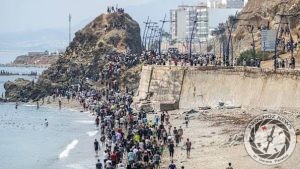
The scenes emerging from Ceuta have once again reminded Europe that borders are never merely lines upon a map. They are places where history, politics, economics and human desperation collide — often with tragic consequences. Reports that tens of thousands of Moroccan nationals attempted to enter the Spanish enclave over a remarkably short period, many choosing the treacherous route through the Mediterranean rather than the official frontier, have produced yet another humanitarian disaster on Europe’s southern frontier. Whatever the final casualty figures ultimately prove to be, every life lost represents a profound failure of politics.
Ceuta occupies an unusual position in international affairs. Situated on the North African coast yet forming an integral part of Spain and therefore of the European Union, it has for generations represented both an opportunity and a barrier. For those seeking entry into Europe, it is one of only two land borders between Africa and the European Union. For Madrid it is sovereign Spanish territory. For Morocco, although practical relations have generally remained stable, the enclave has long represented an historical anomaly.
That geography means that migration into Ceuta has never been solely a question of border management. It has always possessed a diplomatic dimension. Every significant deterioration in relations between Rabat and Madrid has carried with it the possibility that migration pressures might increase dramatically.
Many observers have therefore viewed the latest events through the prism of regional diplomacy rather than spontaneous migration alone. Spanish officials have suggested that Moroccan border enforcement was significantly relaxed during the crossings, while Morocco has rejected accusations that it deliberately facilitated the movement of migrants. Determining precisely what occurred will require careful investigation. Yet the political context makes the controversy impossible to ignore.
Relations between Spain, Morocco and Algeria have become increasingly delicate because of the unresolved status of Western Sahara. Since Morocco assumed effective control over most of the territory following Spain’s withdrawal in 1975, the dispute has remained one of Africa’s longest-running territorial conflicts. Large numbers of Sahrawis continue to live in refugee camps centred around Tindouf in Algeria, while Morocco administers most of the territory and regards it as an integral part of the Kingdom. The United Nations, however, continues formally to classify Western Sahara as a non-self-governing territory whose final political status has yet to be determined.
Spain finds herself in an unenviable position. As the former colonial power, she carries historical responsibilities while simultaneously maintaining vital political, economic and security relationships with both Morocco and Algeria. Algeria remains indispensable to Spain’s energy security and has consistently supported the Polisario Front’s claim that the Sahrawi people possess an unfulfilled right of self-determination. Morocco, meanwhile, has become one of Europe’s most important partners in migration management and counter-terrorism.
Against that background, Prime Minister Pedro Sánchez’s recent visit to Algiers inevitably acquired significance extending well beyond bilateral relations. Although the visit centred publicly upon cooperation and regional stability, many commentators interpreted it as carrying implicit diplomatic messages concerning Spain’s relationship with Algeria and, indirectly, the Western Sahara question. Some analysts have argued that Morocco’s subsequent posture regarding migration into Ceuta reflected dissatisfaction with Madrid’s broader regional diplomacy. Whether that interpretation ultimately proves correct remains a matter for political and historical assessment rather than established fact. Nevertheless, the chronology has naturally invited speculation.
If migration has indeed become a diplomatic instrument, Europe should be profoundly concerned.
This would not represent an isolated phenomenon. Turkey has repeatedly demonstrated the leverage that migration flows may confer in negotiations with the European Union. Belarus has been accused of encouraging migrants towards the borders of Poland and Lithuania during periods of heightened political tension. Libya’s chronic instability has likewise repeatedly generated migration crises affecting southern Europe. Increasingly, vulnerable populations risk becoming participants in geopolitical disputes in which they possess neither agency nor influence.
That development represents a dangerous evolution in international relations. States unquestionably possess legitimate security interests. They also possess every right to pursue foreign policies that advance their national objectives. Yet there exists an important moral distinction between defending national interests and exploiting human vulnerability as a means of diplomatic communication. If ordinary civilians become instruments through which governments convey political displeasure, the very foundations of responsible statecraft begin to erode.
The tragedy at Ceuta should also encourage renewed reflection upon Europe’s migration policies themselves. For years, the European Union has relied heavily upon neighbouring countries to manage migration before it reaches European territory. Such arrangements may appear efficient from a bureaucratic perspective, but they inevitably create political dependencies. Whenever migration control depends principally upon the continuing goodwill of third countries, that goodwill acquires strategic value. It becomes a source of influence capable of being exercised whenever broader political disagreements emerge.
None of this diminishes Morocco’s own legitimate concerns regarding border security, economic development or regional stability. Nor does it resolve the extraordinarily complex dispute over Western Sahara, where competing legal claims, historical narratives and geopolitical interests have remained deadlocked for half a century. Those questions demand patient diplomacy and sustained international engagement.
What they cannot justify is the loss of innocent life.
The men, women and children who entered the waters surrounding Ceuta were not diplomats. They were not negotiators over Western Sahara. They did not determine Spanish foreign policy, Algerian regional strategy or Moroccan national priorities. They were ordinary people whose lives became entangled in forces vastly greater than themselves.
The true measure of civilised diplomacy is not found in communiqués issued after ministerial meetings or carefully drafted declarations. It is found in whether governments preserve human dignity even during periods of profound political disagreement. Once human beings become expendable pieces upon a diplomatic chessboard, every participant in that game loses something of their own humanity.
Ceuta therefore stands as more than another migration crisis. It is a warning — that unresolved territorial disputes, geopolitical rivalry and migration management have become increasingly intertwined, and that unless states exercise restraint and responsibility, it will continue to be the powerless who bear the greatest cost.
178 Views



Most Readings