The Shadow of a New Desert War: Could Saudi Arabia Return to Yemen?
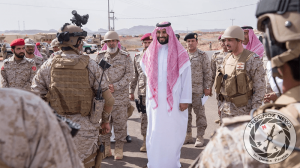
By Matthew Parish, Associate Editor
Monday 3 August 2026
History has a curious habit of returning to the same landscapes, albeit wearing different uniforms. Yemen has long been one of those landscapes—a country whose forbidding mountains, fractured tribal allegiances and strategic geography have repeatedly confounded foreign powers convinced that superior resources would guarantee military success. From the Ottoman Empire to Egypt under Gamal Abdel Nasser, outside intervention has generally proved easier to begin than to conclude.
Now there are growing indications that Saudi Arabia may once again contemplate major military operations against the Houthi movement. Such a decision would represent one of the most consequential developments in the Middle East since the regional confrontation between Iran and the United States intensified. Whether such an operation ultimately occurs or not, the possibility alone illustrates how profoundly the strategic balance of the Arabian Peninsula has altered.
The original Saudi intervention in Yemen, launched in 2015, was founded upon assumptions that appeared entirely reasonable at the time. Riyadh believed that overwhelming air power, generous financial resources and support for the internationally recognised Yemeni government would rapidly restore the existing political order. Instead, the conflict evolved into a grinding war of attrition that transformed the Houthis from a relatively isolated insurgent movement into an experienced military organisation capable of employing ballistic missiles, drones and increasingly sophisticated intelligence capabilities.
Military power alone proved insufficient to overcome geography and political fragmentation. Yemen is not merely a battlefield but an extraordinarily complex society in which local loyalties frequently outweigh national identity. Every military advance created new political dilemmas, while every tactical success generated strategic complications. The war became one of the world’s gravest humanitarian disasters, exacting immense suffering upon civilians while delivering no decisive victory to any participant.
Yet circumstances today differ markedly from those of a decade ago.
The Houthis are no longer simply a domestic insurgency. They have become a regional actor whose military activities increasingly intersect with wider geopolitical struggles involving Iran, maritime security and global energy markets. Their attacks upon shipping in the Red Sea and, more recently, against Saudi interests have transformed what might once have been viewed as a civil war into an issue affecting international commerce. The Bab al-Mandab Strait carries a substantial proportion of world trade. Any sustained disruption there reverberates through global supply chains, insurance markets and energy prices.
From Riyadh’s perspective, this alters the strategic equation fundamentally. A government may tolerate an unresolved border conflict for years. It cannot indefinitely tolerate repeated attacks upon vital economic infrastructure or threats to its principal export routes. Recent reports suggesting Saudi preparations for maritime and possible ground operations therefore reflect a broader calculation that deterrence may have failed.
Nevertheless, military logic and political wisdom do not necessarily coincide.
Any renewed Saudi invasion would face an adversary that has spent years preparing precisely for such a contingency. The Houthis have demonstrated remarkable resilience under sustained bombardment, adapting rapidly to technological change and integrating drone warfare, missile systems and dispersed command structures into their operational doctrine. They have also cultivated an ideological narrative portraying themselves as defenders of Yemeni sovereignty against foreign intervention—a narrative that external invasion risks reinforcing rather than weakening.
Saudi Arabia herself has changed.
Crown Prince Mohammed bin Salman has devoted enormous political capital to Vision 2030, an ambitious programme intended to diversify the Saudi economy beyond hydrocarbons. The Kingdom seeks to become a destination for investment, tourism and international commerce. Stability has become an economic asset as valuable as oil production itself.
War threatens precisely those objectives.
Financial markets dislike uncertainty. Foreign investors dislike regional conflict. International sporting events, technology investment and large-scale infrastructure projects flourish under predictable conditions rather than prolonged military campaigns. A major invasion of Yemen would therefore involve not merely military costs but substantial economic opportunity costs extending far beyond the battlefield.
Iran, naturally, occupies the centre of this strategic calculation.
Although Tehran may not direct every Houthi operation, it unquestionably benefits from Saudi Arabia remaining strategically distracted. Relatively inexpensive missiles and drones capable of threatening vastly more valuable energy infrastructure create a classic example of asymmetric warfare. Even limited Houthi successes can generate disproportionately large economic consequences.
For Riyadh, therefore, the dilemma is acute. Failing to respond risks encouraging further attacks. Responding too aggressively risks becoming entangled once again in an open-ended campaign whose political costs exceed its military gains.
The international community faces equally uncomfortable choices.
Western governments have consistently supported freedom of navigation through the Red Sea while simultaneously expressing concern over humanitarian conditions in Yemen. These objectives may become increasingly difficult to reconcile if large-scale combat resumes. Diplomatic pressure will inevitably intensify upon all parties to prevent another prolonged regional war.
Perhaps the greatest lesson of Yemen is that modern conflicts rarely conclude through battlefield victories alone. Military force can destroy armies, occupy cities and disrupt logistics, but durable political settlements require institutions that command legitimacy among the population concerned. Yemen’s tragedy has always been that political legitimacy has remained more elusive than military success.
Should Saudi Arabia ultimately launch a renewed invasion, she may achieve tactical gains. It may secure sections of coastline, reopen shipping lanes or degrade Houthi military capabilities. Yet unless those achievements are accompanied by a credible political settlement capable of addressing Yemen’s fractured internal landscape, they risk becoming temporary victories in an endless cycle of conflict.
The desert has witnessed countless armies convinced that they possessed the final answer to Yemen’s problems. Few departed believing they had found it.
49 Views



Most Readings




War Without Peace, Peace Without War: Russia’s Non-Binary Conception of Conflict
98 Views