The Eye in the Sky: Why Drone Warfare Is So Frightening
By Matthew Parish
Friday 4 September 2026
There are many ways to die in war, and almost all of them are arbitrary. An artillery shell does not know your name. A ballistic missile does not hate you. A mine does not decide that you, rather than the man walking five metres behind you, ought to die. War has traditionally combined extraordinary violence with a peculiar impersonality. The machinery of death is often indifferent to the identity of the person it kills.
Drone warfare is different. This difference helps explain one of the most striking features of the war in Ukraine: the extraordinary fear inspired by relatively small drones, particularly First Person View, or FPV, attack drones. Their explosive payloads may be modest compared with artillery shells, aerial bombs or missiles. Nevertheless soldiers who have endured heavy shelling may exhibit an altogether different kind of terror when they hear the characteristic buzzing of a drone overhead.
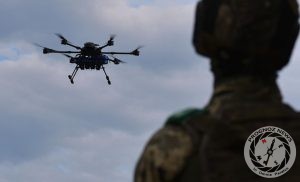
The reason is not principally the explosive. It is the eye. A drone may be watching you. More disturbing still, somebody may be watching you through it. That person can see where you run, where you hide and sometimes even what you are doing with your hands. He may follow you around a building, wait for you to emerge from a trench, observe which vehicle you enter or pursue you down a road. If the drone is an FPV attack platform, the person watching may then deliberately fly the machine into you.
This is an unusually intimate form of warfare conducted across an enormous distance. It deserves more attention than it has received because it is changing not merely the technology of the battlefield but its psychology.
The impersonality of artillery
Artillery has terrified soldiers for centuries, and rightly so. Modern artillery can deliver explosive power vastly greater than that carried by the inexpensive FPV drones that have become ubiquitous across the Ukrainian battlefield. A large-calibre shell can kill or maim several people at once, demolish fortifications and scatter lethal fragments over a substantial area.
Yet there is an important psychological distinction between artillery fire and drone attack. Imagine sitting in a trench while shells fall around you. You know that somebody is trying to kill people in your general vicinity. The enemy may have coordinates for your trench line, headquarters, road junction or building. They may even possess excellent reconnaissance. But the shell itself is blind. Once fired, it follows its ballistic trajectory. It cannot notice that you have climbed out of the trench. It cannot see you running towards a tree line and change direction. It cannot decide that your companion is less interesting than you.
There is consequently an element of probability in the terror of bombardment. You may be killed, but you are being subjected to a lethal statistical process. The psychology of an FPV attack is quite different. You may see the drone turn towards you. At that moment something profound has changed. You are no longer merely within an area being attacked. You have become the object of somebody else’s intention. The distinction may sound philosophical, but on a battlefield it is brutally concrete.
Somebody has chosen you
Human beings have a particular horror of being hunted. The distinction between danger and pursuit is deeply embedded in our instincts. A falling tree is dangerous. A landslide is dangerous. A tiger following you through a forest is something else. In the latter case the danger possesses perception and intention. It observes your responses and adapts itself to them. Drone warfare introduces something resembling this ancient experience into industrialised war.
The drone is not itself conscious, at least in the overwhelming majority of contemporary applications. But there is consciousness behind it. Somewhere, perhaps kilometres away, an operator is looking at a screen. The operator sees a human figure. He sees that figure start running. He moves the controls. The drone follows. The person on the ground changes direction. The drone changes direction as well. The person dives behind a vehicle. The drone circles. Then the person understands something that may be more terrifying than the explosive device attached to the aircraft: someone is doing this to me.
That knowledge makes drone warfare peculiarly personal. A shell may land beside you because mathematics, meteorology and bad luck brought it there. A drone following you around a ruined building is following you because another human being has decided that you are the target. The difference between the two experiences is enormous.
The last seconds
There is another disturbing feature of FPV warfare. In many cases the victim has time to understand what is happening. Death by artillery can be instantaneous and unexpected. The shell that kills you may be one you never hear. The blast arrives before the conscious mind has had an opportunity to construct a narrative around it.
A drone attack can unfold over seconds or even minutes. The target may first hear the drone. Then he may see it. He may realise that it has seen him. He may run. The drone follows. He tries one direction and then another. Perhaps he fires at it. Perhaps he throws something. Perhaps he hides. And throughout this process he knows that somewhere another human being is watching. This creates an extraordinary asymmetry of experience. For the operator, the engagement takes place through a screen. For the person being pursued, it is immediate, physical and existential.
Yet paradoxically the screen may also make the encounter more intimate for the operator than traditional long-range warfare. An artillery crew may never see the people killed by its shells. A bomber crew may see little more than coordinates or distant flashes. An FPV operator can sometimes see an individual human being until almost the instant of detonation.
Modern technology has therefore created the curious phenomenon of simultaneously remote and intimate killing.
The participants may never come within several kilometres of one another, yet in one important sense they encounter each other directly. One sees. The other knows that he is being seen.
The buzzing sound
This also explains the peculiar psychological significance of the sound of drones. Every war develops its own acoustic vocabulary. Soldiers learn the sounds of incoming and outgoing artillery, rockets, aircraft and explosions. Civilians living close to the front acquire the same grim expertise. The drone adds something different. Its buzzing does not necessarily mean that an explosion is imminent. It means that an eye may be present.
This uncertainty is itself corrosive. Is the drone observing? Is it armed? Has it seen me? Is it looking for somebody else? Is another drone following it? Should I run, thereby revealing myself, or remain still? Is the building beside me protection or a trap?
The sound therefore becomes associated not merely with danger but with surveillance. It is difficult to overstate the psychological importance of this distinction. A person under shellfire asks, in essence: Where will the next shell land? A person beneath a hostile drone asks: Is it looking at me? The first question concerns probability. The second concerns intention.
Civilians beneath the drones
For civilians, this psychological transformation may be even more disturbing. Civilian populations in war have always suffered from bombardment. Cities have been shelled, bombed and struck by missiles. These forms of violence can be vastly more destructive than individual FPV attacks. Nevertheless the drone introduces a particular anxiety because civilians may understand that whoever controls it can potentially distinguish individuals.
A person walking along a road, driving a civilian vehicle or standing outside a house may wonder whether the drone operator can see sufficiently well to recognise what he or she is doing. The terrifying question is no longer merely whether the neighbourhood is being attacked. It is whether the person behind the camera will classify you as a target.
This places enormous psychological weight upon the decisions of individual operators and upon the command structures, training and discipline governing them. International humanitarian law has long required distinction between civilians and combatants and imposed constraints upon attacks expected to cause excessive civilian harm. Drone technology does not remove those obligations. In some circumstances, enhanced observation ought to make compliance easier because the operator may possess better information about what is happening on the ground.
But the same technology also creates the possibility of highly individualised violence. The capacity to distinguish is morally valuable only if distinction is actually practised. An indiscriminate weapon may kill a civilian because it cannot discriminate adequately. A precisely controlled weapon may kill a civilian despite the operator having had an opportunity to observe that person. These situations can look identical after the explosion. Psychologically and morally they are very different.
The destruction of sanctuary
Drone warfare also attacks one of the most important psychological resources available to people in war: the belief that somewhere nearby is safe. Under artillery bombardment there are recognisable forms of protection. Cellars, bunkers, trenches and sufficiently substantial buildings reduce vulnerability. Terrain matters. Distance matters. Cover matters. Drones complicate these calculations.
A small aircraft can inspect roads behind the front. It can hover near entrances. It can watch routes between positions. It can sometimes pursue vehicles travelling at speed. Reconnaissance drones can identify activity that subsequently attracts other forms of fire.
The result is a battlefield increasingly characterised by exposure. The soldier does not merely fear being attacked while occupying a position. He fears being observed while moving between positions. The driver fears the journey. The casualty fears evacuation. The infantryman fears crossing open ground. The civilian fears the road to the shop.
In heavily drone-saturated areas, ordinary movement itself becomes psychologically exhausting. One begins to behave as though the sky has eyes. Increasingly, it does.
A panopticon over the battlefield
The nineteenth-century philosopher Jeremy Bentham devised the famous idea of the Panopticon: a prison designed so that inmates could never know whether they were being watched. The importance of the system lay not in continuous observation but in the possibility of continuous observation. Prisoners would modify their behaviour because they could never be certain when the observer’s eye was upon them.
Drone warfare creates something resembling a battlefield Panopticon. No army possesses enough drones to watch every soldier continuously. Nor does every drone carry a weapon. But the person on the ground does not necessarily know which drone is watching, what it can see or what may follow from being observed. The possibility of observation begins to regulate behaviour. Vehicles are concealed. Movement is postponed. Soldiers remain under cover. Supply operations become more difficult. Evacuations become dangerous. People hesitate before crossing exposed ground.
This is why the military significance of drones cannot be measured merely by counting the kilograms of explosives they deliver. A drone carrying a small explosive charge may exert influence over an area vastly larger than its lethal radius because everyone within that area must behave as though he might be observed. The weapon’s psychological radius is therefore much larger than its explosive radius.
The economics of fear
There is another disturbing asymmetry. FPV drones can be remarkably inexpensive compared with the targets they threaten. The relevant comparison is not merely between the cost of a drone and the cost of a tank or armoured vehicle. It is between the cost of the drone and the quantity of human behaviour it can disrupt.
A relatively inexpensive machine in the air may cause dozens of people to remain under cover. It may delay a vehicle movement. It may complicate logistics or medical evacuation. It may force soldiers to disperse. It may cause civilians to abandon roads. This is an extraordinary return on investment in fear. Traditional military economics often concentrates upon destruction: how much explosive power can be delivered for a particular expenditure?
Drone warfare suggests another metric: how much uncertainty can be imposed? By that measure drones are formidable weapons.
The human being at the other end
None of this should lead us to imagine drone operators as people casually playing video games. That cliché obscures more than it explains. Operators may themselves be close enough to the front to be exposed to attack. They work under pressure. They may witness death repeatedly at unusually close visual range. They may see injured people, failed attacks and the consequences of successful ones. They know that enemy forces are searching for their positions.
There may also be a considerable psychological burden in repeatedly observing the people one attacks. The distance created by the machine does not necessarily create emotional distance. In some circumstances it may do the opposite. The operator may spend far longer watching a target than an infantry soldier does during a brief exchange of fire. This is another paradox of drone warfare.
Technology has increased the physical distance between killer and target while sometimes reducing the perceptual distance between them. The operator may be kilometres away, yet he can see the target’s body movements on a screen. The target cannot see the operator at all. But he knows that the operator can see him.
When the machine chooses
There is an even more unsettling development on the horizon. The distinctive terror of contemporary drone warfare arises substantially from the knowledge that another person is observing and pursuing the target. But advances in artificial intelligence and autonomous navigation raise the possibility that parts of this process may increasingly be delegated to machines.
This would create a different kind of horror. The soldier pursued by today’s FPV drone can at least understand the encounter within an ancient human framework: another human being is hunting him. The soldier pursued by an autonomous weapon confronts something stranger. The machine may identify patterns, classify objects, select trajectories and potentially make increasingly consequential decisions without the immediate intervention of a human operator.
The eye in the sky would remain. But there might no longer be a human eye behind it.
Whether states permit autonomous systems to make lethal decisions without meaningful human control will therefore be one of the defining moral and legal questions of twenty-first-century warfare. Ukraine is not merely demonstrating the military effectiveness of drones. She is providing an early glimpse of a transformation whose implications are much larger.
The return of individual killing
Industrial warfare seemed for more than a century to be moving relentlessly towards abstraction. Coordinates replaced faces. Artillery grids replaced individual adversaries. Bombers destroyed factories, railway stations and city districts. Missiles crossed hundreds or thousands of kilometres to strike points programmed into computers. Drone warfare has unexpectedly reversed part of this process.
It has restored the individual human figure to the centre of technologically sophisticated warfare. A person appears on a screen. Someone watches him. Someone decides what he is. Someone follows him. And sometimes someone kills him. The explosive charge may be smaller than an artillery shell. The physical destruction may be less spectacular than that produced by a glide bomb or ballistic missile. Yet the psychological effect can be disproportionately profound because the person beneath the drone understands that the violence is no longer merely falling around him. It is interested in him.
That may ultimately be what makes drone warfare so distinctively frightening. The drone converts the vast impersonal machinery of modern war into something resembling a personal encounter. It gives distant violence an eye, a steering mechanism and an intention. For soldiers and civilians living beneath drone-saturated skies, therefore, the most terrifying moment may not be the explosion. It may be the moment before it, when the little aircraft turns. Because that is the moment you realise that it has seen you.
6 Views



Most Readings



Crimea Under Pressure: Ukraine’s Long Campaign Against Russia’s Southern Bastion
98 Views