What Has Happened to Ukraine’s Prosecutor General?
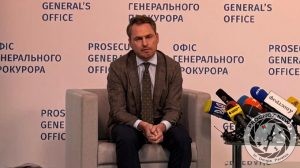
By Matthew Parish
Monday 7 September 2026
Something extraordinary has happened at the summit of Ukraine’s law-enforcement establishment. Over the course of Friday 4 to Sunday 6 September 2026, an investigation that began with allegations that a senior official in the Office of the Prosecutor General was protecting fraudulent call centres has moved progressively closer to Prosecutor General Ruslan Kravchenko himself. Kravchenko has not been arrested, charged with an offence or publicly identified by the National Anti-Corruption Bureau of Ukraine (NABU) as a member of the alleged criminal organisation. He emphatically denies wrongdoing and, contrary to reports on Saturday that his whereabouts could not be established, he says that he has continued working normally. Nevertheless, evidence aired in the High Anti-Corruption Court on Sunday evening has made the affair substantially more serious for him personally than it appeared when Operation “Carthage” first became public.
The immediate facts are dramatic enough. NABU and the Specialised Anti-Corruption Prosecutor’s Office (SAPO) say that they have uncovered a criminal organisation whose members systematically received unlawful payments from fraudulent call centres in return for permitting them to operate, then laundered millions of hryvnias in alleged criminal proceeds. According to NABU, the organisation was created in the middle of 2025 by a senior official in the Prosecutor General’s Office who recruited serving prosecutors and other associates. Five people have so far been identified as alleged participants. One of the central figures is Serhii Kropyva, Deputy Head of the Prosecutor General’s Office Department of International Cooperation, whom investigators detained and whom the High Anti-Corruption Court on Sunday 6 September remanded in custody until 2 November, subject to the possibility of bail of UAH 120 million.
Yet the most important question is no longer merely what Kropyva did. It is how close Kropyva was to the Prosecutor General, what services he may have performed for him and whether those relationships tell us anything about the alleged criminal scheme. The evidence disclosed in court on Sunday does not answer these questions, but it makes them considerably harder to avoid.
Operation Carthage
Fraudulent call centres are a peculiarly unpleasant feature of organised crime in Ukraine and elsewhere in the former Soviet world. They are often sophisticated commercial operations in which employees telephone victims in Ukraine and abroad pretending to represent banks, investment houses, cryptocurrency companies or public authorities, persuading them to disclose financial information or transfer money. Such enterprises can employ large numbers of people and generate enormous revenues. Their difficulty is that conspicuous premises full of employees committing fraud by telephone are vulnerable to police raids, searches and seizures unless somebody ensures that the authorities leave them alone.
According to NABU and SAPO, that is precisely what the alleged organisation did. Investigators say that participants systematically received payments from fraudulent call centres in exchange for non-interference and subsequently used various mechanisms to legalise the resulting wealth. More than UAH 20 million was allegedly spent on valuable assets, including property and jewellery. These are allegations and will ultimately have to be proved in court, but the decision of the High Anti-Corruption Court to detain Kropyva, albeit with provision for bail, demonstrates that the affair has now moved beyond leaked recordings and journalistic speculation into formal criminal proceedings.
What transformed the affair into a national political crisis was NABU’s decision to search premises at the Office of the Prosecutor General. Initial reporting indicated that investigative measures concerned Kravchenko himself, his First Deputy Mariia Vdovychenko and Odesa Oblast Military Administration head Oleh Kiper. The Prosecutor General’s Office initially denied that Kravchenko’s home or office had been searched, only to acknowledge the following day that NABU detectives had conducted investigative actions in official premises “used by” Kravchenko and other senior officials. That change in formulation inevitably increased suspicions that the Office was engaged in damage limitation.
The searches were themselves highly unusual. NABU officers were reported entering the prosecutorial compound with ladders and investigative actions continued around midnight. The Prosecutor General’s Office subsequently complained that NABU detectives might have exceeded the scope of their judicial authorisation and gained access to unrelated criminal files, including material concerning possible unlawful activity by NABU and SAPO employees and persons associated with SAPO’s leadership. The Office says that it will investigate whether such access was lawful and whether any of those materials were copied or removed. NABU has every right to investigate prosecutors, the Office acknowledges, but NABU must itself remain within the law.
This is therefore no longer an ordinary corruption case. It is a confrontation between institutions.
Kravchenko answers back
On Sunday, Kravchenko broke his relative public silence and attempted to seize control of the narrative. He categorically denied any involvement in protecting illegal call centres, denied issuing instructions that might facilitate their activities and denied using his powers as Prosecutor General for such purposes. He said that Kropyva had been suspended and that preparations were being made for his dismissal. He ordered internal checks of the Department of International Cooperation and the unit responsible for combating cybercrime and directed that personnel involved in supervising and investigating illegal call-centre cases undergo polygraph examinations. He also said that investigators had been given complete access to his working office and had encountered no obstruction.
Kravchenko also addressed the more colourful story of his supposed disappearance. Ukrainska Pravda had reported on Saturday, citing political sources, that his whereabouts had been unknown for more than twelve hours after the operation began. His Office denied this at the time and Kravchenko has now denied it personally, saying that he was working on Saturday and continued working on Sunday, including taking some time for exercise. There is consequently no adequate evidential basis for stating that the Prosecutor General fled, disappeared or sought refuge in hospital.
In one sense, therefore, the mystery of the missing Prosecutor General is over. Kravchenko is still Prosecutor General and he is publicly fighting back. Unfortunately for him, Sunday’s court hearing produced a substantially more difficult problem.
The house in Kozyn
During the hearing concerning Kropyva’s detention, a SAPO prosecutor described evidence suggesting a much closer personal relationship between Kropyva and Kravchenko than might be inferred merely from their positions in the prosecutorial hierarchy. According to material presented by the prosecution, Kropyva was involved in organising renovation work at a house in Kozyn, an affluent settlement outside Kyiv, in which Kravchenko lives. The evidence reportedly included discussions about work at the property and the installation of a substantial gas generator. SAPO characterised Kropyva as a trusted person and friend of the Prosecutor General.
This matters because the earlier public debate about references in intercepted conversations to such apparently mundane things as “dark tiles”, alarm systems and internal sensors could initially be dismissed as a rather tenuous attempt to connect the Prosecutor General with the principal criminal allegations. The Prosecutor General’s Office itself made precisely this argument: conversations about household fittings do not demonstrate that Kravchenko protected fraudulent call centres, received criminal proceeds or knew that anybody else was doing so. That remains entirely correct as a matter of elementary evidential logic.
But the significance of the Kozyn evidence is different. If Kropyva was not merely Kravchenko’s subordinate but a trusted associate organising matters at the Prosecutor General’s residence, then the relationship between the alleged organiser of the criminal enterprise and the head of the institution in which he worked becomes considerably more important. It still does not prove that Kravchenko knew of Kropyva’s alleged criminal activities. Friendship with a criminal does not make somebody a criminal, particularly when the alleged criminality has yet to be proved. Yet it does make the proposition that Kropyva was merely some rogue subordinate operating at institutional distance from the Prosecutor General more difficult to maintain.
Later on Sunday the story developed further. Investigative journalists associated with Bihus.Info reported that they had identified the Kozyn property. They describe it as a house of approximately 300 square metres registered to a 73-year-old woman and say that the property does not appear in Kravchenko’s asset declaration. This reporting must be treated with appropriate caution: identification of the property and the legal arrangements governing Kravchenko’s use of it will require further verification, and the mere fact that a person lives in a house he does not own does not establish a declaration violation, still less corruption. Nevertheless, the house has now become an independent strand of public scrutiny rather than an incidental detail in the call-centre investigation.
Kravchenko has responded to the issue as well. He says that his family selected the house during the winter and moved there in May and rejects attempts to connect the arrangements concerning the property with proceeds from fraudulent call centres. The questions therefore multiply faster than the answers.
What is Kravchenko actually accused of?
This distinction is essential. As of the time of writing, the public allegations established by NABU concern an alleged criminal organisation headed by an official in the Prosecutor General’s Office. Kropyva is the official publicly identified in Ukrainian reporting as the central suspect and he is now subject to a judicial preventive measure. Kravchenko himself has not been publicly charged with participation in that organisation.
There are nevertheless several reasons why Kravchenko has become entangled in the affair. He previously headed the State Tax Service, serving from December 2024 until June 2025 before becoming Prosecutor General. NABU recordings reportedly contain references to a person described as “the boss”, including references compatible with a person bearing Kravchenko’s patronymic, Andriiovych, who had previously headed the Tax Service. The Prosecutor General’s Office itself has acknowledged that investigators apparently interpret at least some references to “the boss” as referring to Kravchenko.
Then there is the personal relationship with Kropyva disclosed in court, including the latter’s apparent involvement in arrangements concerning the Kozyn house. None of these matters, considered separately or together, presently establishes that Kravchenko received money from fraudulent call centres, ordered that they be protected, interfered with investigations or knowingly benefited from criminal proceeds. Kravchenko explicitly denies all of these propositions.
That distinction must be maintained however politically inconvenient it may become. The purpose of an anti-corruption investigation is to establish whether crimes have occurred, not to generate guilt by association.
Two Ukrainian states
Yet the deeper significance of Operation Carthage lies beyond the individual allegations. Ukraine has developed two partially competing architectures of state power. The first might be called the vertical state: the Presidency, traditional prosecutorial structures, regional administrations, security institutions and the informal networks through which power has historically been exercised. The second might be called the reform state: NABU, SAPO, the High Anti-Corruption Court and the mechanisms of competitive appointment, external scrutiny and institutional autonomy created after the Revolution of Dignity.
This distinction should not be romanticised. The presidential system is not uniformly corrupt and the anti-corruption agencies are not inherently virtuous. NABU detectives can exceed their powers just as prosecutors can abuse theirs. Independent institutions acquire institutional ambitions, rivalries and political constituencies of their own. That is why the Prosecutor General’s allegation that NABU detectives may have gained access during their searches to unrelated files concerning NABU and SAPO cannot simply be dismissed. If true, the precise scope of the search warrants and the material accessed will require serious judicial scrutiny.
Nevertheless Operation Carthage demonstrates why the reform architecture exists. If credible allegations arise that senior officials within the Prosecutor General’s Office are participating in organised crime, the Prosecutor General cannot sensibly be expected to investigate his own immediate institutional environment without external scrutiny. An independent investigative institution must be able to enter even the most powerful offices of the state.
In Russia, such an institutional confrontation would scarcely be imaginable. An anti-corruption agency does not independently raid the prosecutorial hierarchy contrary to the preferences of the political vertical because genuinely independent law-enforcement institutions do not exist in that sense. Ukraine’s apparent chaos therefore reflects something that is simultaneously dangerous and healthy: competing institutions possess sufficient autonomy to investigate one another. Ukraine is discovering that the rule of law is not always orderly.
The problem for Kravchenko
The most serious immediate problem for Kravchenko may consequently be political rather than criminal. A Prosecutor General does not need to be convicted of corruption before his authority begins to deteriorate. He commands an institution whose credibility depends upon its ability to prosecute organised crime, money laundering, corruption and abuse of public office. One of his senior officials is now in custody accused of participating in precisely such conduct. The same official is alleged by SAPO to have been a trusted associate who assisted with personal arrangements at the house where the Prosecutor General lives. Investigators have searched premises used by Kravchenko himself and intercepted conversations are being examined for references to him.
The position becomes still more awkward because Kravchenko must now oversee his Office’s response to investigators who are examining people close to him while his Office simultaneously examines whether those investigators themselves exceeded their lawful authority. That arrangement contains obvious possibilities for conflicts of interest, retaliatory investigations and mutual accusations of political motivation.
Kravchenko’s decision to order internal reviews and polygraph examinations is therefore understandable but may not be sufficient. Polygraphs have questionable evidential value and an institution investigating itself will inevitably struggle to command public confidence when an independent criminal investigation is already under way. The decisive evidence will come from financial records, communications, property arrangements, witness testimony and the lawful analysis of material obtained by NABU and SAPO, not from whether prosecutors pass or fail lie-detector examinations.
There is also a more elemental problem of authority. Kravchenko may remain entirely innocent of criminal wrongdoing and nevertheless discover that the scandal has rendered his position increasingly difficult. Every instruction he gives concerning organised crime will now be examined through the prism of Operation Carthage. Every personnel decision concerning NABU or SAPO will attract suspicion. Every development concerning the Kozyn property will become national news.
Political authority can disappear long before legal authority does.
What happens next?
There remain three broad possibilities. The first is that the investigation stops below Kravchenko. Kropyva and perhaps others are prosecuted, investigators discover no persuasive evidence that the Prosecutor General knew about the alleged protection racket and Kravchenko survives. Even then, questions of judgement would remain: how did an alleged criminal organisation penetrate so senior a level of the Prosecutor General’s Office and how did a person now accused of organising it become sufficiently trusted to involve himself in the Prosecutor General’s personal arrangements?
The second possibility is considerably more serious. Investigators may uncover financial transfers, communications, witness evidence or other material establishing that Kravchenko knew of or participated in some aspect of the alleged scheme. Nothing presently available publicly justifies saying that this has occurred. Were it to occur, however, his position would almost certainly become untenable and Ukraine would face one of the gravest law-enforcement scandals of President Volodymyr Zelenskyy’s administration.
The third possibility remains the most institutionally dangerous: ambiguity. NABU and SAPO develop suspicions concerning Kravchenko but cannot establish them conclusively. The Prosecutor General’s Office pursues allegations that NABU exceeded the lawful scope of its searches. Each institution investigates people associated with the other. Selective recordings and investigative materials appear in the media. Politicians, journalists and civil society divide into rival camps and questions of criminal responsibility become inseparable from the broader struggle for control of Ukraine’s law-enforcement machinery. There are already enough ingredients for this outcome to be taken seriously.
Ukraine’s strange progress
It is tempting to see this episode simply as further evidence of Ukrainian corruption. That interpretation is too easy. Corruption undoubtedly remains a profound problem in Ukraine, as it does throughout much of the post-Soviet world, but corruption itself does not explain why senior prosecutors are being investigated by an agency institutionally independent of them, why the High Anti-Corruption Court is publicly considering evidence against a senior official or why competing institutions are openly disputing the legality of one another’s conduct.
Ukraine is trying to rebuild her state while fighting an existential war. She is attempting simultaneously to dismantle informal networks of political and commercial patronage, preserve democratic pluralism, prosecute corruption, satisfy the institutional requirements of European integration and survive a Russian invasion. No state could perform all these tasks without friction.
The old Ukrainian model depended heavily upon networks: political networks, prosecutorial networks, business networks, regional networks and networks of personal protection. The emerging Ukrainian model depends upon institutions designed to frustrate those networks. The collision between the two was always going to be violent, because institutions become meaningful precisely when they refuse to obey informal instructions from powerful people.
Operation Carthage may ultimately demonstrate that a criminal network penetrated the Office of the Prosecutor General. It may reveal misconduct by anti-corruption investigators. It may implicate Ruslan Kravchenko or it may vindicate his insistence that a subordinate betrayed his trust without his knowledge. The evidence presently available does not permit those questions to be answered responsibly.
But the position has changed materially in the last twenty-four hours. The story is no longer merely that one of Kravchenko’s senior officials has been accused of protecting fraudulent call centres. A court has remanded that official in custody with extraordinarily substantial bail. A SAPO prosecutor has publicly described evidence of a close personal relationship between him and Kravchenko. The official allegedly organised matters concerning the house in Kozyn where Kravchenko lives. Journalists have now identified what they believe to be that property and questions are being asked about its ownership and declaration. Kravchenko has responded publicly, denied wrongdoing, suspended the official, promised his dismissal and ordered extensive internal investigations.
So what has happened to Ukraine’s Prosecutor General?
For the moment, Ruslan Kravchenko remains exactly that. He is in office, exercising his powers and vigorously denying allegations that he says are false. There is presently no public basis for describing him as guilty of corruption or participation in organised crime.
Yet he has crossed an invisible line. Three days ago he was principally the man who supervised prosecutions. Today evidence concerning his associates, his conversations and even the house in which he lives is being discussed in the High Anti-Corruption Court and across the Ukrainian media. He may ultimately emerge from this affair legally untouched, but his continued political authority will depend increasingly upon facts being uncovered by institutions that he does not control.
The Prosecutor General remains a prosecutor. But he is now also part of the investigation.
27 Views



Most Readings