Andy Burnham, Thatcherism and the argument Britain never finished
By Matthew Parish
Monday 7 September 2026
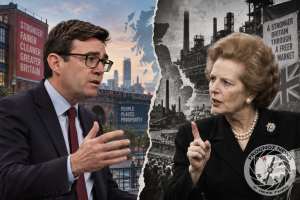
There is something faintly remarkable about the durability of Margaret Thatcher. She left Downing Street in 1990, died in 2013 and yet in 2026 the British Prime Minister, Andy Burnham, has made dismantling aspects of her economic settlement one of the defining intellectual ambitions of his government. In his first speech as Prime Minister, Burnham declared that Britain had taken “some wrong turns” in the 1980s: political power had been centralised, economic power privatised and large parts of the country de-industrialised.
His criticism is more sophisticated than the traditional Labour complaint that Thatcherism was simply cruel. Burnham’s argument is essentially that the economic model inaugurated during the 1980s has exhausted itself. Privatisation, financialisation, weak regional government and an excessive faith in markets have produced an economy in which London and certain highly productive sectors flourish while former industrial communities remain trapped in stagnation. His answer is stronger public control of infrastructure, greater regional autonomy, industrial policy and what he calls “good growth” — economic expansion whose benefits are recycled into the communities producing it.
There is a considerable amount of truth in this diagnosis. But there is also a danger that Burnham is confusing the defects of Thatcherism with the defects of everything that happened after Thatcher. More importantly, there is a danger that in rejecting an excessively romantic conception of markets he substitutes an equally romantic conception of the state.
The interesting question is therefore not whether Margaret Thatcher was right or Andy Burnham is right. It is which parts of Thatcherism remain indispensable to a successful modern economy and which have become obstacles to one.
What Thatcherism actually was
The mythology surrounding Thatcherism makes the argument unnecessarily difficult. Thatcher did not invent markets, capitalism or private property. Britain had been a capitalist economy for centuries before she entered Downing Street. Nor did she abolish the state: public expenditure remained enormous and the National Health Service survived her premiership intact.
Thatcherism was instead a response to a very particular British catastrophe. By the late 1970s Britain suffered inflation, weak productivity, recurrent industrial disputes, inefficient nationalised industries, powerful producer interests and a widespread sense that governments had lost the capacity to govern. The Winter of Discontent was not invented retrospectively by Conservative propagandists. Something really had gone badly wrong.
The Thatcherite solution contained several interconnected propositions. Competitive markets generally allocate resources better than governments. Prices contain information that bureaucracies cannot efficiently reproduce. Private ownership creates stronger incentives to control costs and invest intelligently. Trade unions should not possess sufficient coercive power to paralyse industries or governments. Governments should maintain monetary credibility rather than attempting permanently to purchase employment through inflation. Individuals should ordinarily be allowed to retain and dispose of the fruits of their labour.
These propositions were hardly eccentric. Variants of them became conventional economic wisdom throughout much of the developed world. And several were substantially correct.
British governments before Thatcher had repeatedly attempted to protect declining industries rather than facilitate economic adjustment. Nationalised enterprises frequently became vehicles for political patronage, industrial conflict and demands upon the Treasury. Governments tried prices policies, incomes policies, corporatist bargaining and repeated currency interventions. None solved Britain’s relative economic decline. The market revolution therefore corrected genuine pathologies. Burnham’s mistake would be to forget why Thatcherism happened.
But Thatcherism created pathologies of its own
Where Burnham has considerably more force is in asking what happened next. Markets are extraordinary mechanisms for answering one particular question: what allocation of resources follows from the preferences and purchasing power of the people participating in them? They do not necessarily answer a different question: what sort of country do we want to have in thirty years? Those questions can produce very different answers.
Suppose a steel mill in northern England can produce steel for £600 a tonne while a foreign competitor can deliver equivalent steel for £500. The market answer appear straightforward: import the steel. But suppose the closure of the mill destroys several thousand skilled jobs, collapses the surrounding supplier network, reduces the local tax base, increases welfare expenditure, destroys engineering apprenticeships and leaves Britain strategically dependent upon foreign steel during a future war. Suddenly the £100 difference does not capture the entire transaction.
This is one of the strongest criticisms that can be made of the economic philosophy that followed Thatcher. Markets frequently price private costs exceptionally efficiently while pricing collective externalities badly or not at all. Britain discovered this dramatically through de-industrialisation. Manufacturing declined as a proportion of the economy while finance and services expanded. In aggregate GDP statistics this could look perfectly rational. But economic geography mattered. Financial services concentrated overwhelmingly around London whereas the disappearing industries had sustained communities across northern England, Wales, Scotland and the Midlands.
Capital moved much more easily than people. A factory can disappear in months. A town cannot.
The forgotten importance of place
This is where Burnham’s experience in Greater Manchester gives his argument particular intellectual coherence. His economic philosophy is really less socialism than localism.
He argues that Britain simultaneously possesses too much state and too little government: excessive centralisation in Whitehall combined with inadequate public capacity where government actually needs to work. His current programme accordingly emphasises devolution alongside stronger public direction of transport, energy and infrastructure. That distinction matters.
Thatcherism attacked the state principally as an economic actor but paradoxically left Britain extraordinarily centralised politically. Local government remained dependent upon decisions taken in Westminster and Whitehall. Britain consequently developed an unusual combination: economically liberal but administratively centralised.
Burnham’s Manchester experience offers an interesting counterexample. His celebrated reform of Greater Manchester’s buses did not abolish private enterprise. It changed who controlled the network. Public authorities determined routes, fares and integration while private operators could still provide services.
This suggests something more interesting than the tired nationalisation-versus-privatisation argument. The relevant distinction may sometimes be between public ownership and public control. Burnham himself now emphasises precisely this distinction, arguing that essential infrastructure may require public direction without necessarily requiring conventional nationalisation. That is potentially a powerful idea.
The strange economics of natural monopolies
The strongest case against doctrinaire Thatcherism concerns industries in which genuine competition is impossible. Water is the obvious example. One cannot sensibly construct four competing networks of reservoirs, treatment plants and pipes running underneath London so that households can choose between rival water suppliers. The underlying infrastructure is a natural monopoly.
Privatising such an enterprise therefore does not magically create a market. It merely converts a public monopoly into a private monopoly. The same difficulty appears, in different forms, with electricity grids, railway infrastructure and certain other utilities. Markets work through competition. Where competition cannot meaningfully exist, privatisation alone cannot deliver the principal virtue that supposedly justifies markets.
Instead the state must regulate prices, investment, environmental standards and service obligations. At that point an awkward question arises: if government must regulate virtually everything important about the enterprise, precisely what advantages are being obtained from private monopoly ownership? Burnham’s scepticism about the Thatcherite settlement is strongest here.
His emphasis upon making infrastructure function properly for businesses is also important. Reliable electricity grids, transport systems, water supplies and telecommunications networks are not alternatives to capitalism. They are prerequisites for it. Adam Smith would have understood the point perfectly well.
Where Burnham becomes vulnerable
Yet there is an intellectual trap waiting for Burnham. The fact that markets sometimes fail does not establish that governments succeed. Governments suffer their own characteristic failures: bureaucracy, regulatory capture, political favouritism, short electoral horizons, weak incentives, administrative inertia and the tendency to allocate capital according to political rather than commercial considerations.
The history of British nationalisation provides abundant warnings. A government-owned company does not suddenly cease being inefficient merely because its profits theoretically belong to the public. Indeed its incentives may become worse. Managers know that bankruptcy is politically difficult. Trade unions know that governments fear disruption. Ministers discover that commercially necessary closures are electorally painful.
Losses consequently become subsidies and subsidies become permanent.
This is why Conservative leader Kemi Badenoch’s accusation that Burnham risks returning Britain to the 1970s, while rhetorically predictable, cannot simply be dismissed. There really was a reason Britain abandoned that economic model.
Thatcher’s greatest insight
The deepest insight of Thatcherism was not privatisation. It was incentives. Human beings respond to them.
Entrepreneurs take greater risks when successful businesses can make them wealthy. Investors move capital towards jurisdictions offering attractive returns. Companies invest when regulation is predictable. Workers acquire skills when doing so improves their prospects. Managers control costs when failure carries consequences. Any Burnhamite economic settlement that forgets these elementary truths will fail.
Britain has a particular reason to remember them because she desperately needs investment. Capital is extraordinarily mobile. A government cannot simultaneously tell international investors that Britain requires hundreds of billions of pounds of their money and treat earning a return upon that investment as morally suspicious. Burnham appears aware of this contradiction. He has explicitly said that Britain needs wealth creation and wants successful entrepreneurs not merely to create companies in Britain but to remain there.
That qualification makes his philosophy considerably more interesting than conventional socialism. The emerging argument seems to be that Britain needs capitalism without extractive capitalism. The difficulty will be defining the difference.
The problem with “good growth”
Burnham speaks repeatedly about “good growth”. Politically the phrase is excellent. Economically it is dangerous. Growth already means producing more goods and services that somebody values sufficiently to purchase. Once governments distinguish between good and bad growth, politicians must decide which economic activities deserve encouragement. That opens uncomfortable questions.
Is an artificial intelligence company good growth? Is an investment bank? A defence manufacturer? A supermarket distribution centre? A North Sea oil platform? A luxury property development? Different voters will give radically different answers. Industrial policy can therefore slide almost imperceptibly into politicians attempting to predict which technologies, industries and companies will succeed. Governments have a notoriously uneven record at this.
The better interpretation of “good growth” would therefore concern conditions rather than outcomes. Government should provide infrastructure, education, transport, energy, research institutions, housing and predictable law. It should prevent monopoly and corruption. It should internalise genuine environmental and social externalities. Then entrepreneurs should largely determine what businesses to create. The state should prepare the field rather than decide who wins the match.
Thatcherism’s greatest failure
Nevertheless there is one respect in which Burnham’s criticism deserves to become conventional wisdom. Thatcherism underestimated the political importance of economic geography. A country is not merely an aggregate GDP number. It consists of places. If London grows by £100 billion while a collection of northern towns loses £50 billion, national output has increased by £50 billion. The spreadsheet records success. Politics may record catastrophe.
People derive identity, dignity and social status from communities as well as incomes. When industries disappear, something more than wages disappears with them. Apprenticeships vanish. Families leave. High streets deteriorate. Property values stagnate. Public services contract. The most ambitious young people migrate elsewhere. Eventually economic geography becomes political geography.
Brexit cannot be explained solely in these terms, but the extraordinary regional inequalities that developed over the preceding decades plainly contributed to the revolt against Britain’s political and economic establishment. Burnham is therefore onto something important when he connects Thatcherism, centralisation and Brexit. The free market created winners. British politics neglected the places containing the losers.
The synthesis Britain actually needs
The answer is consequently neither Thatcherism nor its repudiation. Britain needs markets precisely where markets work. Competitive industries should remain competitive. Entrepreneurs should be allowed to become extremely rich by creating things people voluntarily buy. International investment should be welcomed. Trade should remain open. Governments should resist protecting inefficient businesses merely because they possess politically influential employees or shareholders.
But Britain also needs government precisely where markets do not work. Natural monopolies require stringent public control. Infrastructure requires long-term planning. Defence production requires strategic capacity. Scientific research frequently requires public investment before commercial returns become apparent. Regional transport networks generate benefits that cannot always be captured through ticket prices. Housing markets cannot function efficiently where planning rules artificially prevent construction. And communities devastated by economic transformation cannot simply be told to wait for market equilibrium.
This is not socialism. Nor, properly understood, is it necessarily anti-Thatcherite. It is recognition that markets and states are instruments suited to different problems.
The ghost of Margaret Thatcher
Andy Burnham is therefore right about something larger than his individual policies.
The economic settlement created during the 1980s has lasted extraordinarily long. Even Labour governments largely operated within it. Tony Blair modified Thatcherism but did not overturn it. Gordon Brown regulated markets but embraced global finance. David Cameron extended the logic of competition and privatisation while adding austerity. Subsequent governments tinkered with the structure while rarely questioning its foundations. Forty years is long enough for any political settlement to deserve reconsideration.
But Burnham should be careful about what he believes he is burying. The free market is not an ideology invented by Margaret Thatcher. It is an extraordinarily powerful decentralised information system. Prices coordinate the decisions of millions of people without requiring anybody to understand the whole economy. Competition disciplines incompetence. Profit encourages experimentation. Failure reallocates capital. These mechanisms remain indispensable.
What Thatcherism got wrong was the temptation to suppose that because markets are extraordinarily good at some things they must therefore be good at everything. Burnham risks making precisely the inverse error. The task before Britain is not to choose between the market and the state. It is to recover the intellectual confidence to distinguish between the circumstances in which each works.
Margaret Thatcher asked Britain to rediscover the market after the state had become too powerful. Andy Burnham is asking Britain to rediscover the state after the market has sometimes been allowed to become too powerful. There is merit in that argument. The measure of Burnham’s government will be whether he understands that the greatest achievement would not be to defeat Thatcherism, but to absorb its most important lessons while correcting the things it never understood.
38 Views



Most Readings