Caritas in Ukraine: The Quiet Work of Keeping a Country Alive
By Matthew Parish
Monday 7 September 2026
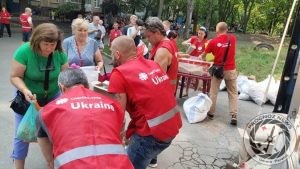
There are organisations whose importance in wartime is immediately apparent. The Armed Forces defend the country. The emergency services extinguish fires, pull people from ruined buildings and clear the wreckage after missile strikes. Hospitals treat the wounded. Governments maintain electricity, water, roads and the machinery of the state. Then there are organisations whose contribution is less dramatic but whose absence would rapidly become apparent. They look after the elderly woman whose children have left the country, the family whose house has been destroyed, the displaced child who has begun to exhibit the psychological symptoms of war, the disabled person who cannot navigate the ordinary mechanisms of humanitarian assistance and the exhausted mother who simply does not know where to turn next.
Caritas is one of these organisations. The work of Caritas in Ukraine illustrates an important truth about modern war. A country does not survive merely because her army continues to fight. She survives because, behind the soldiers, there remains a functioning society in which people continue to care for one another.
More than emergency relief
Caritas Ukraine is part of the international Caritas movement and has worked in Ukraine for more than three decades. Since the beginning of Russia’s full-scale invasion in 2022, the scale of its activities has necessarily expanded enormously. Caritas Ukraine reports that more than four million Ukrainians have received assistance through its network since 2022 and that approximately 100 local Caritas organisations now operate across the country.
Those figures are impressive, but statistics do not quite capture what an organisation such as Caritas actually does. The conventional image of humanitarian assistance is a cardboard box: food, medicines, blankets and perhaps hygiene products distributed to people who have suddenly lost everything. Caritas certainly performs this sort of emergency work. Yet its activities extend substantially further, into housing, cash assistance, psychological support, social protection, support for children, assistance to elderly and disabled people and the longer process of rebuilding independent lives.
In 2025 alone, Caritas Ukraine says that some 1.9 million people received support through its network. It reports more than €200 million in cash assistance cumulatively and millions of individual services, while its housing programmes assist displaced people and those whose homes have been damaged by Russian attacks.
This distinction matters because wars lasting years create different humanitarian problems from wars lasting weeks. A person whose house has been destroyed needs somewhere to sleep tonight. Six months later, however, he may need legal advice about documents, assistance repairing his home, psychological counselling, employment and help navigating state institutions. A pensioner may initially require food but subsequently need continuing social assistance. A displaced child may be physically safe but nevertheless profoundly traumatised. Humanitarian relief therefore gradually becomes something closer to social reconstruction. That is where organisations such as Caritas become particularly valuable.
Chernihiv
Chernihiv provides an unusually powerful example. The city was one of the principal targets of Russia’s initial invasion in February and March 2022. Russian forces approached and partially surrounded her but failed to capture her. The fighting nevertheless inflicted enormous damage upon residential districts and surrounding villages. The Russian withdrawal from northern Ukraine did not end the war for Chernihiv Oblast. Communities close to the Russian and Belarusian borders have continued to live with the consequences of invasion, displacement, damaged homes, economic disruption and recurrent attacks.
Caritas Chernihiv operates from locations in Chernihiv and Nizhyn. Its activities include humanitarian assistance, child-friendly facilities, inclusion programmes, mobile teams, legal assistance, psychological assistance, social transport and a “social wardrobe” through which clothing and other necessities can be provided to people who need them. This range of services reveals something about the character of the humanitarian problem in northern Ukraine. There is no single category called “war victim” with a single corresponding need.
A destroyed house is a housing problem, a financial problem and frequently a legal problem. It may become a psychological problem. If the owner is elderly or disabled, it becomes a mobility and social-care problem as well. If children lived there, their education and emotional welfare become part of the equation. Caritas attempts to address these problems as aspects of the same human predicament rather than as unrelated bureaucratic categories.
Its humanitarian programmes in Chernihiv are expressly intended not merely to respond to immediate crises but also to provide longer-term assistance helping people adapt socially, recover their resources and move gradually towards stable lives. That is a sensible philosophy of humanitarian work because dignity consists of rather more than survival.
Children and the elderly
The two ends of life are particularly vulnerable in wartime. Children may become accustomed to air-raid sirens with a speed adults find disturbing. They learn where the shelter is. They know the sound of explosions. They understand that school may suddenly be interrupted. Yet apparent adaptation should not be mistaken for absence of trauma.
Caritas Chernihiv’s work has therefore included children’s spaces, individual counselling and therapy. Its 2024 reporting describes work in both Chernihiv and Nizhyn supporting children and families who had experienced the trauma of war.
At the other end of the demographic spectrum are Ukraine’s elderly. This is one of the least glamorous subjects in humanitarian work and one of the most important. Younger people can evacuate. They may have cars, smartphones, relatives abroad, foreign languages, employment prospects and sufficient physical resilience to begin again somewhere else. An 82-year-old widow living in a village may have none of these things.
Her entire world may consist of her house, her garden, her neighbours and a pension collected locally. Asking her to abandon them can amount to asking her to abandon the structure of her life. Caritas Chernihiv has provided warm winter kits to elderly people living alone in the region, alongside broader crisis-centre and social support. These apparently modest interventions can make the difference between an elderly person remaining safely independent and descending into a crisis requiring far more extensive assistance.
There is a tendency in discussions about war to concentrate upon extraordinary acts. Yet much of humanitarianism consists of ordinary things supplied under extraordinary circumstances: heating, clothing, transport, food, medicine, conversation and somebody answering the telephone.
Mobile humanitarianism
The mobile teams are particularly important. Humanitarian organisations naturally tend to establish themselves in cities because cities possess offices, warehouses, transport connections, hospitals and concentrations of people requiring assistance. Yet some of the people most in need are precisely those least capable of travelling to a humanitarian centre.
This is particularly true in rural northern Ukraine.
Caritas has consequently developed mobile services operating in frontline and war-affected regions, including Chernihiv Oblast. The principle is elementary but important: where vulnerable people cannot reach assistance, assistance must reach vulnerable people. This may become increasingly important as the war continues. Ukraine’s humanitarian crisis is ageing together with the war itself. Savings are exhausted. Buildings deteriorate. Families become geographically dispersed. Volunteers become tired. International attention fluctuates. People who could tolerate an emergency for three months discover that four years of emergency is something quite different. The longer the war lasts, the more humanitarian organisations must evolve from distributors of emergency supplies into institutions of social resilience.
The importance of trust
There is another reason organisations such as Caritas matter. Humanitarian assistance depends upon trust. People must believe that an organisation will still be there next month. Donors must believe their money is being spent properly. International partners must be confident that assistance reaches its intended beneficiaries. Vulnerable people must be able to disclose personal circumstances without fearing exploitation.
Caritas Ukraine emphasises accountability, transparency and relationships of trust with donors, partners and communities as central principles of its work. Caritas Chernihiv has also participated in safeguarding training and monitoring intended to reinforce procedures protecting the people with whom it works.
This institutional dimension is easily overlooked. Charity is not merely generosity. At scale it requires accounting systems, safeguarding procedures, trained social workers, psychologists, drivers, warehouses, project managers, procurement procedures and people capable of determining who needs what. Compassion without organisation achieves surprisingly little. Caritas combines the two.
Christian charity in a plural country
Caritas is a Catholic organisation and Caritas Ukraine describes herself as the Church’s authorised body for social ministry. Her work is nevertheless valuable far beyond the boundaries of any particular religious community. Indeed this is one of the more interesting features of religious humanitarian organisations in Ukraine. Faith provides an institutional and moral architecture for service while the practical assistance is directed towards human need.
There is nothing particularly theological about needing a wheelchair-accessible vehicle, psychological counselling or repairs to a roof destroyed by an explosion. Yet there is something profoundly Christian in the proposition that the person requiring those things should not be abandoned.
Ukraine’s wartime experience has produced innumerable examples of this practical ecumenism. Churches have become shelters. Priests have become humanitarian coordinators. Parish networks have become distribution systems. Religious charities work alongside secular NGOs, municipalities, international organisations and volunteers.
One need not share the theology to admire the results.
Rebuilding people as well as buildings
Eventually Ukraine will have to undertake reconstruction on an immense scale.
The phrase “reconstruction of Ukraine” often summons images of bridges, power stations, apartment blocks, railways and factories. All of these things will indeed have to be rebuilt. But countries consist of people before they consist of infrastructure.
A traumatised child cannot be reconstructed with concrete. An isolated pensioner cannot be repaired with a World Bank loan. A disabled person does not regain independence because a motorway has reopened. A widow who has lost her husband, her home and her livelihood requires forms of assistance that do not appear easily in spreadsheets measuring physical reconstruction. This is why the work Caritas is undertaking now may remain important long after the fighting ends.
The objective of humanitarian assistance should ultimately be to make humanitarian assistance unnecessary. People must recover independence, communities must recover their internal networks and institutions must recover the capacity to provide ordinary public services. Caritas Ukraine explicitly describes her approach as extending from immediate humanitarian response towards sustainable recovery and reducing vulnerability to future crises. That is exactly the right ambition.
The civilisation behind the front line
Visitors to Ukraine sometimes wonder how life can appear so normal while a gigantic war continues several hundred kilometres away. Cafés remain open. Children go to school. Trains run. People marry. Supermarkets sell vegetables. Grandmothers walk their dogs.
The answer is that normality during wartime is not actually normal at all. It is an enormous collective achievement.
Behind every apparently ordinary Ukrainian community lies an extraordinary network of soldiers, emergency workers, municipal officials, railway employees, doctors, electricians, volunteers, charities, relatives, neighbours and strangers preventing the cumulative effects of war from overwhelming civilian society. Caritas forms part of that invisible architecture. In Chernihiv, where the scars of Russia’s invasion remain unmistakable, its staff and volunteers perform work that seldom produces dramatic headlines: helping families, counselling children, supporting elderly people, assisting persons with disabilities, providing humanitarian supplies, offering legal and psychological assistance and travelling out towards communities whose inhabitants cannot readily come to them.
Yet perhaps these modest acts tell us more about Ukraine’s resilience than many grander things. Russia’s war is not only an attempt to seize territory. It is an attempt to make ordinary Ukrainian life impossible. Every repaired home, every supported pensioner, every child helped through trauma and every family enabled to remain together therefore represents a small repudiation of the logic of the invasion.
Caritas cannot end the war. But it can help ensure that the society Russia sought to destroy remains humane while the war is being fought. That is valuable work indeed.
—
Caritas Ukraine provides humanitarian and social assistance to vulnerable people across Ukraine. Further information about its work and ways to support it may be found at Caritas Ukraine. Donations made through the organisation’s website are very welcome. Readers wishing particularly to learn about or support its work in northern Ukraine may also visit Caritas Chernihiv.
3 Views



Most Readings