The People Who Keep Ukraine Alive
By Matthew Parish
Thursday 10 September 2026
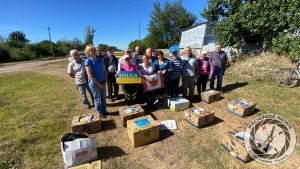
There is a second Ukrainian army. It does not wear uniforms, it does not carry rifles and its members seldom appear in the communiqués from the General Staff. They drive vans, cook soup, unload generators, care for old people, find nappies and medicines, repair battered vehicles, organise warehouses, raise money in English villages and carry boxes into apartment blocks where the electricity has gone off again. They are the enormous, decentralised and frequently improvised Ukrainian volunteer movement and, after more than four years of full-scale war, it is difficult to imagine how Ukraine could have survived without them.
Among this sprawling constellation are organisations with names that will be unfamiliar to most people outside Ukraine: Unity, Will & Strength, Sunrise Kitchen, Chervona Kalyna, Dreams Together, Alona➕Alina and Through The War in Kharkiv; Susy Q in Izium; Planet of People in Kramatorsk; and, thousands of kilometres away, British organisations such as New Forest for Ukraine and HOUF, Helping Our Ukrainian Friends. Some are formally constituted charities, others grew from much smaller networks of volunteers and friends. They vary in size, organisation and resources. What unites them is something more important: they inhabit the space between the gigantic machinery of international assistance and the individual Ukrainian who needs something today.
That space is enormous.
A government can provide an air defence system. The United Nations can organise programmes involving millions of dollars. A major international charity can commission assessments, employ specialists and negotiate with ministries. But none of these institutions necessarily knows that an elderly woman on the outskirts of Kharkiv cannot walk to the nearest humanitarian distribution point, that a displaced mother needs infant formula this afternoon, that a hospital requires a particular consignment of supplies or that twenty people in a damaged building have electricity only when somebody finds them a generator. These are not insignificant problems because they occur on a small scale. Multiply them by several million people across hundreds of Ukrainian towns and villages and they become the substance of civilian survival.
Kharkiv has become one of the great laboratories of this kind of wartime civil society. She lies close to Russia, has endured repeated missile, drone and glide-bomb attacks and has nevertheless refused to die. Her restaurants open, her trains run, people walk their dogs and children continue to grow up beneath the peculiar psychological canopy of air-raid sirens and explosions. Behind this improbable normality lies an extraordinary infrastructure of voluntary work.
Chervona Kalyna offers an unusually vivid example. The organisation traces its origins to the first day of the full-scale invasion, when some 300 students and staff sheltered in the basement of a Kharkiv dormitory. The initial problems were brutally simple: food, water, electricity, transport and fear. From this emergency improvisation grew an organisation that now provides hot meals, humanitarian assistance and psychological support to displaced people and families. It reports having prepared more than 50,000 portions of hot food, supplied more than 20,000 pies to hospitals, conducted more than 1,500 psychological therapy sessions and supported more than 2,000 children and their relatives.
There is something profoundly Ukrainian about this progression. Nobody sitting in a comfortable office in 2021 drew up a strategic plan proposing that a university basement should evolve into a humanitarian institution. The institution arose because Russian missiles began falling and somebody had to feed the people downstairs. Then somebody had to feed somebody else. Then displaced families arrived. Then wounded people needed assistance. Then children needed psychological support. Temporary improvisation became routine, routine became expertise and expertise became an institution.
Sunrise Kitchen embodies the same fundamental idea in its simplest form: people must eat. In peacetime a hot meal is so ordinary that it scarcely merits contemplation. Under bombardment it becomes infrastructure. Electricity fails, shops close, homes are damaged, incomes disappear and elderly or displaced people lose the networks through which they previously sustained themselves. Cooking therefore ceases to be merely domestic activity. A kitchen becomes part of the architecture by which a city remains habitable.
The same is true of Unity, Will & Strength, Dreams Together and Alona➕Alina. The public English-language record of these smaller Kharkiv volunteer initiatives is not always extensive and it would be wrong to invent impressive-looking statistics simply because contemporary charitable culture has developed an obsession with metrics. Indeed their relative invisibility illustrates the point. Much of Ukraine’s humanitarian work takes place beneath the level at which international organisations record it. A person has a van. Another person knows where assistance is required. Somebody has obtained food. Somebody abroad sends money for fuel. Messages are exchanged, a journey is made and another handful of people get through another week.
This is not humanitarianism as an industry. It is humanitarianism as a social instinct.
Through The War provides another illustration of what happens when this instinct becomes permanent. Its volunteers came from ordinary civilian lives and professions. The organisation describes its mission as caring for people who cannot care for themselves, including elderly people requiring continuous assistance, mothers with babies and pregnant women. It also operates from Kharkiv with support reaching it through an international collection of donors and partners.
One of its most striking projects has been a shelter for elderly people who lost their homes because of Russian aggression. British assistance helped renovate rooms and sanitary facilities and improve living conditions, including construction of a terrace allowing residents with limited mobility to get outside. The needs of such a shelter are magnificently unglamorous: bread, meat, milk, vegetables, pasta, washing powder, soap, adult nappies, disinfectant and medicines.
These objects explain war rather better than many speeches do. Wars are discussed in terms of territory, strategy, battalions and geopolitics. Yet for a seventy-five-year-old woman whose apartment has been destroyed, war may mean needing somebody to find adult nappies and blood-pressure medicine. The humanitarian volunteer lives at precisely the point where the abstractions of geopolitics collide with the human body.
Izium and Kramatorsk lie still closer to this reality. Susy Q in Izium belongs to the intensely local tradition of eastern Ukrainian volunteering, in a city that has experienced occupation, destruction, liberation and the continuing consequences of war. Planet of People in Kramatorsk works in another city upon which the front has steadily imposed itself. In places like these, the distinction between volunteer and neighbour becomes increasingly meaningless. The people providing assistance often know the streets, villages and families involved. They understand who is likely to remain when evacuation is advised and why: age, disability, poverty, attachment to a home, fear of uncertainty or simply the stubbornness that becomes understandable when somebody has spent a lifetime accumulating a few rooms and possessions and is told to abandon everything.
This local knowledge is something money cannot readily purchase. Then the chain stretches westwards, all the way to Britain.
New Forest for Ukraine began in February 2022 as a volunteer effort in southern England. Aid initially travelled in cars, then vans and ultimately articulated lorries carrying eight to ten tonnes at a time. The organisation says that it works with vetted Ukrainian charitable foundations and uses proof-of-handover systems intended to trace donations to their recipients. Nobody within the organisation takes a salary and even its hub has been donated.
By September 2026, the scale of what this volunteer organisation reports accomplishing is remarkable: 937 tonnes of humanitarian aid, 80 trucks sent to Ukraine, 170 van deliveries and 889 generators, working with ten vetted Ukrainian charitable foundations. The organisation’s current campaigns concern things as elementary as generators and power packs, medical supplies, infant formula, long-life food, soap and clothing.
Consider for a moment the journey represented by one generator. Somebody in England buys or donates it. Somebody collects it. Somebody brings it to a warehouse. Volunteers inspect it, perhaps service it, catalogue it and place it upon a pallet. Money has to be found for transportation. Paperwork must be completed. A lorry crosses Europe. A Ukrainian partner receives the consignment. Another vehicle carries the generator eastwards. Eventually it arrives in a village, shelter, clinic or apartment building where the lights have been going out.
A person in Hampshire may never know the name of the Ukrainian whose home she has helped illuminate. That is solidarity in its purest form.
HOUF, Helping Our Ukrainian Friends, represents another version of the same bridge between Britain and Ukraine. Such organisations demonstrate something that governments occasionally forget: international solidarity is not exclusively a relationship between states. It can be a relationship between people who have never met. Friendships, community associations, churches, football supporters, Ukrainian expatriates and British volunteers form networks through which relatively modest donations are transformed into physical goods and carried thousands of kilometres towards the war.
The multiplication effect can be extraordinary. Fifty pounds is not much in the budget of a government department. In a volunteer network it may become food, hygiene products or part of the transportation cost of a pallet. A few hundred pounds may become a generator. New Forest for Ukraine currently estimates the cost of sending an articulated lorry carrying approximately ten tonnes of humanitarian assistance at about £2,500.
This is one reason small organisations can achieve disproportionate results. Their overheads may be modest, their knowledge intensely local and the relationship between donor and recipient comparatively short. They can also adapt quickly. When Ukrainians say they need generators, the campaign becomes generators. When the requirement changes to infant formula, medical equipment or long-life food, the collection changes with it. New Forest for Ukraine says Ukrainian partners update their requirements weekly and the organisation adjusts its appeals accordingly.
None of this means that large humanitarian organisations are unnecessary. Quite the opposite. A country fighting a major industrial war needs assistance on a scale that only states and large institutions can provide. Hospitals, electricity grids, water systems, displaced populations and eventually reconstruction require billions. Small charities cannot replace governments, nor should they try.
They perform a different function. They fill the cracks. And war creates cracks everywhere.
A pensioner falls between social services and evacuation arrangements. A family loses its house but does not qualify immediately for some formal programme. A clinic needs a particular item that is absent from the next institutional procurement cycle. A village has electricity on paper but the transformer has been destroyed. A mother needs nappies today rather than when the next assessment has been completed. Small organisations move into these spaces because their principal bureaucratic mechanism is often somebody saying, ‘I know a person who can help.’
This may also explain something larger about Ukraine’s survival. Russia’s war has never been directed solely against Ukraine’s Armed Forces. It is a war against the viability of Ukrainian society. Power stations are attacked, homes are destroyed, cities are bombarded and civilians are displaced. The strategic objective is partly psychological: to make ordinary existence so exhausting, frightening and difficult that resistance eventually appears futile.
Ukraine’s volunteer movement frustrates that objective every day.
When a missile destroys something, somebody repairs it. When people are displaced, somebody feeds them. When electricity disappears, somebody finds a generator. When an elderly person cannot leave, somebody drives towards her rather than away. When money runs short, somebody in Britain organises a sponsored walk, sorts donated goods or spends Saturday morning packing a pallet.
These actions are individually tiny when compared with the movements of armies. Collectively they are formidable.
Ukraine’s history of this war will inevitably be written around presidents, generals, battles and weapons: Kyiv, Mariupol, Bakhmut, Avdiivka, Kharkiv, Pokrovsk, drones, artillery, Patriots and F-16s. That is how wars are conventionally remembered.
Yet there is another history being written simultaneously. It is the history of the people who cooked meals in basements, carried boxes upstairs, drove battered vans along dangerous roads, found medicines for strangers, looked after abandoned animals, housed displaced pensioners, repaired generators and persuaded their neighbours in distant English towns to put another tin of soup into a collection box.
Unity, Will & Strength. Sunrise Kitchen. New Forest for Ukraine. Helping Our Ukrainian Friends. Chervona Kalyna. Dreams Together. Alona➕Alina. Through The War. Susy Q. Planet of People.
They are only ten names among thousands.
Russia set out to demonstrate that Ukraine was not really a country. Instead the war revealed, in the most painful way imaginable, how extraordinarily dense the bonds within Ukrainian society had become. A state is not merely a government, a flag or a line upon a map. Ultimately it is an agreement between strangers that when one of them falls, another will reach down and help her stand again.
Ukraine remains standing because millions of people made precisely that agreement.
36 Views


Most Readings