The Nightclub that Mykolaiv Does Not Need
By Matthew Parish
Saturday 12 September 2026
There are few opportunities in contemporary European business more compelling than opening a nightclub in Mykolaiv. The city has virtually no nightlife, negligible late-night footfall, wartime restrictions upon movement, periodic electricity problems, an economy distorted by invasion, a substantial population that has left and the occasional arrival overhead of Russian military hardware. To the unimaginative investor these facts might represent disadvantages. To the visionary entrepreneur they mean only that there is practically no competition. The market is completely open, principally because there is no market. This is the sort of opportunity that business schools teach people to recognise: identify an unmet consumer need, establish barriers to entry and exploit first-mover advantage. In Mykolaiv the barriers to entry have thoughtfully been established already, principally by the Armed Forces of the Russian Federation. The prospective nightclub proprietor need merely provide the first-mover part. His competitors are unlikely to undercut him because his competitors do not exist, and he can therefore reasonably claim a 100 per cent share of a market worth approximately nothing. Fortunes have been built upon less promising foundations.
The principal problem with nightlife in Mykolaiv is contained in the word ‘night’. Night traditionally involves darkness, leisure and a certain amount of movement between establishments. In wartime Mykolaiv darkness has acquired more practical purposes, leisure is complicated and wandering around looking for another bar is not necessarily the recreational activity it once was. The conventional European progression from restaurant to bar to nightclub to kebab shop must therefore be substantially accelerated. One cannot spend until midnight discussing whether everybody is ready to go somewhere else because by then the answer has already been provided by the authorities. The Mykolaiv nightclub must consequently pioneer a revolutionary concept: the afternoon nightclub. The doors open at five, by six the DJ is playing, at seven everyone is drinking, at eight the dance floor is full, at nine somebody is crying in the lavatory and at ten two people who met three hours earlier are discussing whether their relationship has a future. This represents approximately the same emotional trajectory as an ordinary Saturday night in London, except that the entire procedure has been compressed by half and everybody has remembered to bring identification.
There are considerable advantages to this arrangement. Happy Hour can begin before most people have finished work, last orders can occur before customers have become sufficiently drunk to damage the furniture and the nightclub can close at an hour at which respectable restaurants elsewhere in Europe are still taking reservations. Staff can go home early and customers can wake the following morning with hangovers acquired with exceptional administrative efficiency. Much of the inefficiency of European nightlife derives from the fact that everybody spends several hours pretending not to want to do what they eventually intend to do anyway. People sit in restaurants until ten, move to bars until midnight and arrive at clubs at one in the morning, where they spend another hour staring at one another before beginning the serious business of the evening. Mykolaiv has no time for this nonsense. If you intend to dance with the attractive woman standing beside the bar, you had better introduce yourself immediately because shortly everyone may have to go home, move to a shelter or discover that the attractive woman has already secured the last available taxi. War encourages decisiveness, and nightlife adapted to wartime conditions may therefore prove unexpectedly productive.
The club itself should naturally be underground. In Berlin this would be considered fashionable; in Mykolaiv it would be considered prudent. The distinction illustrates the difference between western European nightlife and Ukrainian nightlife rather well. In Berlin people queue for two hours to enter a concrete basement because they wish to experience the atmosphere of post-industrial collapse, whereas in Mykolaiv post-industrial collapse is available outside free of charge. The interior designer should therefore resist excessive authenticity. There is no need to commission distressed concrete because Mykolaiv already possesses distressed concrete, and exposed electrical cables should likewise be avoided because nobody wants to spend an evening wondering whether they are decorative or the consequence of something that happened on Tuesday. Industrial chic becomes less amusing when the industry has actually closed.
Instead the club should be extravagantly elegant: velvet, mirrors, proper glassware, beautiful lighting, women in improbable dresses, men wearing jackets that have not been designed to contain military equipment and champagne served without irony. The purpose of the establishment should be to construct a small bubble of unnecessary civilisation in a city where necessity has been dictating almost everything for far too long. The drinks menu should acknowledge its location without descending into tasteless wartime gimmickry. There should be Ukrainian vodka, Ukrainian wine, Ukrainian beer and proper cocktails prepared by somebody who knows the difference between a Negroni and three unidentified liquids poured into a glass. There should emphatically not be cocktails called the HIMARS, the Shahed or the Storm Shadow. War already intrudes sufficiently into Ukrainian life without appearing on the cocktail menu accompanied by a slice of orange. Anyone proposing such an idea should be removed from the marketing department and assigned to something more suitable, perhaps cleaning the generator.
The business plan would nevertheless require a section rarely encountered in hospitality investment prospectuses. The risk factors would include inflation, labour shortages, reduced consumer expenditure, changing regulations, interruptions to electricity supplies and Russian ballistic missiles. One can imagine the conversation with the insurance broker. The broker asks what sort of premises are involved and is told that it is a nightclub. He asks for the location and receives the answer ‘Mykolaiv’. There follows a silence long enough to determine whether the telephone connection has failed. The broker might eventually enquire whether the proprietor has considered another line of work: sheep farming in a minefield, perhaps, Somali maritime logistics or adventure tourism in Zaporizhzhia Oblast. Something conservative.
Financing would be equally entertaining. A prospective investor might ask for projected annual footfall and be told that nobody knows. He might ask for average customer expenditure and receive the same answer. Projected EBITDA would be described as ‘highly conceptual’, market growth as ‘dependent upon several geopolitical variables’ and the exit strategy as ‘preferably before curfew’. Nevertheless, a sufficiently imaginative spreadsheet can prove almost anything. There may be tens or hundreds of thousands of theoretical customers within the wider urban area and, if merely one per cent of them were to attend every Saturday, the club would be packed. The fact that the overwhelming majority have demonstrated no desire whatsoever to attend a nightclub can be relegated to an appendix entitled ‘Assumptions’. This is how investment banking works.
Marketing would present another challenge because advertising nightlife in a city without nightlife requires persuading people that they have been suffering from a problem they had not previously identified. The establishment could advertise itself as ‘Mykolaiv’s hottest nightclub’, which would probably be true automatically. It could describe itself as ‘the number one nightlife destination in Mykolaiv’, which might also be true, or even as ‘Mykolaiv’s most exclusive club’, which would become increasingly accurate the fewer people attended. Indeed exclusivity could become the establishment’s defining characteristic. London clubs employ enormous men with clipboards to prevent undesirable customers entering, whereas the Mykolaiv nightclub could dispense with this expense because geopolitical circumstances have already reduced the queue. If customers ask whether they are on the guest list, the correct answer is that everyone is on the guest list. If they enquire about the dress code, the answer is simply: please come.
A nightclub without customers possesses several underrated advantages. There are no fights, nobody steals glasses, the lavatories remain immaculate, the bartender remembers everybody’s name, table reservations are exceptionally easy to obtain and every customer enjoys VIP treatment because statistically every customer is a VIP. The owner can wander through the empty premises admiring the enormous amount of space available for future expansion. This is known in entrepreneurial literature as scalability. Nevertheless, eventually somebody will come, and this is where the business model becomes dangerous because the nightclub may accidentally become successful.
The first customers will probably arrive out of curiosity. Ukrainians possess an admirably developed appetite for watching other Ukrainians undertake obviously insane projects. Someone announces that he has opened a nightclub in wartime Mykolaiv and the natural response may not be ‘why?’ but ‘where?’ Four people arrive, then eight. Somebody photographs a cocktail. A young woman posts a photograph of herself wearing a backless dress in surroundings where backless dresses have not been strategically necessary for several years, and her friends enquire where she is. Twenty more people arrive. The owner, who has spent six months worrying that nobody would come, immediately discovers the alternative problem that everyone has arrived simultaneously and there are only two bartenders. This is capitalism.
The atmosphere might then become extraordinary precisely because nobody expected it to exist. Soldiers on leave, local business people, volunteers, students, engineers, journalists and aid workers would find themselves occupying the same improbable basement. Some foreign visitor would be sitting at the bar wondering how his life had progressed from an economics degree in Surrey to drinking Ukrainian cognac in Mykolaiv while somebody nearby explained the relative acoustic signatures of different varieties of incoming munition. Then the air-raid siren would sound and the nightclub’s resident DJ would encounter the only performer in southern Ukraine with an absolute legal and artistic right to interrupt his set. The air-raid siren does not take requests, does not accept tips, does not care whether the dance floor is full and possesses a repertoire that is limited but extremely recognisable.
The music stops, everyone looks at their telephone, the foreigners look alarmed and the Ukrainians look irritated. The bartender begins securing bottles with the weary professionalism of a person whose employment contract presumably did not originally describe this procedure. A man who has spent twenty minutes attempting to introduce himself to an attractive woman discovers that Russian military aviation has unexpectedly provided him with a conversational opportunity. He asks whether she comes here often and she points out that the club opened yesterday. Romance has always flourished under difficult conditions. The proprietor’s greatest achievement would nevertheless be maintaining the distinction between danger and entertainment. War must never become the theme of the club. The nightclub exists to exclude war for a few hours, not to turn war into interior decoration.
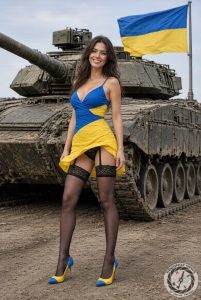
That is why people should dress absurdly well. A backless dress is particularly magnificent in this environment because it is almost perfectly unsuited to contemporary military conditions. It provides no camouflage, no thermal insulation, no storage capacity and no ballistic protection whatsoever. Its entire function is aesthetic, which makes it one of the purest possible expressions of civilisation. The wearer is announcing that for this evening she does not intend to be a refugee, volunteer, logistics coordinator, analyst of air-raid alerts or amateur expert upon Iranian drone technology. She intends to be a beautiful young woman drinking something expensive while pretending not to notice that three men are looking at her. Human civilisation has survived worse periods of history through less sophisticated mechanisms.
Then comes the most exciting part of the evening: closing time. In ordinary nightclubs customers leave gradually, whereas in Mykolaiv the dispersal must resemble an evacuation exercise. At ten nobody wants to go. Shortly afterwards the staff begin making suggestions, the owner becomes increasingly anxious and romantic negotiations acquire a sense of urgency. Eventually everyone is simultaneously attempting to obtain transport. The nightclub that spent the afternoon trying desperately to attract customers now deploys its entire workforce to remove them. The proprietor encourages everybody to come again tomorrow and, when asked what time, replies ‘five’. No nightclub in Ibiza has ever uttered these words.
Soon the streets empty, the doors close, the generator is checked and the day’s receipts are counted. The proprietor discovers that the establishment has sold forty-seven cocktails, twenty beers, three bottles of wine and one bottle of champagne, which constitutes either an encouraging opening night or an extremely expensive private party. He opens his spreadsheet. Revenue is surprisingly good, costs are horrifying and the projected break-even date appears to coincide approximately with Ukrainian accession to the European Union. He goes home satisfied.
The absurdity conceals something serious. War does not merely destroy buildings; it destroys habits and reduces the range of things people imagine themselves doing. Restaurants close earlier, friends meet less frequently, young people leave, public spaces become quieter and a city slowly contracts psychologically as well as economically. There is therefore something worthwhile about reopening spaces whose only purpose is pleasure. A nightclub is magnificently useless. It produces no ammunition, repairs no electricity substations, evacuates nobody and contributes nothing obvious to national defence. People enter it and consume overpriced liquids while standing beside music loud enough to make conversation difficult, and that is precisely why it matters.
The point of defending Ukraine cannot merely be to preserve the territory upon which Ukrainians undertake the defence of Ukraine. Eventually there must be something on that territory besides the defence effort. There must be restaurants, businesses, theatres, lovers, arguments, stupid clothes, terrible dancing, embarrassing messages sent late at night and mornings upon which people regret decisions that had absolutely nothing to do with geopolitics. Otherwise war has already taken too much. The absence of nightlife in Mykolaiv is therefore simultaneously funny and melancholy. The city is not devoid of people, romance, energy or an appetite for life, but war compresses the social world. Darkness becomes functional rather than seductive, and the phrase ‘Saturday night in Mykolaiv’ does not conjure images of queues outside clubs, neon signs and streets full of drunken students deciding where to go next. It raises the more fundamental question of whether anything is open.
For an entrepreneur this is either disastrous or irresistible. Capitalism has always depended upon people capable of looking at an obviously terrible idea and seeing first-mover advantage. Railways were built into wildernesses, hotels erected in deserts and restaurants opened in neighbourhoods everybody sensible had abandoned. Somewhere in the entrepreneurial imagination there must therefore exist a person capable of standing on an empty Mykolaiv street on a Saturday evening, listening to the distant noises of war, observing that every visible business appears to be closed and declaring that the market is underserved. He would, strictly speaking, be correct.
So perhaps somebody should open the nightclub. The accountant will object, the insurer will have a nervous breakdown, the bank will decline the loan, the neighbours will complain about the noise — which in Mykolaiv would represent an almost heroic commitment to normality — the authorities will produce seventeen forms, the generator will fail, the DJ will arrive late, the barman will resign and somebody will steal a mirror. Russian drones will periodically contribute unsolicited percussion. On some evenings almost nobody will come, and the proprietor will stand behind his beautiful empty bar beneath his expensive lights wondering why he did not open a dental surgery in Poland.
Then the door will open. Two women will walk in wearing dresses entirely inappropriate for the strategic environment, four soldiers will arrive, someone will order champagne and the DJ will start playing. For several hours there will be nightlife in a city that does not have any. That may be the most compelling investment thesis of all, because when a market does not exist there is only one way to obtain 100 per cent of it: invent it.
38 Views



Most Readings