The Price of the Sky: How Interceptor Drones Could Break Russia’s Shahed Strategy
By Matthew Parish
Saturday 12 September 2026
Wars are won with money as well as blood. This is particularly true of wars of attrition, in which neither side is capable of imposing an immediate and decisive military defeat upon the other and the contest gradually assumes the character of an immense economic struggle. Soldiers, ammunition, vehicles, aircraft, electricity, factories and increasingly computer processors become resources to be expended, replaced and expended again. The question is no longer merely who possesses the better weapon, but who can continue manufacturing and paying for weapons for longer. The battlefield becomes, amongst many other things, an accounting exercise conducted with explosives.
Russia understands this exceptionally well and the Shahed drone is perhaps the purest expression of this philosophy. The Shahed is not principally formidable because it is technologically sophisticated. Compared with a modern cruise missile or combat aircraft it is a relatively simple machine. Its strategic importance derives instead from the relationship between its cost, range, destructive potential and the quantities in which Russia can manufacture it. A Shahed does not have to be technologically impressive if thousands of them can be manufactured and launched against Ukrainian cities, electricity infrastructure, military installations and other targets. Nor does every Shahed have to arrive. The economic logic remains attractive to Russia if the weapons are sufficiently inexpensive that large numbers can be sacrificed merely to force Ukraine to defend herself.
That creates a potentially disastrous asymmetry. If Russia launches a weapon costing tens of thousands of dollars and Ukraine destroys it using a missile costing hundreds of thousands or even millions, Ukraine has won the immediate engagement while Russia may nevertheless have won the economic transaction. Repeat the transaction thousands of times and tactical success can become strategic exhaustion. This is why the development of Ukrainian interceptor drones may prove to be one of the most important changes in the economics of the war. Their significance lies not merely in the ingenious proposition that one drone can be used to destroy another. It lies in a much more important principle: Ukraine must make it cheaper to defend her skies than Russia finds it to attack them.
The economics of the Shahed extend well beyond the price of the aircraft itself. Once a Russian drone enters Ukrainian airspace it begins imposing costs upon Ukraine irrespective of whether it ultimately strikes anything. Radar systems must track it. Air-raid warnings must be issued. Ukrainian personnel must establish its probable trajectory and assess its likely target. Electronic warfare systems may be activated, mobile air-defence units repositioned and conventional anti-aircraft systems placed on alert. Fighter aircraft may sometimes become involved. A Shahed that eventually crashes harmlessly into a field may therefore still have performed a useful military function because it has compelled Ukraine to expend resources responding to it.
This is one of the peculiar characteristics of air warfare. The attacker chooses when to attack whereas the defender cannot safely choose which attacks to ignore. A drone apparently travelling towards an electricity substation may change direction. Another may be a decoy. A third may appear unimportant but form part of a larger attack in which cruise missiles or ballistic missiles are approaching from other directions. Russia can therefore use large numbers of relatively inexpensive aircraft not merely to inflict damage but to complicate the Ukrainian defensive picture, occupy sensors and crews and consume defensive resources. The proper measure of Ukrainian success cannot consequently be simply the percentage of Russian drones destroyed. It must also include the price Ukraine pays for destroying them.
This is where conventional Western air defence encounters an economic problem for which it was never designed. Western surface-to-air missile systems emerged principally from a world in which aerial threats were themselves expensive. A Soviet bomber was an enormously valuable aircraft. A ballistic missile was expensive. A cruise missile was expensive. It therefore made economic sense to manufacture extraordinarily sophisticated missiles to destroy them. If an interceptor costing hundreds of thousands of dollars destroyed an aircraft worth tens of millions, the exchange was entirely rational. The Shahed overturned this relationship. It introduced an aircraft sufficiently dangerous that it could not be ignored but sufficiently cheap that destroying it with an exquisite missile might represent an economic victory for the attacker.
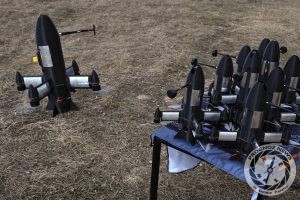
The Ukrainian answer has been to move the defence down the cost curve. Reuters reported earlier this year that estimates for Russian Shahed production costs were around US$35,000 per aircraft, while Ukrainian interceptor manufacturers described machines costing only several thousand dollars, with some costing less than US$1,500. The precise figures vary considerably between models and estimates, but the order of magnitude is what matters. Ukraine is attempting to destroy an inexpensive Russian aircraft using an even less expensive Ukrainian aircraft.
That reverses the economics. If Russia expends tens of thousands of dollars manufacturing and launching an attack drone and Ukraine can destroy it using a machine costing only a few thousand dollars, Russia rather than Ukraine begins to suffer from an unfavourable exchange ratio. There are of course substantial additional costs associated with Ukrainian air defence: radars, communications networks, vehicles, electricity, training, personnel, maintenance, command centres and the occasional necessity of launching more than one interceptor against a target. Yet precisely the same observation applies to conventional missile defence. A Patriot interceptor is not the entire cost of operating a Patriot battery. The important distinction is therefore not whether interceptor drones are free, because plainly they are not, but whether they make mass defence economically sustainable.
This also explains why interceptor drones need not achieve perfection. A comparatively cheap defensive weapon can tolerate misses in circumstances in which an extraordinarily expensive one cannot. The relevant comparison is not even confined to the cost of the Russian drone itself. A Shahed costing perhaps tens of thousands of dollars may destroy an electricity transformer worth millions, damage an industrial plant, interrupt railway operations, force a hospital onto emergency generators, destroy homes or kill civilians. The economic value of a successful interception therefore includes the expected damage that would otherwise have been caused. An interceptor costing several thousand dollars may remain economically rational even if several attempts are sometimes required to destroy the incoming aircraft.
There is nevertheless no static solution to this problem because Russia adapts. Ukrainian interceptor drones that were sufficiently fast to destroy one generation of Shaheds have encountered progressively faster Russian aircraft. Jet-powered variants have compressed interception times further, while Russian engineers continue experimenting with navigation, electronic countermeasures and other methods of defeating Ukrainian defences. Reuters reported earlier this year that Ukrainian developers had already been compelled to increase interceptor speeds as Russian Shaheds became faster, with some newer threats approaching speeds of about 400 kilometres per hour. The contest has therefore become not merely one between a Russian drone and a Ukrainian interceptor but between two industrial innovation systems.
This is where the economics become particularly interesting. Every Russian adaptation has a price. A faster drone may require a more powerful or entirely different propulsion system. Better navigation requires additional electronics. Improved resistance to electronic warfare may demand more sophisticated communications or guidance systems. Greater speed, payload or range inevitably produces engineering compromises elsewhere. Russia can certainly improve the Shahed, and it is already doing so, but the more sophisticated the aircraft becomes the further it moves away from the characteristic that made the Shahed strategically revolutionary in the first place: its cheapness.
The purpose of Ukrainian interceptor development should therefore not be understood merely as finding a perfect weapon capable of destroying every Russian drone. There will never be such a weapon because Russia would develop a countermeasure. The more important objective is to force Russia progressively upwards along the cost curve. Ukraine develops a cheap interceptor; Russia makes the Shahed faster. Ukraine develops a faster interceptor; Russia introduces jet propulsion. Ukraine improves automatic terminal guidance; Russia improves countermeasures. Each turn of the technological cycle costs both sides money, but the decisive question is whose costs rise faster. If Russia must add US$10,000 of complexity to an attack drone in order to defeat a Ukrainian modification costing US$1,000, then Ukraine has achieved something strategically valuable even before the two aircraft meet.
The Ukrainian experience also reveals that the decisive weapon may ultimately be the factory rather than the drone. Traditional air defence is constrained by highly specialised manufacturing. Sophisticated missiles contain advanced seekers, specialised propulsion systems and precision components that cannot necessarily be manufactured rapidly in hundreds of ordinary industrial facilities. Interceptor drones inhabit a different industrial universe. Many of their underlying technologies derive from enormous civilian supply chains: electric motors, batteries, cameras, processors, communications equipment and relatively simple airframes. They can consequently be manufactured by a much broader industrial base and their designs can be altered far more rapidly.
This is already happening. Ukraine has developed multiple families of interceptor drones rather than selecting a single universal design, and the Ministry of Defence has described systems capable of speeds exceeding 350 kilometres per hour, automatic target acquisition and substantial degrees of autonomous interception. One next-generation system tested in the Kharkiv region was described in June as automating approximately 95 per cent of the interception cycle after the human operator selected the target and authorised engagement. This technological development is inseparable from industrial development because increasingly autonomous interceptors can be deployed in larger numbers without requiring an equivalent increase in exceptionally skilled FPV pilots.
The scale at which this might eventually operate is difficult to appreciate if we continue thinking about air defence in the traditional language of missiles. Nobody seriously proposes manufacturing a million Patriot interceptors. Manufacturing a million comparatively small unmanned aircraft is another matter. Ukraine’s defence industry has already demonstrated an extraordinary capacity for distributed production and rapid adaptation, with designs passing from battlefield experience to engineering revision and back into combat on timescales that would appear almost incomprehensible within conventional Western defence procurement systems.
This may ultimately become one of Ukraine’s most important contributions to NATO military doctrine. The lesson is not that sophisticated air-defence missiles are obsolete. They are indispensable against ballistic missiles, cruise missiles and high-performance aircraft. The lesson is that using such weapons indiscriminately against cheap drones is economically irrational. A modern national air-defence system therefore requires layers in which the least expensive effective defensive weapon is allocated to each category of threat. Electronic warfare may defeat some drones. Guns may defeat others. Interceptor drones can destroy another class. Conventional surface-to-air missiles are preserved for threats that genuinely justify their expense.
Europe is beginning to understand the implications. Germany and Ukraine have been expanding cooperation on drone and interceptor production, including a programme involving 15,000 Strila interceptor drones and joint industrial ventures between German and Ukrainian companies. European defence companies are themselves responding to the same economic problem: MBDA unveiled a new Counter Mass Interceptor in July specifically intended to address the increasingly unsustainable practice of using expensive conventional missiles against large numbers of inexpensive drones. What Ukraine discovered under bombardment is gradually becoming a general principle of European air-defence planning.
There remains an uncomfortable mathematical problem. Even exceptionally effective air defence leaks. If Ukraine destroys 95 per cent of 100 incoming drones, five survive. If Russia launches 1,000, fifty survive. If attacks eventually consist of several thousand drones, apparently magnificent interception percentages can still permit substantial destruction. This is why Ukraine’s declared ambition of detecting all aerial threats in real time and intercepting at least 95 per cent of missiles and drones is so demanding.
Russia’s strategy is based upon quantity and quantity cannot ultimately be answered by a handful of exquisite weapons. It must be answered with defensive quantity as well.
The Russian response is already visible in the accelerating use of faster drones, improved guidance and increasingly sophisticated combinations of missiles, drones and decoys. The technological advantage enjoyed by either side may consequently last only months and sometimes weeks. This is perhaps the most important lesson of the Ukrainian drone war. There are no permanent wonder weapons. Every successful technology stimulates a countermeasure and every countermeasure stimulates another innovation. The decisive military capability is therefore not possession of one particular interceptor but the institutional capacity to redesign, manufacture and deploy the next generation before the existing generation becomes obsolete. The contest between Ukrainian interceptor drones and Russian attack drones has become an evolutionary struggle conducted at industrial speed.
The ultimate Ukrainian objective should therefore not be to eliminate Russia’s ability to manufacture Shaheds. That is probably impossible. Nor need Ukraine guarantee that every Shahed will be destroyed. The objective is to alter Moscow’s calculation of whether manufacturing and launching them remains worthwhile. If Russian engineers must progressively make their drones faster, more sophisticated and more expensive while Ukrainian engineers continue producing cheaper interceptors capable of destroying most of them, then the original strategic logic of the Shahed begins to collapse. What started as a weapon designed to exhaust Ukrainian air defence instead becomes a means by which Russia exhausts her own resources.
There will never be an impenetrable shield over Ukraine. Interceptor drones will not make Patriots, NASAMS, fighter aircraft, electronic warfare or anti-aircraft guns obsolete, and no responsible Ukrainian commander would suggest otherwise. Their importance lies in filling the enormous economic gap at the lower end of the air-defence architecture. Expensive weapons should be used against expensive threats. Cheap threats should, wherever possible, be defeated by cheap weapons. Above all, those cheap weapons must exist in enormous quantities.
For decades Western defence procurement moved in almost the opposite direction, towards ever smaller numbers of increasingly exquisite machines. Ukraine has rediscovered an older principle. Wars of attrition require abundance. The country capable of manufacturing ten adequate weapons may sometimes possess a more useful military advantage than the country capable of manufacturing one magnificent weapon. The factory worker, electronics engineer, software developer and procurement officer therefore become participants in air defence just as surely as the soldier watching the radar screen.
Russia originally adopted the Shahed because she understood this principle. Ukraine is now turning the same principle against Russia. That may ultimately prove the most important aspect of the interceptor revolution. Ukraine does not have to make Russian drones impossible to manufacture. She does not have to make them impossible to launch. She does not even have to guarantee that every one will be destroyed. She has to destroy enough of them, cheaply enough and consistently enough that Russia eventually confronts the same question that Moscow once sought to impose upon Kyiv: how long can we afford to keep doing this?
When Moscow rather than Kyiv begins asking that question, the economics of the drone war will have been reversed. And in a long war of industrial exhaustion, reversing the economics may matter every bit as much as winning the battle in the sky.
6 Views



Most Readings