The ethics of law enforcement robotics
By Matthew Parish, Associate Editor
Sunday 10 May 2026
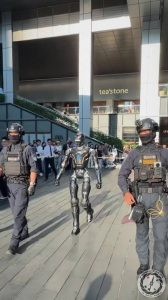
The image of a metallic humanoid in a police uniform patrolling a Chinese city street might once have belonged exclusively to science fiction. Yet recent demonstrations in the People’s Republic of China of robotic police units capable of autonomous movement, speech interaction and public order functions suggest that a concept once confined to the dystopian imagination is beginning to enter reality. While the technology remains primitive by the standards of speculative fiction, the direction of travel is unmistakable. The fusion of robotics, facial recognition, predictive analytics and large language models is creating the possibility of partially or wholly automated police officers.
For many observers, the inevitable cultural reference point is the 1987 film RoboCop, directed by Paul Verhoeven. The film depicted a near-future American city where a mortally wounded police officer is transformed into a cybernetic law enforcement machine controlled by a private corporation. Although remembered today for its stylised violence and satirical excess, the film’s underlying themes have aged remarkably well. It explored the dehumanisation of law enforcement, the privatisation of coercive power, and the dangers inherent in delegating moral judgement to automated systems. Four decades later, those anxieties no longer seem fanciful.
The central danger posed by robotic police officers driven by large language models lies not in mechanical strength or armed capability, but in epistemology. Human police officers make errors because they are fallible human beings. Yet they also possess forms of judgment, empathy and contextual awareness that emerge from lived experience. A frightened child, an intoxicated veteran, a mentally ill homeless man, or a panicked refugee may all technically violate public order rules while nevertheless requiring entirely different responses. Human officers are often imperfect at making such distinctions, but they remain capable of intuition, mercy and hesitation.
Large language models possess none of these qualities. They generate outputs by statistical prediction over immense datasets. They do not understand morality, pain, fear or justice. They simulate understanding through probabilistic language construction. When integrated into policing systems, they may therefore produce the outward appearance of rational authority while lacking any internal comprehension of the consequences of their actions.
This distinction is not philosophical hair-splitting. It becomes critical in environments where force may be used. An automated police unit equipped with crowd control powers, surveillance authority or weapons systems could make decisions based upon correlations that no human being fully understands. The “reasoning” process of advanced machine learning models is often opaque even to their developers. This phenomenon, known as the black box problem, becomes profoundly alarming when transferred into the domain of coercive state power.
The danger is magnified by the nature of policing itself. Police officers do not merely enforce laws mechanically. They exercise discretion constantly. A police officer deciding whether to arrest somebody for disorderly conduct, intervene in a domestic argument, or disperse a political protest is balancing legal rules against social context and proportionality. Liberal democracies tolerate police authority precisely because officers are theoretically accountable moral agents subject to public scrutiny and legal responsibility.
An autonomous robotic officer disrupts this framework entirely. If an automated system injures or kills a civilian, who bears responsibility? The software engineers? The police chief? The government ministry? The manufacturer? The large language model provider? One of the most dangerous characteristics of automated governance systems is the diffusion of accountability. Every participant in the chain may insist that the machine itself made the decision.
This problem has already appeared in smaller forms in existing algorithmic policing systems. Predictive policing software used in the United States has repeatedly been criticised for reinforcing racial and socio-economic biases because it was trained on historical policing data already shaped by discriminatory practices. If police historically over-policed poor neighbourhoods, then machine learning systems trained on arrest statistics may conclude that those neighbourhoods require even greater surveillance. The algorithm thereby converts historical injustice into automated future policy.
In an authoritarian state these dangers become even more acute. China already possesses perhaps the world’s most extensive domestic surveillance apparatus, integrating facial recognition, digital payment monitoring, internet censorship and vast camera networks. Robotic police officers linked to large language models would fit naturally into this architecture. Such systems could theoretically identify individuals, analyse emotional states, interpret speech, cross-reference social media activity and intervene in real time against persons deemed suspicious.
The implications for political dissent are chilling. A human police officer may occasionally ignore a minor infraction out of sympathy or fatigue. A machine may not. Automated systems can enforce rules with relentless consistency. In authoritarian environments this transforms the character of repression. Fear no longer depends solely upon the presence of individual officers. Instead surveillance becomes ambient and permanent.
The psychological consequences may prove enormous. Human societies have historically tolerated state authority partly because authority remained visibly human. Citizens can argue with police officers, appeal to their emotions, or attempt persuasion. Robotic police units remove this relational element. One cannot meaningfully negotiate with a machine whose responses are generated through statistical token prediction.
The comparison with RoboCop becomes increasingly apt here, although perhaps not in the manner originally imagined. In the film the horror did not arise merely from the existence of a cyborg policeman. Rather it emerged from the transformation of policing into an industrialised technological system detached from human accountability. The corporation Omni Consumer Products viewed law enforcement not as a civic duty but as a technical optimisation problem. Crime reduction became an engineering objective rather than a moral or political undertaking.
Modern artificial intelligence discourse often displays similar tendencies. Policymakers and technology executives frequently describe governance problems in computational terms. Crime becomes a dataset. Public disorder becomes a pattern-recognition challenge. Social behaviour becomes an optimisation exercise. Yet societies are not software environments. Human beings do not conform predictably to algorithmic logic.
Moreover large language models possess a dangerous tendency towards hallucination — generating false information with apparent confidence. In ordinary consumer contexts this may be mildly inconvenient. In policing contexts it could become catastrophic. Imagine an automated officer incorrectly identifying a civilian as armed or falsely inferring hostile intent from ambiguous language. A human officer might reconsider, hesitate or seek clarification. An automated system integrated with rapid-response protocols may instead escalate immediately.
There is also the issue of adversarial manipulation. Large language models can often be confused or deceived by carefully constructed prompts or unusual inputs. Criminal organisations, hostile intelligence agencies or political activists would inevitably experiment with methods to manipulate robotic police systems. The resulting contest between hackers and automated law enforcement could produce instability of an entirely new kind.
The economic incentives driving these developments are also significant. Governments facing personnel shortages, rising urban populations and fiscal pressures may view robotic policing as attractive. Machines do not require salaries, pensions, holidays or sleep. They can patrol continuously. They can process immense volumes of surveillance data. Technology firms will inevitably market automated policing as efficient, objective and modern.
Yet efficiency is not necessarily compatible with liberty. Liberal societies intentionally impose inefficiencies upon state power. Warrants, appeals, judicial oversight and human review processes all slow governmental action precisely because coercive authority is dangerous. Automated policing systems risk eroding these frictions in favour of seamless technological administration.
The danger is therefore not simply that robotic police officers may malfunction. It is that they may function exactly as designed. A perfectly efficient authoritarian surveillance machine would represent a profound threat to civil liberty even if technically successful. History demonstrates repeatedly that states rarely relinquish coercive powers once acquired.
There remains, fortunately, considerable distance between contemporary robotic demonstrations and the autonomous enforcers imagined in dystopian cinema. Current humanoid robots remain physically awkward, computationally limited and operationally fragile. Large language models still struggle with reasoning consistency and contextual reliability. Yet technological development tends to proceed incrementally until sudden capability thresholds are crossed. What appears absurd one decade may become mundane the next.
The lesson of RoboCop was ultimately not about robots at all. It was about the erosion of human dignity when institutions surrender moral responsibility to technological systems and corporate incentives. As artificial intelligence becomes increasingly integrated into policing and public safety operations, societies will face difficult choices about how much authority they are willing to delegate to machines incapable of genuine moral understanding.
The temptation to automate order will be immense. The consequences of doing so without restraint may prove far more dystopian than even 1980s cinema imagined.
164 Views



Most Readings






Crimea Under Pressure: Ukraine’s Long Campaign Against Russia’s Southern Bastion
94 Views